BrainCo Revo 3-21 Touch Robot Hand
In stock
- BRAND:
- BRAINCO
- MODEL:
- REVO 3-21 TOUCH
- ORIGIN:
- China
- Warranty:
- 12 MONTHS
- AVAILABILITY:
- SUBJECT TO AVAILABILITY
- SKU:
- BrainCo-Revo-3-Touch
BrainCo Revo 3-21 Touch Robot Hand
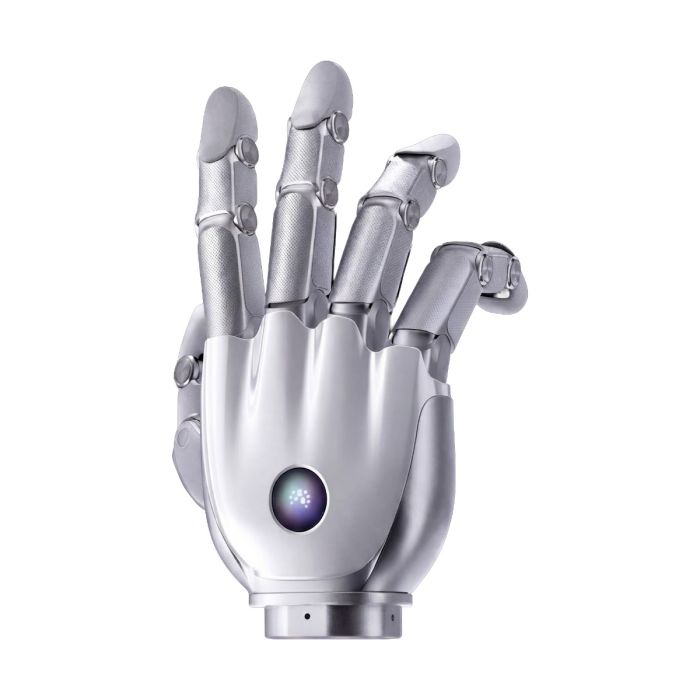
A robot that can close its fingers has solved only half of manipulation; the other half is knowing what the fingers have found. The BrainCo Revo 3-21 Touch Robot Hand is built around that second half, pairing 21 independently driven motors with a piezoresistive sensing array that spreads across the whole palm. The controller therefore receives a map of contact as well as a record of movement, and that is the difference between a hand that merely grips and one that can be taught to handle.
The product is available through this page, by quotation.
Background
BrainCo and the Revo lineage
BrainCo is a Hangzhou-based brain-computer interface company, and the Revo family is its line of dexterous robot hands. Revo 3 is the third generation. This store group also lists earlier models, among them the BrainCo Revo 1 Intelligent Dexterous Bionic Hand and the Brainco Revo 2 Touch Biomimetic Dexterous Right Hand (XTR), for readers who wish to compare generations. The complete current range can be browsed in the BrainCo Revo 3 category.
Revo 3 comes in four versions: Revo 3 U21, U21F, U21T and U21VT. This page concerns the touch version, designated U21T. Its distinguishing feature is a full-palm tactile layer, whereas other versions in the range carry different tactile arrangements or none at all.
Positioning and key technology
The Revo 3 hand is designed for industrial automation, scientific research and advanced robotics manipulation. It has 21 independent motors, giving 21 fully active degrees of freedom, all of them direct-driven and backdrivable. Direct drive means that each joint is moved without an intermediate mechanism of the kind that often stiffens a hand; backdrivability means that an external force can move the joint, which is valuable when a hand must yield on contact rather than resist it.
On top of this articulation sits the tactile system of the U21T: a full-palm piezoresistive array of 451 points. Together, the motion and the sensing give researchers and integrators a hand that can be commanded precisely and can report back what it touches.
Technical Specifications
| Specification | Value |
|---|---|
| Version | Revo 3 U21T |
| Degrees of freedom | 21 (direct-driven and backdrivable) |
| Motors | 21 independent motors |
| Hand dimensions | 216 × 108 × 50 mm |
| Supply voltage | 16–85 V |
| Max current | 10 A (24 V) |
| Max active grip force | ≥100 N |
| Max fingertip pinch force | ≥25 N |
| Total hand payload | 20 kg |
| Four-finger payload | 5 kg |
| Repeatability | 0.1° |
| Joint open/close time | 0.33 s |
| Grasp coverage | 33 grasp types (Feix GRASP taxonomy); full score on the Kapandji opposition test |
| Communication interfaces | EtherCAT / CAN FD / RS-485 |
| Communication frequency | 500 Hz |
| Onboard sensors | IMU (mainboard), temperature (mainboard) |
| Tactile distribution | Full-palm tactile |
| Tactile type | Full-palm piezoresistive array |
| Tactile array | 451 points (piezoresistive) |
| Durability | Rated for over 1,000,000 joint flex cycles |
| Software | C/C++ and Python SDKs for Linux and Windows; ROS support |
| Recommended power supply | Stable 24 V DC, rated at least 100 W |
Specifications as published by the manufacturer; confirmed against the datasheet at quotation.
The manufacturer has not published the weight, the IP rating, the box contents, the operating temperature range or the hand material; they are confirmed at quotation.
What makes the Revo 3-21 Touch different from the basic version?
The clearest difference is sensing. Across the four Revo 3 versions the tactile distribution varies, and the touch version is the one with a full-palm layer. The BrainCo Revo 3-21 Basic Robot Hand belongs to the same platform and has no tactile layer. Both share the same dimensions, the same 21 degrees of freedom and the same communication interfaces, so the choice turns on whether your work needs to know where an object presses.
For a project that only needs to open, close and position fingers, the additional sensing layer may be unnecessary. For a project that studies slip, contact location, in-hand adjustment or learning from demonstration, a 451-point palm array gives the software something concrete to work with.
How is the hand connected and controlled?
The hand communicates over EtherCAT, CAN FD or RS-485, at a communication frequency of 500 Hz. That range of interfaces allows it to be integrated with industrial controllers as well as with the lighter-weight buses often found on research platforms. The mainboard carries an IMU and a temperature sensor.
On the software side, the manufacturer provides cross-platform C/C++ and Python SDKs for Linux and Windows, together with ROS support. A stable 24 V DC supply rated at least 100 W reduces the risk of voltage drop; the hand accepts 16–85 V, with a maximum current of 10 A at 24 V.
Who is the BrainCo Revo 3-21 Touch Robot Hand for?
Research laboratories are the most natural audience: groups working on manipulation, tactile learning or embodied intelligence need a hand with many independently actuated joints and a rich contact signal. Robotics developers building humanoid or arm-mounted platforms form a second group, particularly where the hand must be driven by standard fieldbus protocols. Industrial automation teams exploring tasks that a simple gripper cannot perform will find the coverage of 33 grasp types, in the Feix GRASP taxonomy, a useful reference point.
Buyers who do not need palm sensing may be better served by the Basic version described above. Those who want to compare another touch-equipped version in the range can review the BrainCo Revo 3-21 V-Touch Robot Hand.
What is the BrainCo Revo 3-21 Touch Robot Hand used for?
- Dexterous manipulation research: studying multi-finger coordination with 21 active degrees of freedom.
- Tactile learning: training models on contact data from a 451-point palm array.
- Humanoid robot platforms: giving a humanoid or arm-mounted system a human-scale hand.
- Industrial automation trials: testing handling tasks that need more than a two-finger gripper.
- Grasp taxonomy studies: exploring the 33 grasp types the hand covers.
- Teleoperation and demonstration: capturing and reproducing human hand motion with repeatable joint positioning.
Pricing and Availability
No price is printed on this page. Quotation is the way to proceed: please send your request, stating the quantity and the intended application. Delivery, customs and support are arranged together with the quotation. The BrainCo Revo 3-21 Touch Robot Hand is available on this page.
Frequently Asked Questions
How many degrees of freedom does the hand have?
It has 21 degrees of freedom, driven by 21 independent motors. All joints are direct-driven and backdrivable.
What kind of tactile sensing does it carry?
It carries a full-palm piezoresistive array of 451 points. The mainboard additionally holds an IMU and a temperature sensor.
Which communication interfaces are supported?
The hand supports EtherCAT, CAN FD and RS-485, with a communication frequency of 500 Hz.
Which software tools are available?
The manufacturer provides C/C++ and Python SDKs compatible with Linux and Windows, and ROS is supported.
What power supply is recommended?
A stable 24 V DC supply rated at least 100 W is recommended. The supply voltage range is 16–85 V.
How durable is the hand?
The joints are rated for over 1,000,000 flex cycles. Please include a request for the IP rating and operating temperature range with your quotation enquiry.
Where can I buy the BrainCo Revo 3-21 Touch Robot Hand and what does it cost?
It is available through this page by quotation, and no price is shown here. Send a request and the cost, together with delivery and support terms, will be provided with the quotation.
Summary
The BrainCo Revo 3-21 Touch Robot Hand answers a simple question: what use is a skilful hand that cannot feel? With 21 independently driven, backdrivable joints, a 451-point full-palm tactile array, industrial fieldbus interfaces and cross-platform SDKs, it lets research and automation teams work with contact as well as motion. If that matches your project, this page is the starting point.