
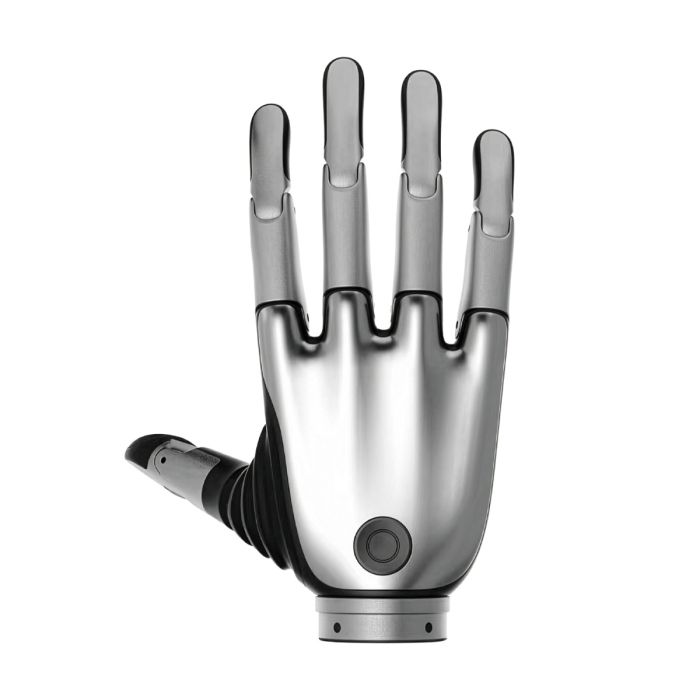
BrainCo Revo 2 Pro Dexterous Right Hand (XER)
In stock
- BRAND:
- BRAINCO
- MODEL:
- REVO 2 PRO
- PART #:
- XER
- ORIGIN:
- China
- Warranty:
- 12 MONTHS
- AVAILABILITY:
- SUBJECT TO AVAILABILITY
- SKU:
- BrainCo-Revo-2-Pro
BrainCo Revo 2 Pro Dexterous Right Hand (XER)
A useful manipulation experiment needs more than a successful grasp: it needs a clear relationship between the command issued and the movement observed. The BrainCo Revo 2 Pro Dexterous Right Hand (XER) brings that question into focus through active and passive joint motion, closed-loop servo control and custom gesture definitions. This bionic dexterous hand is designed for robot integration and research, giving development teams a right-hand component around which to organise control, software and manipulation studies.
The product is available through this page, by quotation.
Background
BRAINCO and the Revo 2 versions
The Revo 2 range comprises Basic (XRL/XRR), Pro (XEL/XER) and Touch (XTL/XTR). This page concerns the Pro right-hand model, XER. Keeping the version and hand orientation explicit is important when preparing a robot bill of materials: a family name alone does not identify the component required for a particular side of a platform.
The range shares an articulated architecture with 6 active joints and 11 degrees of freedom. It also provides SDK support for Linux, Windows and ROS workflows. These common features establish the series as a platform for robot integration and research, while version selection remains a separate procurement decision. The BrainCo Revo 2 category provides a route to the named models without treating them as interchangeable.
Active motion, passive motion and control
The thumb has two active degrees of freedom for abduction and adduction, together with one passive degree of freedom for flexion and extension. Each of the remaining four fingers has one active and one passive degree of freedom for flexion and extension. This distinction matters when describing an experiment: total freedom of movement is not the same as the number of actively controlled joints.
Closed-loop servo control and custom gesture definitions are part of the series. The hand also includes protections for current, stall, high temperature and collision conditions. For a research team, the practical task is to connect these features to a defined control workflow, rather than assume that an articulated hand alone completes a manipulation system. Robot-level supervision, test procedures and application safety remain engineering responsibilities.
Technical Specifications
| Specification | Value |
|---|---|
| Active joints — whole Revo 2 series | 6 |
| Degrees of freedom — whole Revo 2 series | 11 |
| Thumb active degrees of freedom — whole Revo 2 series | 2 |
The figures are as published by the manufacturer and are confirmed against the datasheet at quotation.
The manufacturer has not published the dimensions, wrist mounting dimensions, material, IP rating or service life; these details are confirmed at quotation.
The Pro communication interfaces are 485, CAN FD and EtherCAT, with the interface located below the wrist. The series documentation names RS485 alongside CAN FD and EtherCAT. SDK support covers Linux, Windows and ROS workflows. These interface and software details belong in the integration brief alongside the joint figures, because mechanical articulation and controller connectivity answer different design questions.
How do the active and passive joints affect research planning?
The most useful starting point is to separate the motion available in the mechanism from the commands that the research software will issue. With 6 active joints and 11 degrees of freedom, the Revo 2 architecture contains both active and passive movement. An experiment should therefore describe the intended finger behaviour without equating every degree of freedom with an independently actuated command.
The thumb layout deserves particular attention. Its active degrees of freedom concern abduction and adduction, while its passive degree of freedom concerns flexion and extension. The remaining fingers combine active and passive flexion and extension. Documenting those roles helps a team explain why a chosen gesture is relevant to its research, and how the observed motion will be assessed.
Custom gesture definitions provide a basis for organising commanded hand configurations. Closed-loop servo control supplies the stated control approach. Together, these features support a development discussion about command structure, gesture selection and test methodology; they do not supply an object-specific grasp performance figure. A clear evaluation plan should distinguish successful movement, stable contact and completion of the wider robot task.
The same discipline applies to connectivity. Pro supports 485, CAN FD and EtherCAT, but selecting a bus is only part of the integration work. Teams should identify their host environment, control architecture and required software workflow before preparing the quotation request. Linux, Windows and ROS support gives the discussion concrete starting points without establishing compatibility with every robot controller or software package.
Who is BrainCo Revo 2 Pro Dexterous Right Hand (XER) for?
This model addresses robotics laboratories, university research groups and development teams that need a right-hand bionic end-effector for integration work. Relevant projects include articulated-hand control, gesture-based experiments and manipulation studies. Buyers should have an engineering plan for the host robot, because selecting a hand does not resolve the complete mechanical, electrical or application-control design.
Teams developing humanoid or paired-arm research platforms should identify the required hand orientation before requesting equipment. Where the project calls for a left-hand Pro model, the relevant sibling is the BrainCo Revo 2 Pro Dexterous Left Hand (XEL). For paired-hand studies, list each required model explicitly rather than using a single family designation.
Basic and Touch are also named versions in the range, but the available facts do not establish their complete feature differences. Choosing between them should follow a version-specific technical review, not an assumption based on the names. For XER, the documented case rests on the right-hand configuration, articulated joint layout, Pro communication interfaces and series software and control features.
What is BrainCo Revo 2 Pro Dexterous Right Hand (XER) used for?
- Robot-hand integration: Develop the mechanical, communications and software plan for a right-hand research end-effector.
- Gesture definition studies: Organise custom gestures into a documented sequence of commanded hand configurations.
- Articulation research: Examine the relationship between active joint commands and passive finger movement.
- Control workflow development: Build research software around the supported Linux, Windows or ROS environment.
- Communication integration: Evaluate the selected Pro interface within the host robot's control architecture.
- Manipulation experiments: Investigate hand movement and object interaction within a supervised research programme.
Pricing and Availability
Request a quotation for the XER model with a concise description of the intended robot platform, host software environment and communication interface. Include the planned research tasks and any requirement for a corresponding left hand. This gives the technical discussion a defined scope and helps keep the selected version clear throughout procurement.
Delivery, customs and support are arranged with the quotation. Mechanical fit, environmental requirements and integration documentation should also form part of that discussion. A quotation for BrainCo Revo 2 Pro Dexterous Right Hand (XER) is available on this page.
Frequently Asked Questions
Is XER the right-hand Pro model?
Yes. XER identifies the Pro right-hand product on this page, while XEL is the named Pro left-hand counterpart. Specify the required orientation in the quotation request.
How many active joints and degrees of freedom does it have?
The Revo 2 series has 6 active joints and 11 degrees of freedom. The architecture combines active and passive motion, so the total degrees of freedom should not be treated as a count of independently actuated joints.
How is the thumb articulated?
The thumb has two active degrees of freedom for abduction and adduction and one passive degree of freedom for flexion and extension. Each remaining finger has one active and one passive degree of freedom for flexion and extension.
Which communication interfaces does Pro support?
The Pro interfaces are 485, CAN FD and EtherCAT, located below the wrist. The whole-series interface description uses the designation RS485.
What software support is provided?
The series provides SDK support for Linux, Windows and ROS workflows. Define the intended host environment and integration requirements when requesting a quotation.
What control and protection features are included?
The series includes closed-loop servo control, custom gesture definitions and protections for current, stall, high temperature and collision conditions. These device features do not replace application-level risk assessment or the host robot's safety design.
Where can I buy BrainCo Revo 2 Pro Dexterous Right Hand (XER) and what does it cost?
The product is available through this page by quotation. Request the commercial proposal with the required model, integration brief and support requirements; delivery and customs arrangements are included in that discussion.
Summary
The value of a research hand lies in making commanded movement and observed behaviour part of a coherent experiment. XER offers the Revo 2 active-and-passive joint architecture in a Pro right-hand configuration, with documented communication options, SDK support and control features. A sound selection process connects those facts to the intended platform rather than assuming unlisted performance or mechanical compatibility.
Set out the research objective, identify the required interface and host environment, and resolve the outstanding mechanical and environmental details during quotation. For a technically focused discussion of this right-hand model, this page is the starting point.
Specifications
General
Physical
Mobility
Performance
Connectivity
Software
Hand
Feature
1. High quality and stability – five years of product iteration and professional production lines.
2. Lightweight (383 grams), with 5 kg active grip force, 20 kg single-hand load capacity, and a grip-to-weight ratio of 53.
3. Ergonomic Bionic Design – supports curved surface grasping with anti- collision finger design.
4. Multi-dimensional tactile perception – pressure, friction, direction, proximity, and surface texture.
5. High Sensitivity Tactile Perception – max resolution of 0.01N.
6. Wide voltage support – 64V.
7. Universal Interfaces – RS485 & CAN-FD, and EtherCAT.
8. Standard Protocols and SDKs – Modbus & Protobuf protocols, SDKs for Python / C / ROS.