
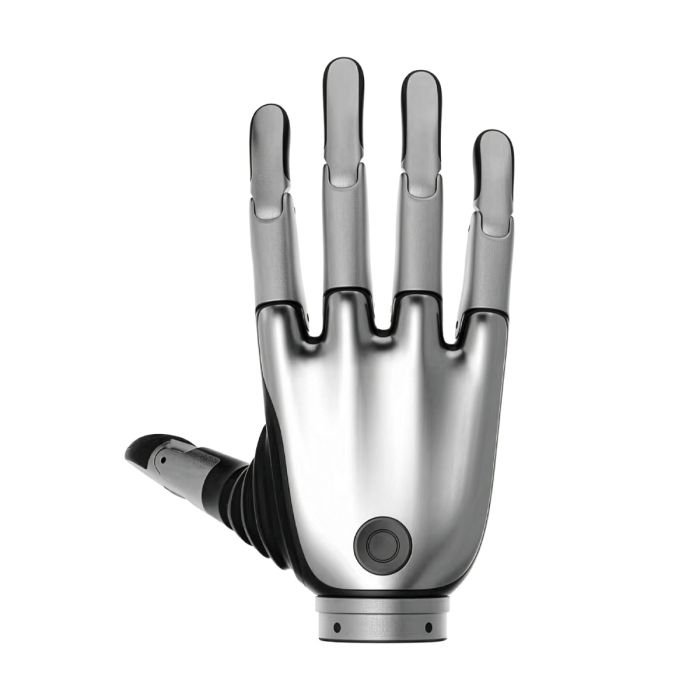
Brainco Revo 2 Touch Biomimetic Dexterous Right Hand (XTR)
In stock
- BRAND:
- BRAINCO
- MODEL:
- REVO 2 TOUCH
- PART #:
- XTR
- ORIGIN:
- China
- AVAILABILITY:
- SUBJECT TO AVAILABILITY
- SKU:
- BrainCo-Revo-2-Touch
Brainco Revo 2 Touch Biomimetic Dexterous Right Hand (XTR)
A robot hand arrives on the bench as a promise and leaves it as a dataset. What matters in between is whether the hand can feel what it touches, report it over a bus the controller already understands, and protect itself when an experiment goes wrong. The Brainco Revo 2 Touch Biomimetic Dexterous Right Hand (XTR) is built around that exchange: a bionic dexterous hand for robot integration and research, fitted with a multi-dimensional fingertip tactile module.
The product is available through this page, by quotation.
Background
BrainCo and the Revo 2 lineage
BrainCo was founded in 2015 and incubated by the Harvard Innovation Lab (i-Lab); the company is based in Somerville, Massachusetts. Its Revo line of bionic hands grew from that start, and the Revo 2 is the second generation. The generation is organised into three versions, each made as a left and a right hand: Basic (XRL and XRR), Pro (XEL and XER) and Touch (XTL and XTR).
This page concerns the Touch right hand, code XTR. Its left-hand counterpart is the Brainco Revo 2 Touch Biomimetic Dexterous Left Hand (XTL), which shares the Touch version code family and is the natural choice when a bimanual set-up is planned.
Positioning and key technology
The Revo 2 is presented by its maker as a hand for integration and research rather than as a finished consumer product. Within the family, the Touch version is the one that adds the tactile layer: a multi-dimensional fingertip tactile module, which the Basic version does not list. Alongside it, the hand offers a control precision of 0.1° and a pinch force of at least 15N.
The second-generation advanced and tactile versions support three communication interfaces for communication and control: RS-485, CAN FD and EtherCAT, with the interface located below the wrist. For software, the SDK supports Python and C and is compatible with Linux, Windows and ROS systems. Together these choices place the hand in the laboratory and the integration cell, where wiring, bus choice and software environment decide how quickly work can begin.
Technical Specifications
| Specification | Value |
|---|---|
| Product type | Bionic dexterous hand for robot integration and research |
| Version code | XTL/XTR (Touch); this page is the right hand, XTR |
| Pinch force | ≥15N |
| Control precision | 0.1° |
| Tactile module | Multi-dimensional fingertip tactile module |
| Communication interfaces | RS-485, CAN FD, EtherCAT (located below the wrist) |
| SDK | Python and C; Linux, Windows and ROS systems |
| Protections | Current, stall, high-temperature and collision protection |
| Default device ID (right hand) | 127 |
| Standard colours | Space Gray, Silver (bulk colour customisation supported) |
Specifications as published by the manufacturer; confirmed against the datasheet at quotation.
The manufacturer has not published the package contents, the ingress protection rating, the tactile sensor resolution or the cable length; they are confirmed at quotation.
What makes the Touch version different from the Basic and Pro versions?
The clearest difference is the sensing at the fingertips. The Touch version carries a multi-dimensional fingertip tactile module, which gives a controller information about contact that position data alone cannot supply. A hand without that layer can close on an object and report where its joints are; a hand with it can contribute evidence about the contact itself. For work on grasp stability, slip handling or in-hand adjustment, that distinction is the reason to choose the tactile version.
The communication options also deserve a comment. The advanced and tactile versions of the second generation support RS-485, CAN FD and EtherCAT, so the Touch hand can be attached to the kind of bus an existing robot controller already uses. If a project does not need tactile feedback, the BrainCo Revo 2 Pro Dexterous Right Hand (XER) is the sibling to review, and the BrainCo Revo 2 Basic Right Dexterous Bionic Hand (XRR) is the entry version of the same generation. The figures on this page belong to the Touch version only and should not be read across to either of them.
How does the hand protect itself and its users during experiments?
Research hardware is handled by many people and driven by code that is still being debugged. The Revo 2 Touch therefore lists four protections: current protection, stall protection, high-temperature protection and collision protection. Each addresses a familiar failure of an actuated hand, whether an overloaded motor, a finger blocked by an object, sustained heating during long sessions, or an unexpected impact.
These protections do not replace sound test design, but they reduce the chance that a mistaken command ends a trial or damages the hand. Combined with a control precision of 0.1°, they help make repeated trials more consistent, which is what a laboratory needs when results must be compared from one day to the next.
Who is the Revo 2 Touch right hand for?
The first group is university and corporate research laboratories working on manipulation, tactile perception and learning-based grasping. For them the fingertip tactile module and the open SDK, with Python and C support and compatibility with Linux, Windows and ROS, shorten the path from unboxing to the first experiment.
The second group is humanoid robot developers who need a right hand with a communication interface suited to their platform. The choice among RS-485, CAN FD and EtherCAT allows the hand to be matched to the controller architecture rather than the reverse. The third group is system integrators and industrial R&D teams exploring tasks that need more than a two-finger gripper.
Teams that need a left hand for a paired arrangement should look at the XTL left hand, linked above. Teams that do not need touch sensing may find the Pro or Basic versions sufficient. Buyers browsing wider options can also see the Hands category or the Research Robots category.
What is the Revo 2 Touch used for?
- Tactile manipulation research: the fingertip tactile module supports studies of contact, slip and grasp quality.
- Humanoid robot integration: a right-hand end effector that connects through RS-485, CAN FD or EtherCAT.
- Algorithm development: the Python and C SDK on Linux, Windows or ROS lets teams test control and learning methods on real hardware.
- Repeatable grasp experiments: a control precision of 0.1° supports trials that can be compared and reproduced.
- Industrial prototyping: current, stall, high-temperature and collision protections suit early trials of handling tasks.
- Teaching and demonstration: a hand with a documented interface and SDK gives students a practical platform for robotics coursework.
Pricing and Availability
No price is displayed on this page. A quotation is the way to proceed: it confirms the configuration, the colour option and the datasheet details that the manufacturer has not published. Delivery, customs and support are arranged together with the quotation. The Brainco Revo 2 Touch Biomimetic Dexterous Right Hand (XTR) is available on this page.
Frequently Asked Questions
Which communication interfaces does the Revo 2 Touch support?
It supports RS-485, CAN FD and EtherCAT. The interface is located below the wrist.
What is the pinch force and control precision?
The pinch force is at least 15N and the control precision is 0.1°.
Which software environments does the SDK support?
The SDK supports Python and C and is compatible with Linux, Windows and ROS systems.
What is the default device ID of the right hand?
The default ID of the right hand is 127; the left hand uses 126.
Which colours are available?
The standard colours are Space Gray and Silver, and bulk colour customisation is supported.
What protections does the hand include?
It includes current, stall, high-temperature and collision protection.
Where can I buy the Brainco Revo 2 Touch Right Hand (XTR) and what does it cost?
It is available through this page by quotation. No price is shown here; request a quotation and the details, including delivery, customs and support, will be confirmed with it.
Summary
A robot hand is only as useful as the information it returns and the ease with which it joins a system. The Brainco Revo 2 Touch Biomimetic Dexterous Right Hand (XTR) answers both points: a fingertip tactile module for contact, three industrial communication interfaces, an SDK for Python and C across Linux, Windows and ROS, and four built-in protections. It suits research and integration teams that want their experiments to end as clear data rather than as repairs. To specify the hand, confirm the unpublished details and arrange delivery, this page is the starting point.
Specifications
General
Physical
Mobility
Performance
Connectivity
Software
Hand
Shipping
What's included
Videos