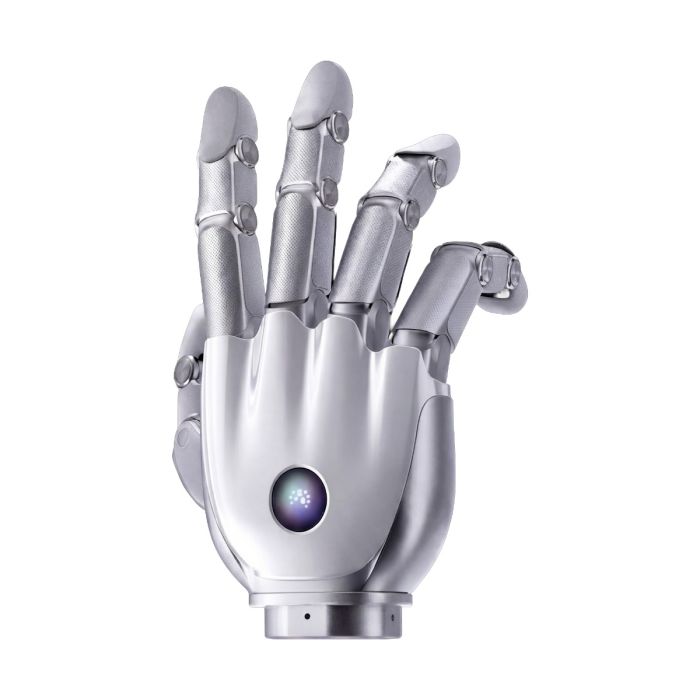
BrainCo Revo 3-21 V-Touch Robot Hand
In stock
- BRAND:
- BRAINCO
- MODEL:
- REVO 3-21 V-TOUCH
- ORIGIN:
- China
- Warranty:
- 12 MONTHS
- AVAILABILITY:
- SUBJECT TO AVAILABILITY
- SKU:
- BrainCo-Revo-3-V-Touch
BrainCo Revo 3-21 V-Touch Robot Hand
Lifting a light bulb and lifting a hammer ask the same of the arm but very different things of the hand. Most robotic grippers are designed for the hammer. The BrainCo Revo 3-21 V-Touch Robot Hand is designed for the bulb: a biomimetic hand with direct-driven, backdrivable joints, a tactile array in the palm and vision-based touch sensing in the fingertips, so that a controller can learn how an object is being held and not merely that it has been gripped.
The product is available through this page, by quotation.
Background
The Revo lineage and the Revo 3 family
The Revo 3 is the third generation of BrainCo's Revo robot hands, and earlier generations remain in the catalogue for buyers who wish to compare them, including the Brainco Revo 2 Touch Biomimetic Dexterous Right Hand (XTR). Within the Revo 3 generation, four versions are named: Revo 3 U21, U21F, U21T and U21VT. This article concerns the V-Touch hand, and every figure below belongs to that version alone.
The hand is designed for industrial automation, scientific research and advanced robotics manipulation. That range of intended uses is a useful guide to its character. It is a hand meant to be integrated into arms, humanoid platforms and laboratory test benches, and to be programmed and studied, rather than a finished consumer product.
Positioning and key technology
Three design choices define the V-Touch hand. First, it offers 21 degrees of freedom, distributed as four DoF in each of the four fingers and five DoF in the thumb. Second, the joints are direct-driven and backdrivable, which means that the fingers can be moved from outside and are not locked against external contact. Third, the tactile system is layered: a piezoresistive array across the palm, plus vision-tactile sensing at the fingertips.
Together these choices place the hand among research-grade dexterous end-effectors. Its mobility is documented by test results rather than adjectives: a full score on the Kapandji opposition test and coverage of 33 grasp types in the Feix GRASP taxonomy. The hand is also rated for over 1,000,000 joint flex cycles, a figure that matters to anyone planning repeated trials or continuous cells.
Technical Specifications
| Specification | Value |
|---|---|
| Version | Revo 3 U21VT (V-Touch) |
| Total degrees of freedom | 21 (direct-driven and backdrivable) |
| DoF distribution | Four fingers × 4 DoF, thumb × 5 DoF |
| Hand dimensions | 216 × 108 × 50 mm |
| Supply voltage | 16–85 V |
| Max current | 10 A (24 V) |
| Max active grip force | ≥100 N |
| Max fingertip pinch force | ≥25 N |
| Total hand payload | 20 kg |
| Four-finger payload | 5 kg |
| Repeatability | 0.1° |
| Joint open/close time | 0.33 s |
| Communication interfaces | EtherCAT / CAN FD / RS-485 |
| Communication frequency | 500 Hz |
| Onboard sensors | IMU (mainboard), temperature (mainboard) |
| Tactile type | Palm piezoresistive array + fingertip vision-tactile |
| Tactile array | 336 points (piezoresistive) + 2000 markers (vision-tactile) |
| Tactile force range | 0–20 N |
| Tactile resolution | 0.01 N |
| Durability | Over 1,000,000 joint flex cycles |
| Motion ability | Full score on the Kapandji opposition test; 33 grasp types (Feix GRASP taxonomy) |
| Software | Cross-platform C/C++ and Python SDKs for Linux and Windows |
Specifications as published by the manufacturer; confirmed against the datasheet at quotation.
The manufacturer has not published the weight, the IP rating, the operating temperature range, the package contents or the hand-only mass without the wrist; they are confirmed at quotation.
What makes the Revo 3-21 V-Touch different from a conventional gripper?
A conventional gripper is usually judged by its force and its stroke. The V-Touch hand should be judged by what it can perceive and how freely it can move. Its grip force is at least 100 N and its fingertip pinch force at least 25 N, yet the more distinctive numbers are those of the tactile system: a palm array of 336 points, 2000 markers in the vision-tactile layer, a force range of 0–20 N and a resolution of 0.01 N.
The second difference is mechanical. Because the joints are direct-driven and backdrivable, the hand does not behave as a rigid clamp. For teams working on compliant contact, teleoperation or learning from demonstration, that property can shape how the whole manipulation stack is designed.
The third difference is motion range. With 21 degrees of freedom, a five-DoF thumb and coverage of 33 grasp types, the hand can attempt postures that two-finger and three-finger devices cannot. A repeatability of 0.1° and a joint open/close time of 0.33 s describe how precisely and how quickly those postures are reached.
How does the V-Touch version relate to the other Revo 3 versions?
The Revo 3 family is offered in several versions, and the V-Touch designation marks the one with both palm sensing and fingertip vision-tactile sensing. Each version has its own figures, so none of the numbers on this page should be carried over to another version.
Buyers who wish to compare versions can consult the BrainCo Revo 3-21 Basic Robot Hand and the BrainCo Revo 3-21 Touch Robot Hand, and state the version they need when requesting a quotation.
Who is the Revo 3-21 V-Touch Robot Hand for?
The principal buyers are university and corporate research groups working on dexterous manipulation, tactile learning and embodied intelligence. For them, the tactile layers and the open interfaces matter more than any single mechanical figure, because they produce data that can be recorded, analysed and fed back into a controller.
A second group is the integrator or automation engineer who must handle objects that vary in shape, fragility or position. The hand offers EtherCAT, CAN FD and RS-485 communication, a 500 Hz communication frequency and cross-platform C/C++ and Python SDKs for Linux and Windows, which allows it to fit into existing control architectures rather than require a new one.
A third group is developers of humanoid and service robots who need a hand with human-like proportions of fingers and thumb. Buyers whose tasks do not call for touch sensing at all may prefer to look at the BrainCo Revo 3-21 Basic Robot Hand, while those who wish to compare an alternative tactile version may review the BrainCo Revo 3-21 Touch Robot Hand.
What is the Revo 3-21 V-Touch Robot Hand used for?
- Dexterous manipulation research: studying in-hand movement, regrasping and the use of 21 degrees of freedom on a laboratory arm.
- Tactile perception and learning: collecting palm and fingertip contact data for algorithms that react to touch.
- Industrial automation: handling parts of varied shape in cells where a simple gripper cannot adapt.
- Humanoid and embodied-AI platforms: providing a human-proportioned hand for robots that must work with tools and everyday objects.
- Teleoperation and demonstration: using backdrivable joints and fast communication to transfer human hand motion to a robot.
- Teaching and development: training engineers on integration through the C/C++ and Python SDKs.
Pricing and Availability
No price is shown on this page; a quotation is the way to proceed. Please send us your application, arm or platform, control interface and quantity, and we will prepare it. Delivery, customs and support are arranged together with the quotation. The BrainCo Revo 3-21 V-Touch Robot Hand is available on this page.
Frequently Asked Questions
How many degrees of freedom does the hand have?
The hand has 21 degrees of freedom, direct-driven and backdrivable. They are distributed as four DoF in each of the four fingers and five DoF in the thumb.
Which communication interfaces are supported?
The hand supports EtherCAT, CAN FD and RS-485, with a communication frequency of 500 Hz.
Which software is available for integration?
Cross-platform C/C++ and Python SDKs are available, compatible with Linux and Windows.
What power supply should be used?
The supply voltage range is 16–85 V and the maximum current is 10 A at 24 V. A stable 24V DC supply with a power rating of at least 100W is recommended, to reduce the risk of voltage drop.
What does the tactile system measure?
It combines a palm piezoresistive array of 336 points with fingertip vision-tactile sensing using 2000 markers. The tactile force range is 0–20 N with a resolution of 0.01 N.
How durable is the hand?
The hand is rated for over 1,000,000 joint flex cycles.
Where can I buy the BrainCo Revo 3-21 V-Touch Robot Hand and what does it cost?
It is available through this page, by quotation. No price is shown here; please request a quotation and the details will be sent to you.
Summary
The light bulb is the right test for this hand. The BrainCo Revo 3-21 V-Touch Robot Hand answers it with 21 degrees of freedom, backdrivable direct-driven joints, a palm array and fingertip vision-tactile sensing, supported by EtherCAT, CAN FD and RS-485 interfaces and C/C++ and Python SDKs. Its grip force and payload figures show that strength has not been traded for sensitivity. For research groups, integrators and humanoid developers who need a hand that reports what it touches, this page is the starting point.