
BrainCo Revo 1 Intelligent Dexterous Bionic Hand
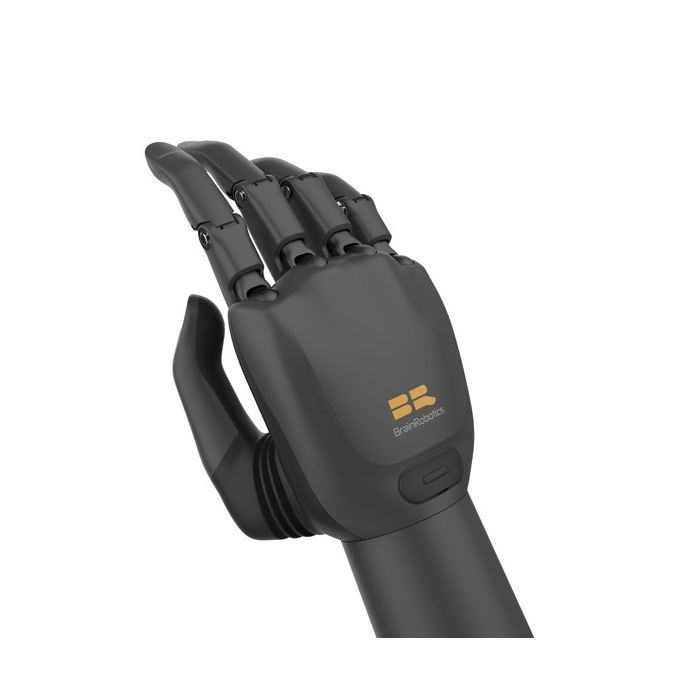
The BrainCo Revo 1 Intelligent Dexterous Bionic Hand is a robotic dexterous hand platform from BrainCo, a brain-computer-interface and human-machine-interface company that publicly lists “BrainCo Bionic Dexterous Hand Revo1” among its product lines on its official website. BrainCo positions itself as a company working across bionic hands, bionic knees, neurotechnology, and AI-oriented robotics solutions.
In stock
- BRAND:
- BRAINCO
- PART #:
- Intelligent Dexterous Bionic Hand
- ORIGIN:
- China
- Warranty:
- 12 MONTHS
- AVAILABILITY:
- SUBJECT TO AVAILABILITY
- SKU:
- BrainCo-Dexterous-Bionic-Hand
BrainCo Revo 1 Intelligent Dexterous Bionic Hand
Most robotic arms are solved long before their hands are. The trajectory is planned and the safety zone drawn, and then everything depends on a pair of jaws meeting an object that was never designed for them. The BrainCo Revo 1 Intelligent Dexterous Bionic Hand approaches that problem from the other side: it begins with the anatomy of the human hand and asks how much of it can be put into a compact, programmable end-effector.
The product is available through this page, by quotation.
Background
BrainCo and the Revo family
BrainCo is the manufacturer of the Revo range of dexterous hands, and the Revo 1 is the generation described on this page. It is offered in three named versions: the Revo 1 Basic (MRL1/MRR1), the Revo 1 Basic Touch (MTL1/MTR1) and the Revo 1 Advanced (MEL2/MER2). Each is supplied in a left-hand and a right-hand form, as the model codes indicate.
Later generations from the same manufacturer are also offered by this store. Readers who wish to compare may consult the BrainCo Revo 2 Basic Right Dexterous Bionic Hand (XRR) or the BrainCo Revo 3-21 Basic Robot Hand. The complete first-generation line is gathered in the BrainCo Revo 1 category.
Positioning and key technology
The Revo 1 is a biomimetic dexterous hand with 6 active joints and 10 degrees of freedom. The thumb has two active degrees of freedom, one for abduction and adduction and one for flexion and extension. Each of the remaining four fingers has one active degree of freedom for flexion and extension, together with one passive degree of freedom for flexion and extension. This arrangement allows the fingers to wrap around an object rather than simply pinch it, while keeping the number of motors, and therefore the control burden, modest.
The hand has a maximum load of 30 kg and a five-finger grip force of 50 N. Two behaviours are built into its firmware. On power-up it runs a position calibration sweep, and during that sweep all fingers move. In turbo mode, when a finger stalls against an object, it pauses for the configured stall duration and then continues gripping at 500 ms intervals. For integration, the hand is supported by a C SDK and a Python SDK.
Technical Specifications
| Specification | Value |
|---|---|
| Active joints | 6 |
| Degrees of freedom | 10 |
| Thumb | 2 active degrees of freedom (abduction/adduction, flexion/extension) |
| Four fingers, each | 1 active and 1 passive degree of freedom (flexion/extension) |
| Maximum hand load | 30 kg |
| Five-finger grip force | 50 N |
| Supply voltage (Revo 1 Basic) | 9.5 ~ 28 V |
| Default device ID | 1 (adjustable within 1 - 254) |
| Software development kits | C SDK and Python SDK |
| Power-on behaviour | Automatic position calibration sweep |
Specifications as published by the manufacturer; confirmed against the datasheet at quotation.
The manufacturer has not published the weight, the dimensions, the IP rating, the contents of the box or the operating noise; they are confirmed at quotation.
What makes the Revo 1 different from a conventional gripper?
A conventional two-jaw gripper is excellent at one thing: closing on a part whose shape it was chosen for. Change the part and the gripper is changed with it. The Revo 1 is built on the opposite principle. A thumb that moves in two directions can be placed opposite the fingers in several ways, and four fingers that each combine a driven joint with a passive one will follow the contour of an object rather than fight it. The result is a hand that can be asked to hold a varied set of objects without a change of tooling.
The control behaviour supports this. The automatic calibration sweep at power-on means the hand establishes its own finger positions before it receives instructions, which removes a manual step from every start-up. Turbo mode addresses a different difficulty: a finger that meets resistance and stops. Instead of remaining motionless, it waits for the configured stall duration and then resumes gripping at 500 ms intervals, which is useful when an object needs to be held firmly and settled gradually.
Integration is eased by the C SDK and the Python SDK. The default device ID is 1 and can be changed within the range of 1 to 254, which allows more than one hand to be addressed in a single installation. Engineers should note that all fingers move during the power-on sweep, and the hand should be mounted so that its fingers have free space at start-up.
Which Revo 1 version should be chosen?
Tactile sensing depends on the version, and that is the main point of decision. The Revo 1 Basic (MRL1/MRR1) is the version for teams whose work is chiefly about finger motion and grasp planning. The Revo 1 Basic Touch (MTL1/MTR1) is named for tactile capability and suits work in which contact information matters. The Revo 1 Advanced (MEL2/MER2) is the third option, with model-specific interfaces and tactile options of its own.
The supply voltage of 9.5 ~ 28 V is stated for the Revo 1 Basic only, and it should not be assumed to apply to the other versions.
Who is the Revo 1 for?
Research laboratories are the most natural buyers. A hand with 10 degrees of freedom and two SDKs gives a team a platform on which grasping algorithms can be developed and compared without first building the hardware. Universities and technical institutes will find the same qualities useful in teaching, since students can move from a script in Python to a visible finger movement within a single session.
Developers of assistive and rehabilitation technology form a second group. Their work depends on a hand that resembles the human hand in arrangement, and they may find interest in the wider Medical Robots category. Integrators of humanoid and service robots are a third group, looking for an end-effector that is more adaptable than a gripper but less complex than a fully actuated hand.
Buyers who want a newer generation, or a hand with a different finger design, may prefer the BrainCo Revo 3-21 Basic Robot Hand. Those who specifically need the first-generation interfaces, or who already have software written for them, will be best served by the Revo 1.
What is the Revo 1 used for?
- Grasping research. Studying how a thumb and four fingers conform to objects of different shapes.
- Teaching robotics. Giving students a hand they can program through the Python SDK.
- Assistive-technology development. Prototyping devices in which a hand-like layout is essential.
- Humanoid robot projects. Fitting a biomimetic hand to an arm or upper-body platform.
- Object-handling trials. Testing holds of items up to the 30 kg maximum hand load.
- Multi-hand installations. Addressing several hands through adjustable device IDs from 1 to 254.
Pricing and Availability
No price is printed on this page. Each Revo 1 version is supplied by quotation, so that the model code, the left or right orientation and the quantity can be specified at the outset. Delivery, customs and support are arranged together with the quotation. The Revo 1 Intelligent Dexterous Bionic Hand is available on this page.
Frequently Asked Questions
How many joints and degrees of freedom does the Revo 1 have?
It has 6 active joints and 10 degrees of freedom. The thumb has two active degrees of freedom, and each of the four fingers has one active and one passive degree of freedom.
What can the hand carry and how firmly does it grip?
The maximum hand load is 30 kg and the five-finger grip force is 50 N.
Which software tools are available?
A C SDK and a Python SDK are available. The default device ID is 1 and can be set anywhere from 1 to 254.
What happens when the hand is switched on?
It runs an automatic position calibration sweep, during which all fingers move. The hand should therefore have clear space around it at start-up.
What is turbo mode?
When a finger stalls against an object, it pauses for the configured stall duration and then continues gripping at 500 ms intervals.
Which versions are offered, and do they all include tactile sensing?
The versions are the Revo 1 Basic (MRL1/MRR1), the Revo 1 Basic Touch (MTL1/MTR1) and the Revo 1 Advanced (MEL2/MER2). Tactile sensing depends on the version selected.
Where can I buy the Revo 1 and what does it cost?
The hand is available through this page by quotation. No price is published here; send a request stating the version and orientation required, and a quotation will be prepared.
Summary
The question that opened this page was what happens at the moment of contact. The Revo 1 answers it with a thumb that moves in two directions, four fingers that combine driven and passive joints, a 30 kg maximum hand load and a 50 N five-finger grip force. It calibrates itself at power-up, keeps gripping after a stall in turbo mode, and is programmed through C and Python. For laboratories, teachers, assistive-technology developers and robot builders who need a hand rather than a gripper, this page is the starting point.