
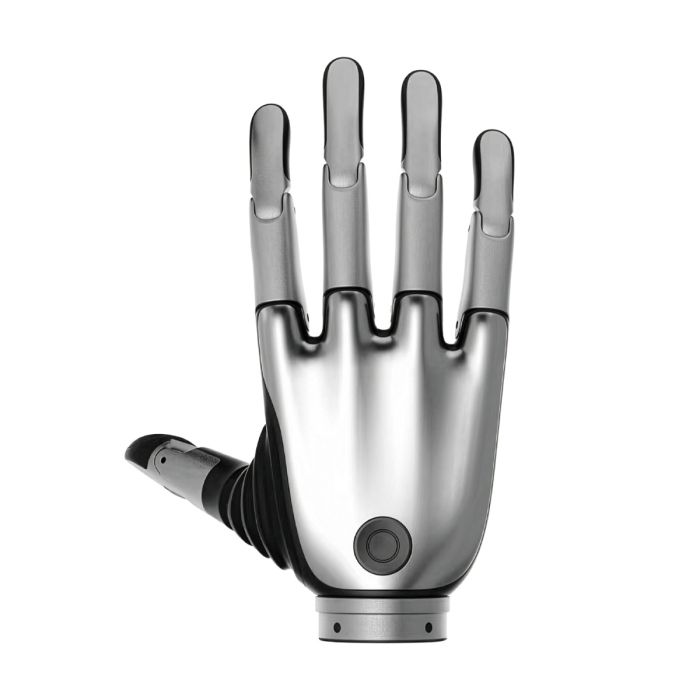
Brainco Revo 2 Touch Biomimetic Dexterous Left Hand (XTL)
In stock
- BRAND:
- BRAINCO
- MODEL:
- REVO 2 TOUCH (LEFT)
- PART #:
- XTL
- ORIGIN:
- China
- AVAILABILITY:
- SUBJECT TO AVAILABILITY
- SKU:
- BrainCo-Revo-2-Touch-Left
Brainco Revo 2 Touch Biomimetic Dexterous Left Hand (XTL)
Some hands are bought for what they lift; others are bought for the conversation they hold with the controller. The Brainco Revo 2 Touch Biomimetic Dexterous Left Hand (XTL) belongs to the second group: a bionic dexterous hand for robot integration and research, supplied in the left-hand configuration of the Touch version, for teams who care as much about commanding fingers precisely as about closing them.
The product is available through this page, by quotation.
Background
BrainCo and the Revo 2 family
BrainCo is the maker of the Revo line of bionic hands. The Revo 2 is offered in three versions: Basic (XRL/XRR), Pro (XEL/XER) and Touch (XTL/XTR). The final letter of each code separates the left hand from the right, so the XTL described here is the left-hand Touch unit, and its mirror counterpart carries the code XTR.
A family arranged in this way allows a laboratory or integrator to choose the level of capability a project requires and to move across the range without relearning the platform. The whole range may be compared in the BrainCo Revo 2 category, and other products of this kind are gathered under Hands.
Positioning and key technology
The Revo 2 is a bionic dexterous hand for robot integration and research. It has 6 active joints and a total of 11 degrees of freedom, which is to say that several joints are driven while the remaining motion is obtained through the mechanical design of the hand. The Touch version, to which the XTL belongs, is the tactile member of the family.
On the control side, the hand includes closed-loop servo control and custom gesture definitions. It also carries protections for current, stall, high temperature and collision conditions, which matter a great deal on a research bench where programs are written, rewritten and occasionally mistaken. Communication is offered over RS485, CAN FD and EtherCAT, with SDK support for Linux, Windows and ROS workflows.
Technical Specifications
| Specification | Value |
|---|---|
| Version code | XTL (left hand, Touch version) |
| Active joints | 6 |
| Degrees of freedom | 11 in total |
| Pinch force | ≥15N |
| Control precision | 0.1° |
| Communication interfaces | RS485, CAN FD, EtherCAT |
| SDK support | Linux, Windows, ROS |
| Protections | Current, stall, high temperature, collision |
Specifications as published by the manufacturer; confirmed against the datasheet at quotation.
The manufacturer has not published the IP rating, the package contents, the tactile sensor resolution or the motor type; they are confirmed at quotation.
What makes the Touch version different from the Basic and Pro versions?
The three versions share the Revo 2 platform, and the codes tell them apart: XRL/XRR for Basic, XEL/XER for Pro and XTL/XTR for Touch. The Touch version is the tactile one, intended for work in which the contact itself is the subject of study and not merely the result of a grasp.
Buyers who do not need that tactile capability may look at the Basic left hand (XRL) or the Pro left hand (XEL). No figure for those versions is given here; each has its own page.
Why does the left-hand configuration matter?
In a two-handed robot, each hand has its own address, calibration and place in the software. The XTL is the left unit; the matching right unit is the Touch right hand (XTR). Specifying both together keeps a bimanual build consistent.
Who is the Brainco Revo 2 Touch Left Hand for?
University and corporate laboratories will find a hand suited to manipulation research, particularly where tactile feedback is part of the question. Humanoid robot developers and system integrators gain a hand with three industrial and research-oriented communication interfaces and software support across Linux, Windows and ROS.
Teams that need only a gripping hand, without the tactile capability, may be better served by the Basic or Pro version, linked above.
What is the Brainco Revo 2 Touch Left Hand used for?
- Humanoid robot integration: fitting the left hand of a humanoid platform with a hand that has 11 degrees of freedom.
- Manipulation research: studying how grasps are formed and corrected in a laboratory setting.
- Tactile-aware experiments: using the Touch version where contact is the object of study.
- Gesture programming: defining custom gestures through closed-loop servo control.
- ROS-based development: building and testing control software with the supported SDK workflows.
- Bimanual setups: pairing the XTL with the XTR for two-handed work.
Pricing and Availability
No price is printed on this page; quotation is the way to proceed. Delivery, customs and support are arranged with the quotation. The Brainco Revo 2 Touch Biomimetic Dexterous Left Hand (XTL) is available on this page.
Frequently Asked Questions
Is the XTL a left or a right hand?
It is the left hand of the Touch version. The right-hand counterpart carries the code XTR.
How many degrees of freedom does it have?
It has 6 active joints and a total of 11 degrees of freedom.
What pinch force and control precision does it offer?
The pinch force is ≥15N and the control precision is 0.1°.
Which communication interfaces are supported?
The hand supports RS485, CAN FD and EtherCAT.
Which software environments are supported?
SDK support is provided for Linux, Windows and ROS workflows.
What protections are built in?
The hand includes protections for current, stall, high temperature and collision conditions.
Where can I buy the Brainco Revo 2 Touch Left Hand and what does it cost?
It is available through this page by quotation. No price is printed; the cost is given in the quotation together with delivery, customs and support arrangements.
Summary
The Brainco Revo 2 Touch Biomimetic Dexterous Left Hand (XTL) is a hand to be commanded and studied, not only closed. It offers 6 active joints, 11 degrees of freedom, a pinch force of ≥15N, a control precision of 0.1°, three communication interfaces and SDK support for Linux, Windows and ROS. For a quotation on the XTL, this page is the starting point.
Specifications
General
Physical
Mobility
Performance
Connectivity
Software
Hand
What's included
Videos