
UBTECH Walker Humanoid Robot
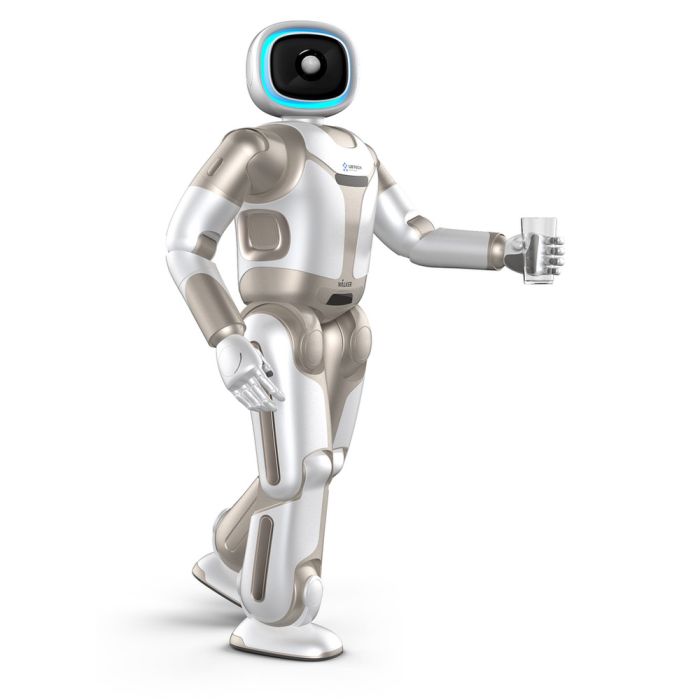
UBTECH Walker is a family of humanoid robots developed by UBTECH Robotics that targets human-centric environments—initially home and office assistance and later industrial and manufacturing scenarios. UBTECH describes the “Walker Robot” as a next-generation humanoid with 36 high-performance servo joints and multi-sensor perception (including force, vision, hearing, and spatial awareness) aimed at household and office use cases.
In stock
- BRAND:
- UBTECH
- PART #:
- Walker
- ORIGIN:
- China
- AVAILABILITY:
- SUBJECT TO AVAILABILITY
- SKU:
- UBTECH-Walker
UBTECH Walker Humanoid Robot
Recognising an object, reaching towards it and moving through a room are separate engineering problems; a useful service robot brings them together. The UBTECH Walker Humanoid Robot combines articulated movement with sensory systems covering force, vision, hearing and spatial awareness. Its relevance lies in that combination: buyers can examine mobility, perception and human interaction within a single humanoid platform, rather than treating each as an isolated demonstration. For a service robotics project, the central question is how those capabilities match the intended task and environment.
The product is available through this page, by quotation.
Background
UBTECH's ambition for robots in the home
UBTECH presents Walker as a step forward in its mission to bring robots into every home. That ambition gives the product a clear context: service robotics in environments where people move, communicate and operate everyday devices. A home is not simply a navigation problem. It also presents objects to distinguish, people to recognise and equipment to control.
Walker combines these areas through its humanoid service robot design. Its 36 high-performance servo joints provide articulation, while its sensory systems address different aspects of interaction with the surroundings. For buyers, the manufacturer's home-focused mission is a useful starting point for assessing the platform, not a substitute for defining the exact activities a project requires.
Movement, perception and interaction in one platform
The integrated drive unit comprises a frameless torque motor, precise harmonic reduction, a drive controller and a dual encoder. Alongside that actuation hardware, Walker uses gait planning and control to achieve stable walking on multiple types of terrain. The manufacturer's terrain illustrations include carpet, floor, grass, stairs, uphill surfaces, tiles and obstacles.
Visual navigation, stereo vision and multimodal interaction connect movement with environmental understanding. The software system comprises Ubuntu + Linux RT Preempt + ROS + Android, with URDF+Gazebo as the emulation platform. These named technologies give technical teams a concrete basis for discussing software integration and simulation, while the scope of project-specific development belongs in the quotation discussion.
Technical Specifications
| Specification | Value |
|---|---|
| High-performance servo joints | 36 |
| Height | 145cm |
| Weight | 77kg |
| Extended-state single-arm load | 1.5kg |
| Single-arm span | 540mm |
| Wi-Fi | 802.11 a/b/g/n 5G/2.4 GHz dual-band |
| Battery | Lithium iron phosphate 54.6V/10Ah/ 6 kg |
| Charging time | 2h |
| Usage time | 2h |
| Processor entries | Intel i7 7500U Frequency 2.7Ghz; Intel i5 6200U Frequency 2.3Ghz |
Specifications are as published by the manufacturer and are confirmed against the datasheet at quotation.
The manufacturer has not published the maximum walking speed, IP rating, box contents, camera resolution, payload when walking, noise level or operating temperature; these details are confirmed at quotation.
How does Walker combine navigation and human interaction?
Walker has built-in visual navigation, identified as U-SLAM, with autonomous path planning. Its visual navigation gathers environmental information including contours, colours and depths. This places perception alongside route planning: the robot uses information about its surroundings rather than relying on movement alone.
Through stereo vision, Walker recognises faces, objects and scenes. Its interaction modes include text, voice, vision, movement and environment. These capabilities are relevant to projects that explore how a robot responds to people and surroundings together. Recognition, dialogue and physical behaviour remain distinct parts of an application, so a demonstration plan should specify what each contributes to the intended experience.
Walker also has an open smart home interface for controlling lights, appliances, sockets and other home devices. That interface adds a route for interacting with the environment beyond the robot's own movement. A project brief should identify the devices to be controlled and the required behaviour, making interface integration a practical procurement topic rather than assuming compatibility with every household system.
Connectivity includes Wi-Fi, an Ethernet RJ45 interface and an EtherCAT high-speed real-time bus. For technical evaluation, distinguish the available connections from the application that will use them. Network arrangements, device integration and software responsibilities should be defined around the actual deployment.
Who is UBTECH Walker Humanoid Robot for?
Walker is relevant to research groups, robotics development teams and organisations evaluating humanoid service applications. Its combination of articulated movement, visual navigation and interaction provides several areas for investigation within the same platform. A university team, for example, can structure an evaluation around perception and movement, while a demonstration team can focus on how those capabilities are presented to an audience.
Smart home developers have a particular reason to examine its open home-control interface. The useful starting point is a defined scenario: which device receives a command, how the user interacts with Walker and what response completes the task. This keeps the evaluation centred on integration rather than on the humanoid form alone.
Buyers exploring the wider UBTECH Walker category or comparing Bipedal Humanoids should assess platforms against their own operational requirements. For this model, the stated arm load applies to a single arm in an extended state. It is not a walking-payload figure, and those requirements must remain separate when preparing a project brief.
For organisations in the Gulf, procurement planning should also describe the intended indoor or outdoor setting, interaction requirements and responsibilities for technical operation. These are project questions to resolve before deployment, not assumptions to draw from a terrain illustration or a list of interaction modes.
What is UBTECH Walker Humanoid Robot used for?
- Service robotics research: Explore the relationship between articulated movement, sensing and task design in a humanoid platform.
- Navigation evaluation: Examine visual navigation and autonomous path planning within a defined test environment.
- Human–robot interaction: Develop demonstrations using text, voice, vision and movement as interaction channels.
- Smart home integration: Investigate control of lights, appliances and sockets through the open smart home interface.
- Perception studies: Build evaluation scenarios around stereo-vision recognition of faces, objects and scenes.
- Simulation-led development: Use the stated URDF+Gazebo emulation platform as part of a structured robotics development workflow.
Pricing and Availability
Request a quotation for Walker with a description of the intended application, operating environment and integration requirements. Include the tasks you want to demonstrate, the home devices involved and the technical responsibilities your team expects to undertake. This gives the quotation discussion a practical scope beyond the robot's headline specifications.
Delivery, customs and support are arranged with the quotation. Ask for the processor configuration, supplied items and any project-specific integration work to be identified clearly in the offer. A quotation for UBTECH Walker Humanoid Robot is available on this page.
Frequently Asked Questions
What type of robot is Walker?
Walker is a humanoid service robot with 36 high-performance servo joints. It combines force, vision, hearing and spatial awareness sensing with navigation and multimodal interaction.
How much can Walker's arm carry?
The stated load is 1.5kg for a single arm in the extended state, with a single-arm span of 540mm. This specification should not be treated as a payload rating for walking.
How long are the usage and charging times?
The stated usage time is 2h, and the charging time is 2h. Project planning should include the intended task sequence and charging arrangements rather than treating runtime as the only operational consideration.
Can Walker navigate autonomously?
Walker includes U-SLAM visual navigation with autonomous path planning. Its visual navigation obtains environmental information such as contours, colours and depths, while gait planning and control support stable walking on multiple terrain types.
What software system does Walker use?
The software system is Ubuntu + Linux RT Preempt + ROS + Android, and the emulation platform is URDF+Gazebo. Define the required software interfaces and development responsibilities when requesting a quotation.
Can Walker control smart home devices?
Walker has an open smart home interface for controlling lights, appliances, sockets and other home devices. Identify the exact devices and required interactions in the project brief so that integration requirements are addressed explicitly.
Where can I buy UBTECH Walker Humanoid Robot and what does it cost?
The product is available through this page by quotation. Submit your application and configuration requirements to obtain an offer covering the robot and the agreed delivery, customs and support arrangements.
Summary
Walker's central proposition is the connection between movement, perception and interaction. Its articulated hardware, visual navigation, stereo recognition and smart home interface give buyers several connected areas to evaluate, while the stated software system provides a technical foundation for development discussions.
A sound purchasing decision begins by turning that combination into a specific task brief: what the robot must recognise, where it must move and how it must interact. Keep the extended-arm load separate from walking requirements, define the integration scope and resolve the unpublished details through quotation. For that evaluation and procurement discussion, this page is the starting point.