
UBTech Walker Tienkung Embodied Intelligence Humanoid Robot
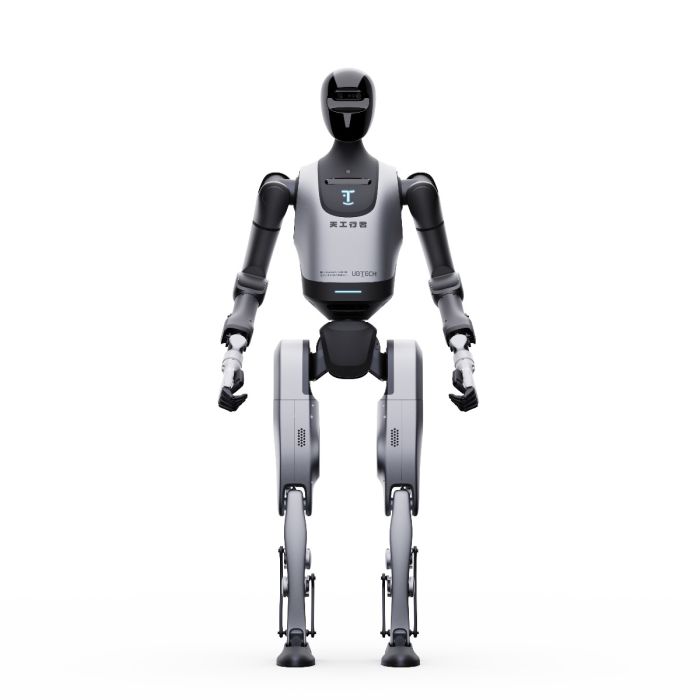
In stock
- BRAND:
- UBTECH
- MODEL:
- WALKER TIENKUNG EI
- ORIGIN:
- China
- AVAILABILITY:
- SUBJECT TO AVAILABILITY
- SKU:
- UBTECH-Walker-Tienkung-EI
UBTech Walker Tienkung Embodied Intelligence Humanoid Robot
A simulation can describe a movement; a physical experiment must account for the interaction between sensing, control and the world around it. The UBTech Walker Tienkung Embodied Intelligence Humanoid Robot brings that distinction into the research laboratory. Its series combines a fully electric humanoid architecture with open joint and sensor interfaces, while the Embodied Intelligence version has overall computing power that can reach up to 550 TOPS. For an institution choosing a research platform, the central question is how these resources fit its experiments, teaching programme and development methods.
The product is available through this page, by quotation.
Background
Joint development of the Walker Tienkung series
The Walker Tienkung series is jointly developed by UBTECH Robotics Corp., Ltd. and Beijing Humanoid Robotics Innovation Center Co., Ltd. The developers describe the series as full-size, fully electric humanoid running robots. This establishes the product's lineage and platform type without turning the description into a claim about running speed, terrain performance or suitability for an unattended deployment.
The series is designed for scientific research and educational scenarios. That purpose is important when preparing a purchase specification: a research platform is selected around experimental access, development work and learning objectives, rather than an assumption that it arrives ready to carry out a commercial service role. Institutions evaluating Research Robots should begin with the questions their teams need to investigate and the facilities in which that work will take place.
Embodied intelligence and development access
Embodied intelligence research examines how perception, decisions and physical action work together. In this context, access to the robot's underlying systems matters alongside its mechanical configuration. The entire Walker Tienkung series provides open interfaces for all joints and sensors, supporting industry-specific secondary development for research, education and other scenarios.
The listed development resources include high-fidelity URDF Models & Open-source Training Frameworks. These resources connect the platform with modelling and training workflows, but the supplied facts do not identify individual framework packages or software releases. For a laboratory, defining the required software environment is therefore a separate part of the procurement brief, alongside the physical configuration and intended experiments.
Technical Specifications
| Specification | Walker Tienkung | Walker Tienkung · Voice & Vision | Walker Tienkung · Embodied Intelligence |
|---|---|---|---|
| Degrees of freedom, series configuration | Up to 42 degrees of freedom | Up to 42 degrees of freedom | Up to 42 degrees of freedom |
| Configurable robotic arm, each arm | 7-DoF robotic arm | 7-DoF robotic arm | 7-DoF robotic arm |
| Optional wrist force sensor | High-precision six-axis force sensor | High-precision six-axis force sensor | High-precision six-axis force sensor |
| Optional dexterous hands | Five-finger hands | Five-finger hands | Five-finger hands |
| Continuous operating time, series figure | More than 3.5 hours | More than 3.5 hours | More than 3.5 hours |
| Overall computing power | No figure stated for this version | Up to 550 TOPS | Up to 550 TOPS |
Specifications are as published by the manufacturer and are confirmed against the datasheet at quotation.
The manufacturer has not published dimensions, battery capacity for the Embodied Intelligence version, IP rating, payload, operating temperature or power adapter rating; these details are confirmed at quotation.
What should researchers check before choosing Walker Tienkung Embodied Intelligence?
The first distinction is between an available configuration and the equipment included in a particular quotation. The series can be equipped with up to 42 degrees of freedom. Each arm can be configured with a 7-DoF robotic arm, and the wrist can be fitted with a high-precision six-axis force sensor and dexterous five-finger hands. These are configuration statements, not a guarantee that every quoted robot includes every option.
For manipulation research, that distinction affects the experiment itself. An investigation of contact forces has different instrumentation needs from a study of joint control or hand motion. A clear brief should identify the required arm configuration, wrist sensing and hands, then connect those choices to the data the team intends to collect. This is a more useful selection method than treating the maximum degree-of-freedom figure as a complete description of the robot.
Computing capacity also needs to be read in context. Both the Voice & Vision and Embodied Intelligence versions have overall computing power that can reach up to 550 TOPS. The supplied facts do not establish a computing advantage for Embodied Intelligence over Voice & Vision, nor do they identify processor models or software compatibility. Selection between them should therefore follow the quoted configuration and development requirements, not an assumed difference in headline computing power.
The series uses powerful joint actuators, a high-precision IMU and a dual-battery quick-swap system, and can achieve continuous operating time of more than 3.5 hours. A research schedule should still define the planned activities, supervision and battery-handling arrangements. The operating-time figure is useful for initial planning, but it does not describe a complete experimental duty cycle or establish the battery capacity of this version.
Who is Walker Tienkung Embodied Intelligence for?
The strongest fit is with universities, scientific laboratories and educational institutions that need a humanoid platform for structured development work. Open interfaces across joints and sensors support teams whose objectives involve investigating the robot's physical systems rather than only observing a finished demonstration. Advanced teaching programmes can also use the platform as a focus for discussing modelling, sensing and control.
Research and development groups exploring embodied intelligence should assess whether the available configurations match their planned studies. Useful procurement questions include which signals must be accessible, which physical interactions will be investigated and which modelling resources the team requires. Those questions help turn a broad interest in humanoid robotics into a specific, reviewable project scope.
Teams comparing the named versions can also review the UBTech Walker Tienkung Voice and Vision Humanoid Robot. The shared computing ceiling alone does not establish which version better suits a particular programme. The supplied information supports comparison at quotation rather than a recommendation based on unlisted differences. The wider UBTECH Walker category provides a separate route for exploring the product family.
What is Walker Tienkung Embodied Intelligence used for?
- Embodied intelligence research: Investigating the relationship between sensing, decision-making and physical action within a supervised research programme.
- Joint-control development: Using the series' open joint interfaces as a basis for secondary development and experimental control work.
- Sensor integration studies: Building research activities around open sensor interfaces and clearly defined data requirements.
- Manipulation experiments: Planning arm, wrist-force and hand studies around the configuration selected for the project.
- Modelling and training workflows: Incorporating the listed URDF models and training frameworks into a defined development process.
- Advanced robotics education: Giving supervised learners a physical platform around which to study humanoid systems and experimental methods.
Pricing and Availability
Request a quotation that identifies the Embodied Intelligence version and describes your research or educational objectives. Include the desired arm, wrist-sensor and hand configuration, together with the software resources your team expects to use. A configuration-specific quotation gives procurement staff and technical leads a common basis for assessing the proposed platform.
Delivery, customs and support are arranged with the quotation.
For configuration review and a formal quotation, the product is available on this page.
Frequently Asked Questions
Is this robot intended for research or commercial service?
The product is designed for scientific research and educational scenarios. The supplied facts do not establish a ready-to-deploy commercial service application.
Does every configuration have 42 degrees of freedom?
The series can be equipped with up to 42 degrees of freedom. The selected joint configuration should be specified in the quotation rather than inferred from the maximum figure.
Are the wrist force sensors and dexterous hands included?
The wrist can be fitted with a high-precision six-axis force sensor and dexterous five-finger hands. These are configurable features; the quotation should identify which are included.
What computing power does the Embodied Intelligence version offer?
Overall computing power can reach up to 550 TOPS. The same ceiling is listed for the Voice & Vision version, so this figure alone does not distinguish the versions.
Can developers access the joints and sensors?
Yes. The entire Walker Tienkung series provides open interfaces for all joints and sensors to facilitate secondary development.
What modelling and training resources are listed?
The listed resources are high-fidelity URDF Models & Open-source Training Frameworks. Specific framework names, releases and integration requirements are not identified in the supplied information.
Where can I buy Walker Tienkung Embodied Intelligence and what does it cost?
The product is available through this page by quotation. Request a proposal for your required configuration, with delivery, customs and support arrangements addressed alongside it.
Summary
The step from simulation to physical experimentation requires more than a humanoid shape. Walker Tienkung Embodied Intelligence combines the series' open joint and sensor interfaces with configurable manipulation hardware and computing power that can reach up to 550 TOPS. Its stated research and educational purpose provides a clear starting framework, while a configuration-specific quotation connects those capabilities to the institution's actual work. For defining that experimental scope and requesting the appropriate platform, this page is the starting point.