
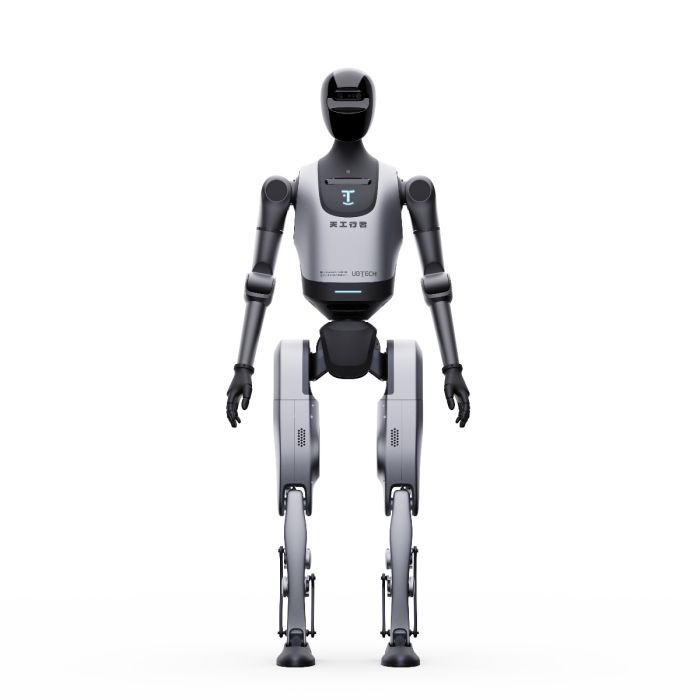
UBTech Walker Tienkung Voice And Vision Humanoid Robot
In stock
- BRAND:
- UBTECH
- MODEL:
- WALKER TIENKUNG VOICE AND VISION
- ORIGIN:
- China
- Warranty:
- 12 MONTHS
- AVAILABILITY:
- SUBJECT TO AVAILABILITY
- SKU:
- UBTECH-Walker-Tienkung
UBTech Walker Tienkung Voice And Vision Humanoid Robot
The important question in a humanoid laboratory is not simply whether a robot can move, but what researchers can learn from controlling that movement. UBTech Walker Tienkung Voice and Vision Humanoid Robot brings full-body joint and sensor interfaces together with the ability to integrate natural language interaction. Its purpose is scientific research and education: a setting where access to the platform matters as much as the demonstration itself. For teams planning experiments around locomotion, teleoperation or human–robot interaction, the purchasing decision begins with the relationship between the research question and the available interfaces.
The product is available through this page, by quotation.
Background
Joint development and the Walker Tienkung family
The Walker Tienkung series consists of full-size, fully electric humanoid running robots jointly developed by UBTECH Robotics Corp., Ltd. and Beijing Humanoid Robotics Innovation Center Co., Ltd. The named versions are Walker Tienkung (TK2101), Walker Tienkung · Voice & Vision (TK2201), and Walker Tienkung · Embodied Intelligence (TK2301). This page concerns the Voice and Vision product, so its specification must remain distinct from figures or equipment associated with other configurations.
The family belongs within the broader field of Research Robots, where a platform is selected as an experimental instrument rather than simply as a finished appliance. In that context, laboratories need to establish which parts of a system they can control, what information they can collect and how an experiment will be supervised. Those questions provide a more useful starting point than comparing visually impressive demonstrations alone.
Open interfaces and language integration
The platform provides full-body joint and sensor interfaces supporting teleoperation, data acquisition and secondary development. The Voice and Vision version can integrate a voice module and a large language model for voice interaction, supporting natural language interaction. That integration capability is distinct from a statement that a particular module, model or ready-configured conversational service is included.
For a research programme, this distinction affects how work is planned. Joint and sensor access supports investigation of the physical platform, while language integration introduces a separate interaction layer to define and evaluate. An institution should describe both its physical experiment and its intended conversational workflow when requesting a quotation, rather than treating either as an automatic substitute for the other.
Technical Specifications
| Specification | Value |
|---|---|
| Voice & Vision net weight | ≈61kg |
| Series joint-module peak torque | 300Nm |
| Robot body in the packing list | × 1 |
| Power adapter in the packing list | × 1 |
| Remote controller in the packing list | × 1 |
| Safety rope in the packing list | × 1 |
| Electronic User Manual in the packing list | × 1 |
| Electronic Warranty Card in the packing list | × 1 |
| Factory inspection report in the packing list | × 1 |
Specifications are as published by the manufacturer and are confirmed against the datasheet at quotation.
The manufacturer has not published the maximum payload, IP rating, maximum walking speed, operating temperature or power adapter rating; these details are confirmed at quotation.
What does Walker Tienkung Voice and Vision offer a research team?
The principal research value lies in the combination of locomotion capability and access to the robot's interfaces. The platform is capable of stable walking on irregular terrains such as slopes and sandy ground. Its open interface design supports teleoperation, data acquisition and secondary development, allowing these capabilities to form the subject of an investigation rather than remaining only a demonstration to observe.
Terrain adaptability should be considered separately from environmental protection. Walking on sandy ground does not establish an IP rating, and a locomotion capability does not define a safe operating envelope for every experimental site. A laboratory planning terrain trials should specify the surface, supervision arrangements and test objectives, then establish the relevant limits during the quotation process.
Natural language interaction adds another research direction. Voice and Vision can integrate a voice module and a large language model, creating scope for experiments in how people communicate with a physical robot. The research team still needs to define the intended commands, evaluation criteria and relationship between spoken input and physical actions. This is particularly important when an experiment combines an interaction task with movement.
These capabilities do not establish a particular camera arrangement, software framework or computing configuration. Buyers should distinguish a supported development direction from an item explicitly included in the supplied configuration. A clear project brief helps separate essential equipment from optional integration work and makes the quotation a practical technical review.
Who is Walker Tienkung Voice and Vision for?
The product is designed for scientific research and educational scenarios. Relevant buyers include university robotics laboratories, research institutes and teaching teams working with humanoid systems. Its full-body joint and sensor interfaces are pertinent to groups that need teleoperation or data acquisition as part of their experimental method, rather than only a robot that performs a prepared routine.
For education, the appropriate question is how the robot fits a supervised learning programme. Humanoid platforms can provide a shared subject for mechanical, control and interaction studies, but the institution must define the level of student access and the procedures for practical sessions. The supplied electronic manual, remote controller and safety rope belong in that planning discussion; their inclusion does not replace institutional risk assessment.
Teams evaluating the UBTech Walker Tienkung Embodied Intelligence Humanoid Robot alongside this version should request a configuration comparison. Both named versions can integrate a voice module and a large language model. That shared capability alone does not establish which is the better fit, so selection should follow the project's required interfaces, equipment and integration responsibilities.
What is Walker Tienkung Voice and Vision used for?
- Locomotion research: Study humanoid movement with experiments focused on the platform's walking behaviour.
- Terrain experiments: Investigate walking on irregular surfaces, including slopes and sandy ground, within an agreed test plan.
- Teleoperation studies: Use the full-body joint and sensor interfaces in supervised remote-control research.
- Data acquisition: Build research workflows around information accessed through the robot's joint and sensor interfaces.
- Natural language interaction: Explore voice interaction through integration of a voice module and a large language model.
- Teaching and secondary development: Organise educational projects around modifying and evaluating humanoid behaviour.
Pricing and Availability
Request a quotation specifying Walker Tienkung · Voice & Vision (TK2201), your intended research or teaching use, and the integration work your team expects to undertake. Include any requirements for voice interaction, sensor access or terrain testing so that the proposed configuration can be reviewed against the project rather than selected by name alone.
Delivery, customs and support are arranged with the quotation. The quotation should also resolve the unpublished operating details and identify the equipment and documentation supplied for your configuration. A quotation request for this product is available on this page.
Frequently Asked Questions
Which Walker Tienkung version does this page cover?
This page covers Walker Tienkung · Voice & Vision (TK2201). It is separate from Walker Tienkung (TK2101) and Walker Tienkung · Embodied Intelligence (TK2301).
Is voice interaction already included?
The Voice and Vision version can integrate a voice module and a large language model for natural language interaction. The specific module, model and integration scope need to be identified in the quotation.
Can it walk on uneven terrain?
The platform is capable of stable walking on irregular terrains such as slopes and sandy ground. Experimental conditions and supervision should be defined before practical testing.
Does it support secondary development?
Yes. It provides full-body joint and sensor interfaces supporting teleoperation, data acquisition and secondary development; the project brief should identify the access and development workflow your team requires.
What is included in the packing list?
The packing list contains a robot body, power adapter, remote controller and safety rope, together with an electronic User Manual, electronic Warranty Card and factory inspection report. It lists one of each item.
Is this intended for scientific research or education?
Yes, the product is designed for scientific research and educational scenarios. Institutions should plan their own experimental procedures, supervision and assessment around the chosen configuration.
Where can I buy Walker Tienkung Voice and Vision and what does it cost?
You can request a quotation through this page. The quotation establishes the configuration and commercial terms, with delivery, customs and support arranged alongside it.
Summary
The value of a research humanoid is measured by the questions it helps a team investigate, not only by the movements it can demonstrate. Walker Tienkung Voice and Vision combines a full-size, fully electric humanoid platform with open joint and sensor interfaces and the ability to integrate natural language interaction. Its stated purpose is research and education, making the experimental plan central to selecting the right configuration.
Define the required access, interaction workflow and test conditions, then use the quotation to resolve the remaining technical details. For turning that research brief into a configuration discussion, this page is the starting point.