
Elephant Robotics myGripper H100 Left Hand (4010700101)
In stock
- BRAND:
- ELEPHANT ROBOTICS
- MODEL:
- myGripper H100
- PART #:
- 4010700101
- ORIGIN:
- China
- Warranty:
- 12 MONTHS
- AVAILABILITY:
- SUBJECT TO AVAILABILITY
- SKU:
- Elephant Robotics Technology-4010700101
Elephant Robotics myGripper H100 Left Hand (4010700101)
A grasp is more than a closing movement: it is a sequence of joint positions, speeds and interactions with an object. Elephant Robotics myGripper H100 Left Hand (4010700101) brings those elements into focus for robotics research and education. Its articulated design provides a practical subject for studying how finger movements combine, while its control options connect mechanical behaviour with software development. For a laboratory or teaching team, the central question is not simply whether an object can be held, but how the grasp is commanded, observed and refined.
The product is available through this page, by quotation.
Background
Elephant Robotics and the myGripper H100
Elephant Robotics developed the myGripper H100 for robotics research, education and related scenarios. The range names left-hand, right-hand and combined left-and-right-hand versions. This page concerns the Left Hand version, identified by product code 4010700101; selecting a handed configuration is a separate decision from choosing a control method or planning an experiment.
In robotics teaching, an articulated hand offers a useful bridge between abstract joint commands and visible mechanical movement. In research, it provides a platform around which teams can structure grasping investigations. Those contexts explain the product's positioning without treating a research component as a complete, application-ready robotic installation.
Articulation and software-led control
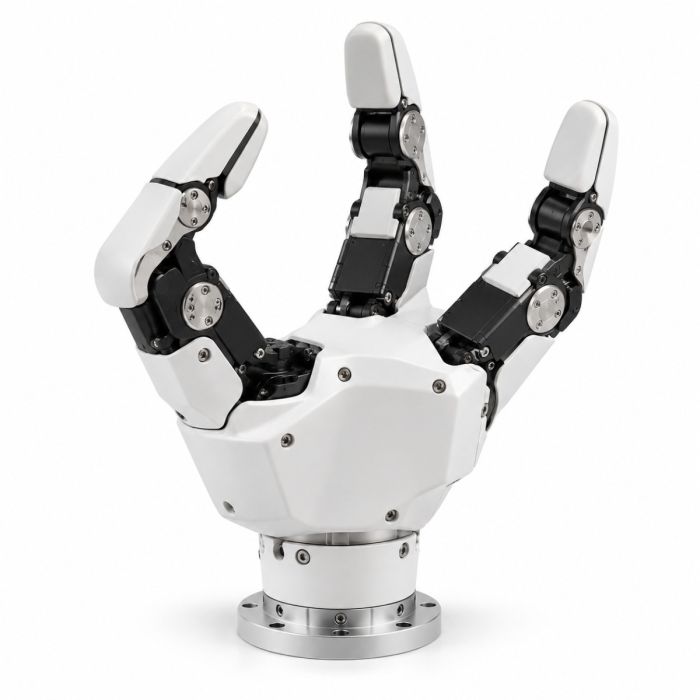
The H100 has 3 fingers corresponding to the human thumb, index finger and ring finger, with 6 movable joints. Its 6 high performance digital servo motors enable control of output torque, motion speed and absolute position. The motor specification also identifies current, position and speed control. These are distinct control considerations that help teams organise experiments around more than a single opening command.
The software provision includes compatibility with ROS1 and ROS2 and support for the RVIZ simulation environment, including display of the robot arm's state and collection of real-time data. A standardised robot driver library is downloadable and installable via PyPI. These resources place software integration alongside the mechanical design as a central part of evaluating the hand.
Technical Specifications
| Specification | Value |
|---|---|
| Payload | 500g |
| Self-weight | 780g |
| Stroke (diameter) | 0 – 130mm |
| Motion speed | 60 degrees per second per joint |
| Number of fingers | 3 |
| Movable joints | 6 |
| Digital servo motors | 6 |
| Lifespan | 1,000,000 cycles or more |
| Power parameters | 24V, 2A |
| Main control processor | 240MHz dual-core |
| Main control performance | 600 DMIPS |
| Main control memory | 520KB SRAM |
Specifications are as published by the manufacturer and are confirmed against the datasheet at quotation.
The manufacturer has not published the dimensions, IP rating, gripping force, operating temperature, left-hand package weight or operating voltage range; these are confirmed at quotation.
The electrical interface is an M8 Pin aviation connector, with RS485 communication and the MODBUS protocol. The main control chip is ESP32, and its listed control features include Wi-Fi and dual-mode Bluetooth. For integration planning, distinguish the connector, communication interface and protocol: each addresses a different part of the connection between the hand and the surrounding control system.
Payload, self-weight and stroke also answer different purchasing questions. Payload describes the stated load capability, self-weight concerns the hand itself, and stroke describes its opening diameter. None of these figures substitutes for an assessment of the intended object, mounting arrangement or complete robot system. Keep those considerations separate when preparing an application brief.
What control options does the myGripper H100 Left Hand offer?
The H100 combines articulated movement with control over output torque, motion speed and absolute position. For research, that gives an experiment several variables to address: the target joint position, the rate of movement and the commanded torque. A well-structured trial separates these variables rather than attributing every change in grasp behaviour to finger geometry alone.
Its RS485 interface and MODBUS protocol establish the stated communication route. ROS1 and ROS2 compatibility, RVIZ support and the PyPI-distributed driver library address the software side. Together, these facts give a development team concrete starting points for reviewing its existing software environment and deciding how the hand will enter a wider experimental workflow.
The controller specification also lists Wi-Fi and dual-mode Bluetooth. These controller features should remain distinct from the stated RS485/MODBUS integration path in a purchasing brief. Define the required command route, host environment and data workflow before specifying the surrounding equipment, rather than treating every listed interface as interchangeable.
For an educational exercise, the same distinction is valuable. Students can examine how a joint command relates to visible movement, then consider how a communication protocol carries that command. This keeps the learning objective grounded in the relationship between software, control and mechanics, without confusing a component specification with the performance of an entire robotic cell.
Who is the myGripper H100 Left Hand for?
This version addresses robotics researchers, educators and development teams whose project calls for a left-hand configuration. It is relevant to work centred on articulated grasping, servo control and the organisation of manipulation experiments. Buyers should identify the required handedness early, alongside the intended objects, controller and mechanical integration requirements.
Where the project instead calls for a right-hand arrangement, consider the myGripper H100 Right Hand. For a project specifying both handed configurations, review the myGripper H100 Left+Right Hand version. These are configuration choices, not a basis for assuming different payloads, speeds or control performance.
For procurement teams, the strongest starting brief combines the intended research or teaching task with the selected version and the surrounding system requirements. This makes the quotation discussion more useful than a request based on the hand alone, particularly where mechanical fit, electrical connections and software responsibilities involve different members of the project team.
What is the myGripper H100 Left Hand used for?
- Grasping research: Structure experiments around finger coordination, commanded movement and the interaction between a hand and a test object.
- Robotics education: Connect lessons on articulated mechanisms with practical observation of joint movement and control commands.
- Servo-control studies: Explore output torque, motion speed and absolute-position control as separate elements of an experimental method.
- ROS development: Build research workflows around the stated ROS1 and ROS2 compatibility and RVIZ support.
- Communication exercises: Use the RS485 interface and MODBUS protocol as subjects for robot-component integration work.
- Handed configuration planning: Evaluate a left-hand arrangement within a project that explicitly defines its manipulation layout.
Pricing and Availability
Request a quotation for the Left Hand version using product code 4010700101. Include the intended application, control environment and integration questions so that the response addresses the project rather than only the component. State any required accessories or documentation explicitly instead of assuming they form part of the supply.
Delivery, customs and support are arranged with the quotation. Submit your requirements through the quotation enquiry available on this page.
Frequently Asked Questions
What is the payload of the myGripper H100 Left Hand?
The payload is 500g, and the hand's self-weight is 780g. These are separate specifications and should be treated separately in system planning.
How many fingers and movable joints does it have?
It has 3 fingers and 6 movable joints. The fingers correspond to the human thumb, index finger and ring finger.
What movement and control parameters are specified?
Motion speed is 60 degrees per second per joint, and stroke diameter is 0 – 130mm. The digital servo motors enable control of output torque, motion speed and absolute position.
Does it support ROS and RVIZ?
The H100 is compatible with ROS1 and ROS2 and supports the RVIZ simulation environment. Its standardised robot driver library is downloadable and installable via PyPI.
Which electrical and communication interfaces are listed?
The hand uses an M8 Pin aviation connector, RS485 communication and the MODBUS protocol. The power parameters are 24V, 2A.
Is this the right-hand or combined version?
No; product code 4010700101 identifies the Left Hand version. The range separately names Right Hand and Left+Right Hand configurations.
Where can I buy the myGripper H100 Left Hand and what does it cost?
The product is available by quotation through this page. Request a quotation with your application requirements to establish the commercial terms and required scope of supply.
Summary
Studying a grasp means looking beyond the closing action to the joints, commands and software that shape it. The myGripper H100 Left Hand combines articulated fingers, servo control and a defined communication interface with ROS and RVIZ support for research and education. Select the handed configuration deliberately, keep component figures distinct from complete-system requirements, and bring the unresolved integration questions into the quotation discussion. For a project built around understanding and developing robotic manipulation, this page is the starting point.