
FF Faber T Industrial EAI Mobile Manipulator
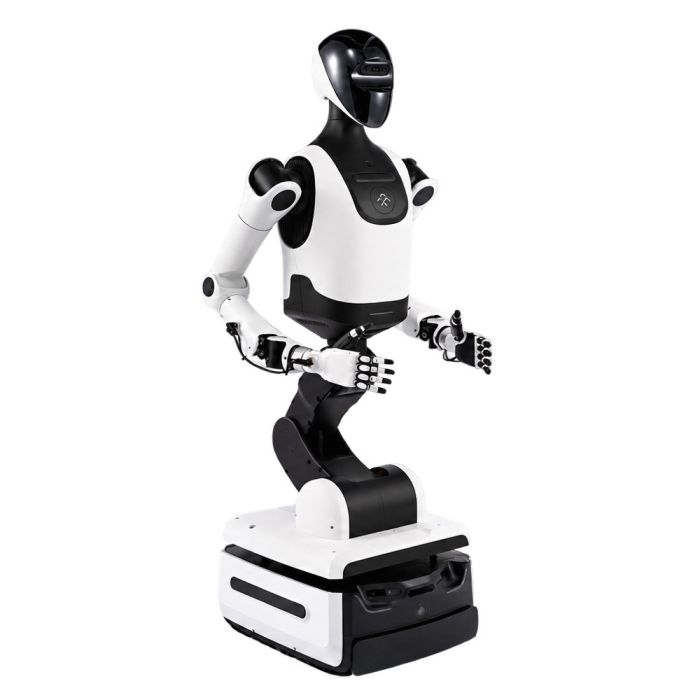
In stock
- BRAND:
- FARADAY FUTURE
- MODEL:
- FABER T
- ORIGIN:
- United States
- Warranty:
- 12 MONTHS
- AVAILABILITY:
- PRE-ORDER
- SKU:
- FF-Faber-T
FF Faber T Industrial EAI Mobile Manipulator
Inspecting an installation and physically operating its equipment are different responsibilities, especially when an intervention exposes people to risk. The FF Faber T Industrial EAI Mobile Manipulator brings those responsibilities into the same industrial robotics discussion. Its stated applications centre on power inspection, energy infrastructure and data centres, including high-risk work such as closing electrical switches. For an engineering buyer, the important starting point is therefore not a demonstration of movement, but a defined task: where the robot must travel, what it must reach and what action the site permits it to perform.
The product is available through this page, by quotation.
Background
Faraday Future and the Faber lineage
Founded in 2014, Faraday Future is a U.S.-based Physical AI ecosystem company working across robotics and mobility solutions. Faber takes its name from the Latin for “skilled craftsman”, a useful expression of the series’ emphasis on physical work rather than observation alone. The family comprises Faber U, Faber T and Faber S, with different positioning within the same industrial robotics range.
The shared Faber description combines autonomous navigation, omnidirectional mobility, dual-arm coordination and precision operation. Its primary use cases are industrial loading, unloading and logistics transfer. These are series-level capabilities and applications; they provide the background to Faber T without making every family specification a separate, established Faber T configuration.
Faber T’s infrastructure focus
Faber T has been deployed at scale for power inspection, energy infrastructure and data centres. It can take over high-risk tasks from people, including closing electrical switches. This gives the model a more specific purchasing context than a general-purpose robotics platform: the buyer begins with an operational responsibility in an infrastructure setting.
The Faber series also uses an open Ubuntu/ROS platform and supports exclusive customisation. For an integration team, that makes the relationship between the physical task and the software workflow an important subject for the quotation. A site should define the required operation, its acceptance criteria and the responsibilities of its technical team before selecting a final configuration.
Technical Specifications
The numerical specifications below describe the Faber series. The series’ degrees-of-freedom range is not a Faber T-specific total, and the arm lifting figure is not a combined-arm payload rating.
| Specification | Value |
|---|---|
| Arm arrangement, Faber series | Dual 7-axis arms |
| Degrees of freedom, Faber series range | 26–35 DOF |
| Single-arm lift, Faber series | Up to 11 pounds |
| Operating range, Faber series | Ground level to about 6.6 feet high |
| Force-control precision, Faber series | Better than 0.5 newtons |
Specifications are as published by the manufacturer and are confirmed against the datasheet at quotation.
The manufacturer has not published Faber T’s dimensions, weight, battery capacity, runtime, compute platform, sensors, drive speed, IP rating, box contents, connectivity or total degrees of freedom; these are confirmed at quotation.
For a practical assessment, distinguish lifting an object from applying force to an installed control. A lifting figure does not, by itself, establish suitability for a switch, latch or other mechanism. Record the equipment interface, required motion and working environment as part of the application brief, rather than treating a headline specification as an acceptance test.
How does Faber T combine inspection with physical intervention?
A mobile inspection workflow concerns where equipment is and what condition it is in. An intervention workflow adds a physical action. Faber T’s stated ability to close electrical switches connects those activities, while its infrastructure positioning gives the buyer a concrete task around which to organise evaluation. It does not remove the need to define authorisation, operating procedures and the limits of the proposed deployment.
At series level, autonomous navigation and omnidirectional mobility address movement, while coordinated arms address manipulation. Both arms can work together on transport, assembly and delicate operations that are difficult for an arm working alone. These capabilities explain the value of combining mobility and manipulation, without establishing that every task or piece of equipment is suitable for this model.
For infrastructure projects, a useful brief separates travel, observation and intervention into distinct acceptance requirements. Define the route, identify the asset and describe the permitted physical action. This keeps the evaluation tied to work that matters on site. It also helps technical and operational teams discuss the same workflow rather than using “inspection robot” and “mobile manipulator” as interchangeable descriptions.
Who is Faber T for?
Faber T is relevant to power inspection teams, energy infrastructure operators and data centre engineering departments evaluating robotic intervention alongside inspection. It also deserves consideration by systems integrators preparing a clearly bounded industrial workflow. The strongest starting point is an existing task with a known equipment interface, a responsible operator and an agreed way to judge completion.
Buyers whose priority is the family’s advanced computing and sensing provision should compare Faber U. That sibling has the Thor high-performance AI compute platform, dual LiDAR and a multi-camera sensing system. Those are Faber U specifications, not specifications to transfer to Faber T.
For projects prioritising the largest arm span in the series and a full embodied-AI data collection toolchain, compare Faber S. A research-led buyer and an infrastructure operator can have very different acceptance criteria. Choosing between the siblings should begin with those criteria, rather than assuming that their shared family name makes their configurations interchangeable.
What is Faber T used for?
- Power inspection: Faber T’s stated deployment includes inspection work in power-related environments.
- Energy infrastructure operations: The model is positioned for deployment in energy infrastructure, with the site’s task defining the integration brief.
- Data centre operations: Data centres are a stated deployment setting for Faber T, making facility workflows a relevant evaluation focus.
- Electrical switch operation: Closing electrical switches is an expressly identified example of high-risk work the model can take over from people.
- Industrial loading and unloading: These are primary Faber-series applications to assess against the intended Faber T configuration.
- Logistics transfer: The Faber series focuses on moving work through industrial processes, with coordinated manipulation supporting transport tasks.
Pricing and Availability
Request a quotation for Faber T against a written application brief. Include the intended environment, equipment to be operated, required workflow and acceptance criteria so that the discussion addresses the actual installation. Identify any customisation requirements separately from the standard product enquiry, particularly where the robot must interact with existing operational procedures.
Delivery, customs and support are arranged with the quotation.
For configuration enquiries and a project-specific quotation, Faber T is available on this page.
Frequently Asked Questions
Is Faber T intended for power inspection?
Yes. Faber T has been deployed at scale for power inspection, energy infrastructure and data centres. These are its explicitly identified deployment areas.
Can Faber T close electrical switches?
Yes. Closing electrical switches is a stated example of the high-risk tasks it can take over from people. Any proposed installation still needs a task-specific safety assessment and operating procedure.
What lifting capacity is listed?
The Faber series has a single-arm lifting figure of up to 11 pounds. This is a series-level figure, not a stated combined-arm payload or a separate Faber T-specific rating.
Does Faber T have the same computing hardware as Faber U?
The Thor high-performance AI compute platform, dual LiDAR and multi-camera sensing system are identified for Faber U. They are not established Faber T specifications and should not form the basis of a Faber T integration plan.
What software platform does the family use?
The Faber series uses an open Ubuntu/ROS platform. The available information does not establish a particular operating-system release, software interface package or connectivity arrangement for Faber T.
Can the platform be customised for an industrial task?
The Faber series supports exclusive customisation. Describe the required equipment interaction, workflow and acceptance tests in the enquiry so that the scope is addressed in the quotation.
Where can I buy Faber T and what does it cost?
Request a quotation through this page. The quotation addresses the proposed configuration and project requirements, with delivery, customs and support arranged alongside it.
Summary
The distinction between inspecting equipment and acting on it is the central reason to consider Faber T. Its infrastructure focus and stated electrical switching application place physical intervention at the heart of the buying decision, while the wider Faber platform supplies the context of mobile, coordinated manipulation.
A sound evaluation keeps those levels separate: Faber T’s intended work, the family’s published capabilities and the requirements of the actual installation. Begin with the task, establish how success will be measured and use the quotation to define the configuration and project scope. For that process, this page is the starting point.