
BWSENSING Cost-Effective Dual-Axis Digital Output With Modbus Inclinometer (BWN427)
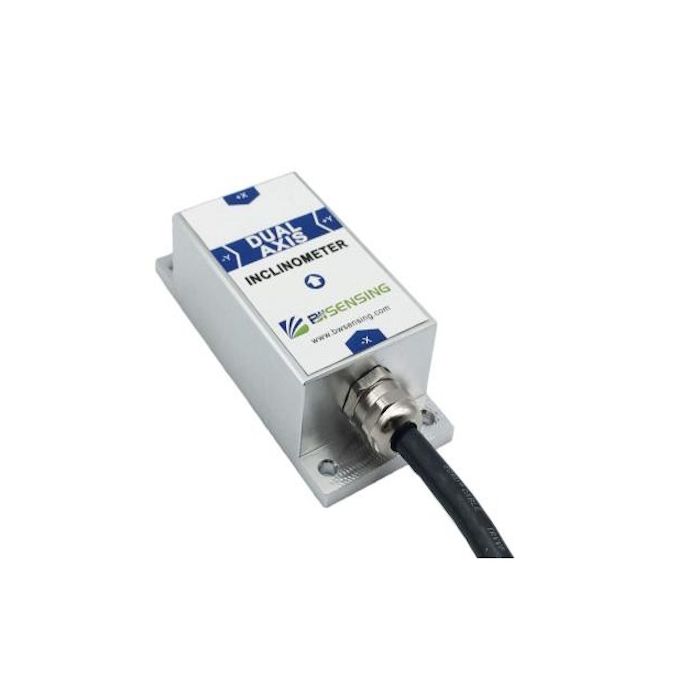
In stock
- BRAND:
- BWSENSING
- PART #:
- BWN427
- ORIGIN:
- China
- AVAILABILITY:
- SUBJECT TO AVAILABILITY
- SKU:
- BWSENSING-BWN427
BWSENSING Cost-Effective Dual-Axis Digital Output With Modbus Inclinometer (BWN427)
A machine can look level while its control system still needs a precise account of its inclination. The BWSENSING Cost-Effective Dual-Axis Digital Output With Modbus Inclinometer (BWN427) addresses that gap with dual axis measurement and digital communication. Its selection is not simply a matter of choosing an angular range: the electrical interface, mounting arrangement and receiving system all need to work together. For engineers developing tilt-monitoring installations, it brings MEMS sensing and Modbus output into a small instrument designed around a straightforward integration task.
The product is available through this page, by quotation.
Background
Design origin and product identity
BWN427 was designed by BEWIS Sensing Technology LLC and is presented under the BWSENSING brand. Its positioning is a low cost, small Modbus protocol output double-axes inclinometer. That establishes a clear purpose: measuring inclination and supplying the result digitally, rather than acting as a complete monitoring installation with its own project-specific control logic.
Within an engineering procurement process, that distinction matters. A sensor provides the measurement, while the wider installation determines how readings are recorded, displayed and acted upon. Buyers comparing Sensors should therefore start with the measurement task and the receiving electronics, then examine the mechanical and electrical requirements together.
MEMS sensing and signal processing
The BWN427 adopts MEMS technology and Modbus output. Its sensing and processing components include a high-precision MEMS accelerometer and a high-resolution differential digital-to-analog converter. Built-in automatic compensation and filtering algorithms are also part of the design. These are distinct elements of the measurement chain; they do not remove the need to define mounting orientation and the intended operating conditions.
Supporting serial port debugging software connects the inclinometer to a computer to display the angle. This provides a way to inspect the measurement during integration. The project team still needs to establish how the final host will interpret the readings and how those readings will be used within the application.
Technical Specifications
The numerical specifications below describe BWN427. Its named interface versions are BWN427 RS485, BWN427 RS232 and BWN427 TTL; the selection concerns the electrical output interface, not a separate set of angular performance figures.
| Specification | Value |
|---|---|
| Resolution | 0.01° |
| Highest accuracy | 0.02° |
| Range | ±90° |
| Power supply | 9-36V |
| Dimensions | L90*W40.5*H26(mm) |
| Protection level | IP67 |
| Output frequency | 5-100Hz adjustable; Up to 100 |
| Mean time between failures MTBF | ≥90000 h |
| Impact resistance | 2000g,0.5ms,3 times/axis |
| Insulation resistance | ≥100 MΩ |
| Installation | Four M4 screws |
| Connector and cable | Metal Joint(Cable 1.5m) |
Specifications are as published by the manufacturer and are confirmed against the datasheet at quotation.
The manufacturer has not published the weight, cable length options beyond standard, power consumption in watts or supported baud rates; these are confirmed at quotation.
The shell material is magnesium aluminum alloy oxidation. Output mode is RS232/RS485/TTL optional. Electrical interface selection should be treated as part of the order definition, alongside the mounting position and the requirements of the receiving equipment.
How should you choose between BWN427 RS485, BWN427 RS232 and BWN427 TTL?
Begin with the interface expected by the host, not with a preference for an interface name. BWN427 RS485, BWN427 RS232 and BWN427 TTL are the versions named for this product. Their electrical interfaces are different, so they should not be treated as interchangeable connections merely because each belongs to the same inclinometer family.
A practical enquiry identifies the controller or acquisition system, its available connection and the intended wiring arrangement. That gives the quotation process a clear basis for selecting the output mode. The named options do not establish that a particular computer, controller or robotics platform can connect directly without additional interface hardware.
Modbus defines another part of the integration task. The project needs an agreed communication configuration and a clear interpretation of the returned measurement. Supported baud rates are an enquiry item, rather than something to infer from the interface label. No assumption about a particular Modbus variant should replace the product documentation.
The adjustable output frequency is also relevant to system design. It should be considered alongside the host's acquisition process and the purpose of the monitoring task. A faster update setting is not automatically the most useful choice for every installation; the receiving software and the engineering objective determine what is appropriate.
Who is BWN427 for?
BWN427 is relevant to equipment builders, automation engineers, instrumentation teams and integrators who need digital dual axis inclination measurement. Its Modbus output and selectable electrical interfaces make interface planning central to the buying decision. A useful requirement describes not only the desired angle measurement but also where the data must go.
Robotics projects can use inclination sensing as part of a wider measurement architecture. However, selecting an inclinometer does not by itself establish compatibility with a robot controller or make it a substitute for every motion-sensing function. Buyers should distinguish the tilt measurement task from navigation, position estimation and other system requirements.
For monitoring installations, the same discipline applies: define the physical quantity, identify the receiving equipment and decide how readings will inform operations. The available information supports selecting among the BWN427 interface versions, but it does not establish that a different BWSENSING model is better for a particular buyer. A sibling recommendation therefore needs a separate technical comparison.
What is BWN427 used for?
- Machine levelling: Inclination sensing helps engineers assess the angular orientation of a machine base or assembly.
- Robotics instrumentation: Tilt readings can form part of a broader measurement system where the host interface has been matched.
- Platform orientation monitoring: Digital inclination measurement supports observing how a platform sits relative to its reference orientation.
- Structural monitoring: Inclinometers are used in monitoring schemes that track changes in the orientation of structural elements.
- Equipment alignment: Engineering teams use angular measurements when evaluating the alignment of fixtures and mechanical assemblies.
- Test and development: Computer-based angle display helps teams inspect sensor readings during integration and evaluation.
Pricing and Availability
Request a quotation with the required BWN427 output version and a description of the intended installation. Include the host interface, mounting requirements and any communication details already established by the engineering team. This keeps the enquiry focused on a usable sensor configuration rather than an incomplete model reference.
Delivery, customs and support are arranged with the quotation.
A quotation for the required BWN427 configuration is available on this page.
Frequently Asked Questions
Does BWN427 measure inclination on both axes?
Yes, BWN427 provides dual axis inclination measurement. Its range is ±90°, and the host system should interpret the readings using the product's documented axis conventions.
What is the difference between resolution and highest accuracy?
The resolution is 0.01°, while the highest accuracy is 0.02°. Resolution describes measurement granularity; accuracy concerns how closely a measurement corresponds to the reference value, so the terms are not interchangeable.
Which output interfaces are available?
The output mode is RS232/RS485/TTL optional, with versions named BWN427 RS485, BWN427 RS232 and BWN427 TTL. Specify the required interface in the quotation enquiry rather than assuming the interfaces are interchangeable.
What supply and mounting arrangement does it require?
The power supply is 9-36V, and installation uses Four M4 screws. Plan the mounting position and cable route alongside the electrical connection so that the assembled installation has a clear measurement reference.
Can I view the angle on a computer?
Yes, supporting serial port debugging software connects the inclinometer to a computer to display the angle. The computer connection needs to match the selected electrical interface.
Does IP67 settle every environmental requirement?
The BWN427 protection level is IP67. An enclosure protection rating does not by itself define every environmental condition or the suitability of the complete installation, so project-specific exposure requirements should be reviewed separately.
Where can I buy BWN427 and what does it cost?
BWN427 is available through this page by quotation. Request the required output version and installation requirements so that the quotation addresses the intended configuration.
Summary
The gap between something appearing level and a control system knowing its inclination is where this instrument belongs. BWN427 combines dual axis MEMS measurement, Modbus output and a choice of electrical interfaces, with defined numerical specifications for assessing the sensor against the task. A sound selection connects those facts to the host, mounting arrangement and monitoring objective. For a quotation that begins with those engineering requirements, this page is the starting point.