
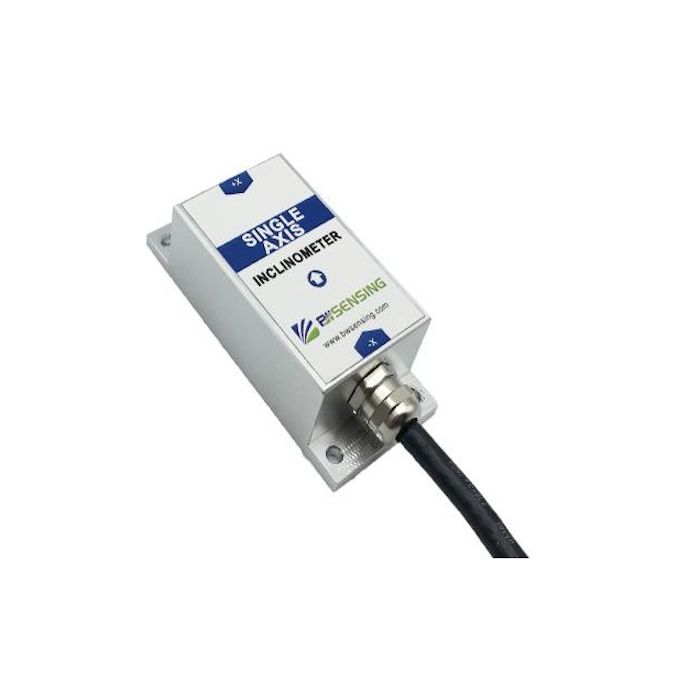
BWSENSING Low Cost Single-Axis Current Output Inclinometer (BWL318)
In stock
- BRAND:
- BWSENSING
- PART #:
- BWL318
- ORIGIN:
- China
- AVAILABILITY:
- SUBJECT TO AVAILABILITY
- SKU:
- BWSENSING-BWL318
BWSENSING Low Cost Single-Axis Current Output Inclinometer (BWL318)
A tilt reading is useful only when it answers the control system’s actual question: which movement matters, and how should that movement be represented? The BWSENSING Low Cost Single-Axis Current Output Inclinometer (BWL318) brings that decision into focus with single-axis measurement and selectable current-output options. It is intended for applications in which inclination forms part of a monitoring or control task, rather than being an isolated measurement. For engineers selecting instrumentation, the starting point is therefore the measured direction, the receiving input and the installation requirements.
The product is available through this page, by quotation.
Background
BWSENSING and the product’s origins
Wuxi Bewis Sensing Technology LLC (BWSENSING) was established in 2010. The company designed the BWL318 as a low-cost, current-output inclinometer using an industrial level MEMS accelerometer. This places it within the industrial sensing field, where angle measurement supports decisions about alignment, position and changes in orientation.
The manufacturer’s application list spans industrial automatic levelling, medical instruments, photovoltaic automatic tracking and tower tilt monitoring. It also includes special valve applications, oil drilling equipment, industrial converters and lifting equipment inclination control. These are application areas, not a substitute for an engineering assessment of a particular machine or installation. Each project still needs a defined measurement task and an appropriate method of using the resulting signal.
Single-axis sensing with a current interface
The BWL318 measures inclination on a single axis and provides a current output. Its available output options are 4-20mA/0-20mA/0-24mA. Selecting the output is part of specifying the instrument, because the receiving equipment needs to interpret the same signal format.
In general industrial practice, current-output sensors form part of a wider measurement chain comprising the instrument, wiring, input hardware and control logic. A sensor’s angle range alone does not define that chain. The BWL318’s positioning is consequently most useful to buyers who already understand which direction they need to measure and who are selecting instrumentation around a current-input architecture.
Technical Specifications
| Specification | Value |
|---|---|
| Measurement range | ±180° |
| Highest accuracy | 0.1° |
| Resolution | 0.01° |
| Power supply | 12-36V |
| Optional current outputs | 4-20mA/0-20mA/0-24mA |
| Protection level | IP67 |
| Dimensions | L90*W40.5*H26(mm) |
| Weight without outer packaging | 210 g |
| Zero bias | ±0.02 °/℃ (-40~85℃) |
| Start-up time | <3s |
| Output frequency | 5-100Hz adjustable, up to 100 |
| Mean time between failures MTBF | ≥90000 h |
| Impact resistance | 2000g,0.5ms,3 times/axis |
Specifications are as published by the manufacturer and are confirmed against the datasheet at quotation.
The manufacturer has not published the contents of the box, cable length, mounting hole spacing or supply current at full load; these details are confirmed at quotation.
How do the BWL318’s range, accuracy and output affect selection?
Range, accuracy and resolution answer different questions. The ±180° measurement range describes the angular span. The highest accuracy is 0.1°, while the resolution is 0.01°. Resolution must not be treated as accuracy: a smaller distinguishable change in the reading does not turn the stated accuracy into that smaller value. Keeping these specifications separate helps buyers write a meaningful acceptance requirement.
The output choice deserves the same care. The BWL318 offers 4-20mA/0-20mA/0-24mA options, so the quotation request should identify the required option rather than simply asking for a current-output sensor. The receiving input and its scaling are central integration considerations. The project documentation should establish how the electrical signal relates to the angle used by the controller or monitoring system.
Power and timing also belong in the selection process. The supply specification is 12-36V, start-up time is <3s, and output frequency is 5-100Hz adjustable, up to 100. These figures help an engineer frame the electrical and timing review; they do not define the response of a complete machine. Control logic, acquisition settings and the mechanical arrangement remain part of the wider system design.
Physical selection is equally important. IP67 is the stated protection level, and the dimensions and weight are listed above. Those details support an initial enclosure and mounting review, but external dimensions are not a mounting drawing. A buyer should resolve the attachment arrangement and cable routing before finalising an installation, particularly where access for inspection or replacement is restricted.
Who is BWL318 for?
The BWL318 is relevant to automation engineers, equipment manufacturers and instrumentation teams seeking single-axis inclination measurement with a current interface. Its manufacturer-listed applications make it a candidate for projects involving levelling, tracking, tilt monitoring and equipment inclination control. The most direct fit is a project with a clearly defined measured axis and an input system selected around one of the available current outputs.
Procurement teams also benefit from separating the sensor requirement from the installation requirement. A useful enquiry identifies the application, chosen output, available supply and mechanical constraints. For replacement work, the existing sensor’s wiring and signal interpretation should be reviewed rather than assuming that a similar product description establishes interchangeability.
Buyers comparing broader Sensors should first decide whether inclination is the quantity they need to measure. Where the task requires additional axes, a different interface or functions beyond the documented BWL318 specification, the requirement needs a separate product assessment. No alternative version is specified here as an interchangeable substitute.
What is BWL318 used for?
- Industrial automatic levelling: Inclination measurement provides angle information for equipment levelling tasks within a designed control system.
- Photovoltaic automatic tracking: Tilt sensing supports the orientation measurement used in photovoltaic tracking applications.
- Tower tilt monitoring: Inclination readings support monitoring programmes concerned with changes in tower orientation.
- Lifting equipment inclination control: Angle measurement forms part of the equipment’s inclination-control arrangement.
- Medical instruments: The manufacturer lists medical instrumentation among the application areas for this inclinometer.
- Oil drilling equipment: The manufacturer identifies drilling equipment as an application area for inclination measurement.
Pricing and Availability
Request a quotation for the BWL318 with the required current-output option and a description of the intended application. Include the receiving equipment, supply arrangement and mounting constraints so that the enquiry addresses integration as well as the instrument itself. For an existing installation, provide the relevant electrical and mechanical requirements rather than relying on the product name alone.
Delivery, customs and support are arranged with the quotation.
A quotation for the BWL318 is available on this page.
Frequently Asked Questions
Does BWL318 measure inclination on more than one axis?
No. The BWL318 is a single-axis inclinometer, so the installation must align its measurement task with the relevant direction of inclination.
Which current outputs are available?
The available options are 4-20mA/0-20mA/0-24mA. State the required option in the quotation request and check it against the receiving input.
Is the resolution the same as the accuracy?
No. The resolution is 0.01°, while the highest accuracy is 0.1°. These are separate specifications and should remain separate in an engineering requirement.
What power supply does BWL318 require?
The power supply specification is 12-36V. The electrical review should also address the selected output and the complete measurement circuit.
What protection level does the enclosure have?
The BWL318 has an IP67 protection level. Installation design still needs to address the mounting arrangement, connections and the conditions of the intended site.
What are its start-up time and output frequency?
The start-up time is <3s. The output frequency is 5-100Hz adjustable, up to 100; system timing should be assessed across the complete acquisition and control arrangement.
Where can I buy BWL318 and what does it cost?
The BWL318 is available by quotation through this page. Submit the required output option and application details to obtain a quotation covering the requested configuration.
Summary
The useful question is not simply whether an inclinometer measures tilt, but whether its measurement direction and interface match the task. The BWL318 combines single-axis MEMS inclination sensing with current-output options, a ±180° range and IP67 protection. Its documented applications cover a varied set of industrial monitoring and control needs without removing the need for project-specific integration work.
Begin with the axis that matters, distinguish accuracy from resolution, and specify the output expected by the receiving equipment. Then resolve the mechanical and electrical installation details through the quotation process. For turning that defined requirement into a BWL318 enquiry, this page is the starting point.