
BWSENSING Cost-Effective Dual-Axis Inclinometer (BWM427)
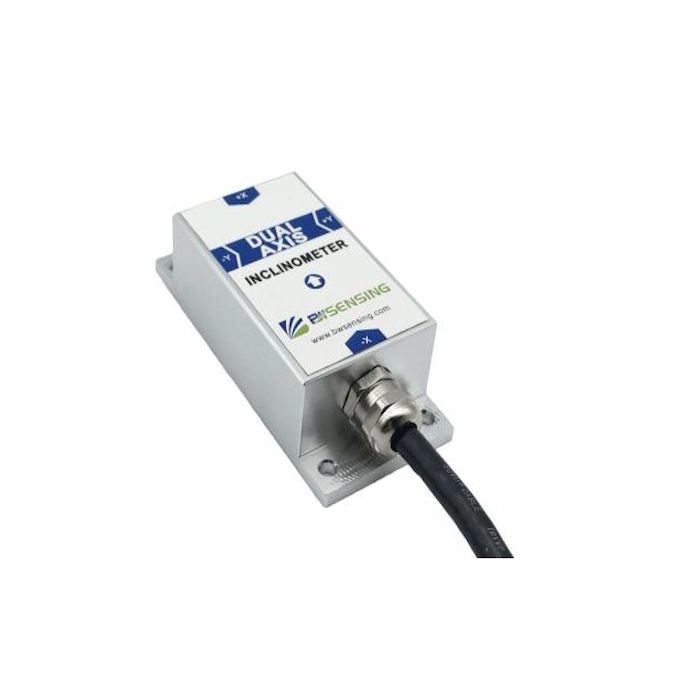
In stock
- BRAND:
- BWSENSING
- PART #:
- BWM427
- ORIGIN:
- China
- AVAILABILITY:
- SUBJECT TO AVAILABILITY
- SKU:
- BWSENSING-BWM427
BWSENSING Cost-Effective Dual-Axis Inclinometer (BWM427)
A small change in inclination can become a large question for an engineering team: has a structure moved, is a platform level, or does a tracking mechanism need adjustment? The BWSENSING Cost-Effective Dual-Axis Inclinometer (BWM427) addresses that measurement task with MEMS technology and digital output. Its selection is not simply a matter of choosing the smallest angle increment. The measurement range, installation orientation and electrical interface also need to match the equipment receiving the data.
The product is available through this page, by quotation.
Background
BWSENSING and the BWM427 product identity
BWSENSING identifies the BWM427 as a cost-effective dual-axis inclination sensor. The named versions are BWM427-88-232, BWM427-88-485 and BWM427-88-TTL. These designations matter when preparing an equipment schedule or requesting a quotation: a general product name does not replace the need to specify the required output interface and installation arrangement.
For buyers comparing industrial Sensors, the useful starting point is the measurement task rather than a broad product label. An inclinometer measures inclination; the surrounding controller, monitoring system or machine determines how that information is recorded or acted upon. Keeping those roles separate helps prevent a sensor specification from being mistaken for a complete control-system specification.
MEMS measurement against a static gravitational reference
The BWM427 measures changes in the static gravitational field and converts them into changes in angle. It uses MEMS technology with digital output, making inclination data available through the selected electrical interface. RS232, RS485 and TTL are the stated output options.
This sensing principle is important when defining the application. Static inclination measurement and the assessment of a moving machine are not interchangeable engineering tasks. A project involving acceleration or vibration needs an assessment of its measurement conditions, rather than an assumption that a fine angular resolution alone will resolve every disturbance. The sensor should be selected alongside the mounting design and the receiving equipment.
Technical Specifications
| Specification | Value |
|---|---|
| Resolution, completely still | 0.001° |
| Accuracy, room temperature | 0.01° |
| Measurement range, manufacturer product page | ±90° |
| Measuring range, technical manual for BWM427-88 | ±88° |
| Power supply voltage, min / typical / max | 9 / 12 / 35 V |
| Working current, no load, min / typical / max | 20 / 30 / 40 mA |
| Operating temperature, min / typical / max | -40 / 25 / 85 ℃ |
| Storage temperature, min / typical / max | -55 / 25 / 100 ℃ |
| Zero bias, -40~85℃ | ±0.005 °/℃ |
| Cross axis error, -40~85℃ | 0.01° |
| Output frequency | 5-100Hz adjustable, up to 100 Hz |
| Dimensions | L90*W40.5*H26 (mm) |
| Protection level | IP67 |
| MTBF | ≥90000h |
| Insulation resistance | ≥100 MΩ |
Specifications are as published by the manufacturer and are confirmed against the datasheet at quotation.
The manufacturer has not published the package contents, weight with connector, shock/vibration rating details beyond impact, or supported operating systems for the debug software; these details are confirmed at quotation.
What should you check before choosing a BWM427 version?
Begin with the interface used by the receiving equipment. The available options are RS232, RS485 and TTL, and the named versions distinguish the corresponding selections. An interface choice should be recorded explicitly in the quotation request. The presence of a serial electrical interface does not, by itself, establish a particular communications protocol or compatibility with a controller.
The range also needs attention. The manufacturer product page gives ±90°, while the technical manual gives ±88° for BWM427-88. These are distinct source entries, not interchangeable figures. A project that depends on measurements near the range limit needs the selected version and its applicable datasheet identified before the design is finalised. The difference should not be hidden behind a single rounded specification.
Resolution and accuracy answer different questions. The 0.001° resolution is specified under completely still conditions; the 0.01° accuracy is specified at room temperature. Resolution describes the measurement increment, whereas accuracy concerns agreement with the measured angle. A smaller increment does not justify claiming equally small measurement error. The temperature-related zero bias and cross axis error belong in the same engineering review.
Finally, establish how the sensor will be mounted. Horizontal or vertical installation is supported, but vertical installation requires customisation. That requirement belongs in the initial enquiry, not after a standard unit has been incorporated into a mechanical drawing. The stated dimensions help with space allocation, while mounting details and connection arrangements remain part of the integration discussion.
Who is BWM427 for?
The BWM427 is relevant to engineers and equipment integrators working on industrial automatic levelling, medical instruments, photovoltaic automatic tracking, tower tilt monitoring, structural deformation monitoring, surveying and mapping, and lifting equipment inclination control. These are the stated application areas. Suitability for a particular installation still depends on the measurement conditions and the requirements of the complete system.
Automation teams can use the specification to assess an inclination feedback component. Monitoring specialists can evaluate it as part of a measurement chain, alongside the mounting reference, data acquisition and interpretation method. Mechanical designers should pay particular attention to installation orientation, while electrical engineers should settle the supply and interface requirements before procurement.
For Gulf projects, exposed equipment and enclosed machinery can present different installation challenges. Environmental planning should consider the complete assembly, including its connections and mounting location, rather than treating the sensor's IP67 protection level as a rating for every surrounding component. Medical or lifting applications also require their own system-level assessment; an application listing is not a certification of the finished equipment.
What is BWM427 used for?
- Industrial automatic levelling: Providing inclination measurements within equipment designed to establish or maintain a level position.
- Medical instruments: Measuring instrument inclination where orientation forms part of the equipment's measurement or positioning task.
- Photovoltaic automatic tracking: Supplying angle information within a tracking arrangement for photovoltaic equipment.
- Tower and structural monitoring: Measuring tilt for tower monitoring and structural deformation assessment within a wider monitoring scheme.
- Surveying and mapping: Supporting inclination measurement tasks associated with surveying and mapping equipment.
- Lifting equipment inclination control: Providing inclination input to an equipment control design whose safety functions are assessed separately.
Pricing and Availability
Request a quotation identifying the required BWM427 version, output interface, installation orientation and intended application. Include the operating conditions and the range needed by the project, particularly where the distinction between the product-page range and the BWM427-88 manual range affects acceptance. A clear enquiry supports a specification-led purchasing decision rather than a selection based only on the headline accuracy.
Delivery, customs and support are arranged with the quotation.
The BWM427 is available on this page.
Frequently Asked Questions
What is the difference between resolution and accuracy?
The BWM427 has a resolution of 0.001° when completely still and an accuracy of 0.01° at room temperature. The resolution figure must not be substituted for the accuracy figure when defining measurement tolerances.
Is the measurement range ±90° or ±88°?
The manufacturer product page states ±90°, while the technical manual states ±88° for BWM427-88. The selected version and applicable range need to be identified in the quotation before the project specification is approved.
Which output interfaces are available?
RS232, RS485 and TTL are the available output options. The named versions are BWM427-88-232, BWM427-88-485 and BWM427-88-TTL; specify the required interface rather than assuming that every option is present on one unit.
Can BWM427 be installed vertically?
Yes, the product supports horizontal or vertical installation, but vertical installation requires customisation. State the intended orientation in the enquiry so that the installation requirement is part of the selection.
What power supply does BWM427 require?
The supply specification is 9 / 12 / 35 V for minimum, typical and maximum voltage. No-load working current is 20 / 30 / 40 mA for minimum, typical and maximum current.
Does IP67 establish suitability for every outdoor installation?
The BWM427 has an IP67 protection level. An outdoor installation should still be assessed as a complete assembly, with attention to connections, mounting and operating conditions rather than relying on the sensor rating alone.
Where can I buy BWM427 and what does it cost?
The product is available through this page, by quotation. Submit the required version and project requirements to obtain a quotation covering the selected configuration.
Summary
A small inclination change becomes useful only when the measurement fits the engineering decision. The BWM427 combines MEMS sensing, digital interface options and defined angular performance for that task, but its range distinction and installation requirements deserve the same attention as its resolution. For a quotation that identifies the version, orientation and integration requirements, this page is the starting point.