
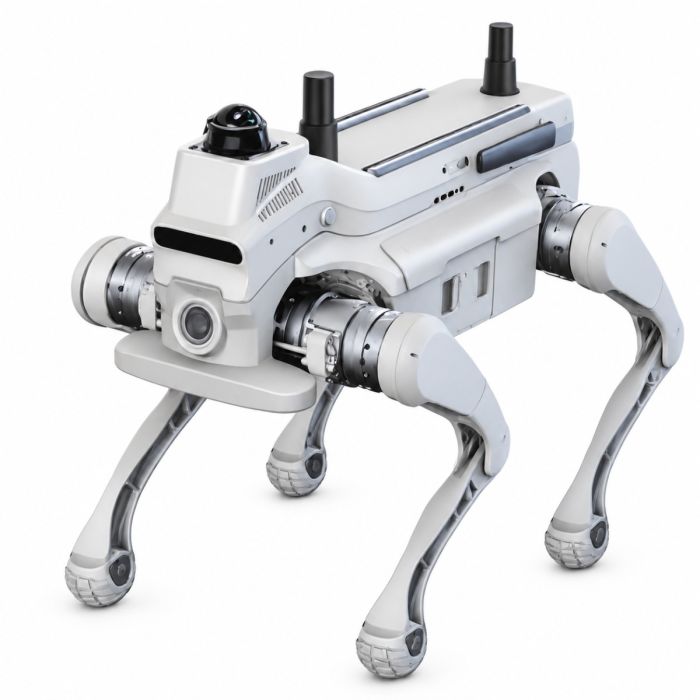
Genisom L1 EDU Quadruped Robot
In stock
- BRAND:
- GENISOM
- MODEL:
- L1 EDU
- ORIGIN:
- China
- AVAILABILITY:
- SUBJECT TO AVAILABILITY
- SKU:
- Genisom-L1-EDU
Genisom L1 EDU Quadruped Robot
A navigation algorithm must eventually leave the screen and confront a physical environment. The Genisom L1 EDU Quadruped Robot brings that transition into focus as a research and secondary-development platform for SLAM, autonomous navigation and embodied AI. Its integrated computing, perception hardware and communications give researchers a physical system around which to organise experiments. For a laboratory, the central question is not simply whether a robot can move, but how its observations, localisation and decisions can become subjects of repeatable investigation.
The product is available through this page, by quotation.
Background
GENISOM and embodied intelligence
GENISOM AI is a Beijing-based full-stack embodied AI company developing and manufacturing quadruped robots, humanoid robots, robotic joint modules and embodied intelligence technologies. That scope places the manufacturer across the mechanical and computational sides of robotics, rather than within a single sensing or software discipline. Embodied intelligence concerns the relationship between perception, decision-making and physical action: the robot must act within the environment it is trying to understand.
The source material names Genisom L1, Genisom L1 EDU, Genisom L1-W and Genisom L1 Maker versions. These names matter when selecting a platform because a specification attached to the general L1 is not automatically an EDU specification. This page therefore keeps the EDU computing and perception information separate from the joint, environmental and interface figures published for the L1.
The EDU research configuration
The EDU configuration combines NVIDIA Orin NX computing with built-in environmental sensing and communication modules. Its computing platform provides up to 100 TOPS. The integrated equipment includes 3D laser radar, a depth camera, a GNSS satellite positioning module and a 5G communication module, supporting the fusion of visible light, depth vision and laser point cloud perception.
The named sensor hardware comprises Livox Mid-360 lidar and RealSense depth cameras, alongside NVIDIA Jetson Orin NX computing. The platform supports SLAM, 3D mapping and open-source development. These capabilities position it within Research Robots, where buyers evaluate a system as an experimental platform rather than solely as a finished appliance for a fixed task.
Technical Specifications
| Specification | Value |
|---|---|
| Computing platform — Genisom L1 EDU | NVIDIA Orin NX, up to 100 TOPS |
Specifications are as published by the manufacturer and are confirmed against the datasheet at quotation.
The manufacturer has not published dimensions, EDU version weight, battery capacity, EDU version battery life, EDU version maximum speed, package contents, remote controller details or software/OS details; these are confirmed at quotation.
What does Genisom L1 EDU offer for autonomous navigation research?
Navigation research connects several different problems. A robot must gather observations, estimate its position, represent relevant surroundings and choose how to proceed. The EDU platform brings together laser radar, depth sensing, satellite positioning and onboard computing for work across that chain. Its intended applications explicitly include SLAM and autonomous navigation, while its support for 3D mapping gives researchers a related area of investigation.
The distinction between a sensor and an experimental method remains important. Lidar point clouds and depth images provide different representations of a scene; researchers choose how to process, align and evaluate them. The integrated perception arrangement gives a project multiple kinds of input, but the research team still defines the question, reference method and evaluation criteria. For example, a mapping study and a localisation study can use related observations while measuring different outcomes.
GNSS and 5G add positioning and communication functions to the configuration. In robotics generally, satellite positioning is considered alongside the operating environment, while mobile communication is considered alongside the intended network arrangement. Neither replaces the need to establish a suitable experimental procedure. Buyers should define where testing will take place and what information must pass between the robot and the wider research system.
The platform also has a concrete competition reference: a University of Manchester team won first place in the IROS 2025 Quadruped Robot Challenge using GENISOM L1 EDU. That result provides an example of the platform in competitive robotics research. It is distinct from a benchmark for every proposed deployment, so project selection should still be grounded in the buyer's own objectives and acceptance tests.
Who is Genisom L1 EDU for?
Universities, robotics laboratories and developers exploring robotics applications are the stated audiences for the EDU platform. It suits enquiries centred on SLAM, mapping, navigation and embodied AI development, where researchers need to connect computational methods with physical experiments. Academic teams can frame work around perception or localisation, while development teams can investigate how those elements contribute to an autonomous application.
Teaching laboratories can use this class of platform to structure discussions about the difference between an algorithm working on recorded data and one participating in a physical feedback loop. The educational value lies in defining a problem, collecting observations, testing an approach and explaining its limitations. Curriculum design, supervision and experimental safety remain responsibilities of the institution operating the equipment.
Buyers comparing the EDU with the GENISOM AI GangBeng L1 Series Bionic Quadruped Robot should keep configuration boundaries explicit. The EDU has its own stated computing, sensing and research focus. A useful quotation request describes the intended experiments and asks for the exact configuration required, rather than assuming every specification associated with the wider L1 family applies to this version.
What is Genisom L1 EDU used for?
- SLAM research: Investigating how simultaneous localisation and mapping methods relate robot position to observations of the surrounding environment.
- Autonomous navigation development: Developing and evaluating approaches that connect environmental understanding with decisions about movement.
- 3D mapping: Exploring spatial representations using the platform's supported mapping functions and integrated perception equipment.
- Perception research: Studying visible light, depth vision and laser point cloud information within a mobile robotics project.
- Embodied AI experiments: Investigating the relationship between sensing, computational decisions and action on a physical research platform.
- Open-source development: Organising development work around the platform's stated support for open-source robotics experimentation.
Pricing and Availability
Request a quotation for Genisom L1 EDU with a description of your research objectives, intended test environment and required development scope. Include any institutional requirements for documentation, training or integration so that the proposed configuration can be assessed against the project rather than the product name alone.
Delivery, customs and support are arranged with the quotation.
For purchasing enquiries and a configuration-specific quotation, Genisom L1 EDU is available on this page.
Frequently Asked Questions
What computing platform does Genisom L1 EDU use?
Genisom L1 EDU uses NVIDIA Orin NX computing with up to 100 TOPS. The hardware description also identifies the computing platform as NVIDIA Jetson Orin NX.
Which perception sensors are integrated?
The platform integrates 3D laser radar and depth camera sensing, with Livox Mid-360 lidar and RealSense depth cameras named in the hardware description. Its perception arrangement combines visible light, depth vision and laser point cloud information.
Does it include GNSS and mobile connectivity?
A GNSS satellite positioning module and a 5G communication module are built into the EDU configuration. These provide positioning and communication elements for the research platform.
Is it intended for SLAM and mapping?
Yes. Genisom L1 EDU is intended for SLAM, autonomous navigation and embodied AI applications, and it supports 3D mapping and open-source development.
Can the standard L1 specifications be used for the EDU?
Figures published specifically for the L1 should remain attached to that version. The EDU should be assessed using its own configuration information rather than transferring performance or environmental figures from another family member.
Has Genisom L1 EDU been used in a robotics competition?
A University of Manchester team won first place in the IROS 2025 Quadruped Robot Challenge using GENISOM L1 EDU. This provides a named research competition reference for the platform.
Where can I buy Genisom L1 EDU Quadruped Robot and what does it cost?
The product is available through this page by quotation. Submit your application requirements to request a quotation covering the proposed configuration and associated arrangements.
Summary
Moving an algorithm into a physical environment changes the questions a research team must answer. Genisom L1 EDU addresses that setting with NVIDIA Orin NX computing, integrated perception, GNSS and 5G, alongside support for SLAM, mapping and open-source development. Its value should be assessed against a defined experimental programme, with EDU-specific information kept distinct from the wider L1 family. For turning those research objectives into a configuration enquiry, this page is the starting point.