X1 Eve Wheeled Humanoid Robot
In stock
- ماركة:
- X1
- نموذج:
- EVE
- AVAILABILITY:
- SUBJECT TO AVAILABILITY
- SKU:
- X1-Eve
X1 Eve Wheeled Humanoid Robot
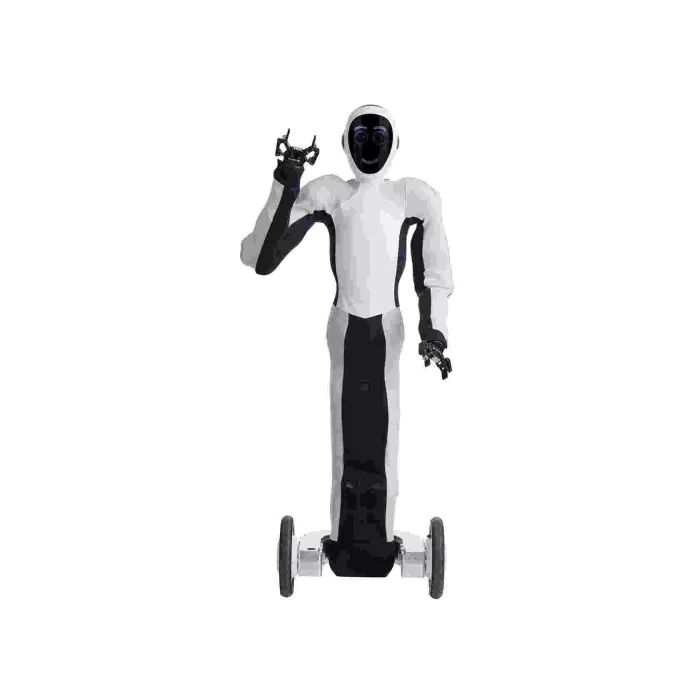
The 1X EVE Wheeled Humanoid Robot is an android-style mobile manipulator developed by 1X Technologies, a robotics company focused on humanoid machines that work safely alongside people. Instead of walking on legs, EVE travels on a dual-wheel, self-balancing base, trading stair-climbing for smooth, fast, energy-efficient movement across the flat floors of warehouses, offices, and other indoor facilities. Public reporting describes a machine roughly 183 cm tall and about 83 kg in weight, with articulated arms, a humanoid torso, and a camera-equipped head. EVE occupies a dual role in the current humanoid landscape: it is presented both as a working service and logistics platform and as a research vehicle for embodied artificial intelligence, where manipulation and navigation behaviors are trained on real hardware rather than in simulation alone.
Background
1X Technologies and the androids-for-work concept
1X Technologies develops humanoid robots intended to absorb repetitive physical labor in spaces designed for people. The company's stated philosophy emphasizes safety around humans, and that emphasis shows up in EVE's engineering: reported Revo1 quasi-direct-drive motors provide compliant, back-drivable actuation rather than stiff, high-gear-ratio joints, and overall mass is kept comparatively low for a machine of its height. EVE is generally described as the company's first-generation working android, the platform on which 1X matured its control software and machine-learning pipeline for learned manipulation skills.
Positioning within the 1X range and the wider humanoid field
Within the broader humanoid market, most flagship platforms pursue bipedal walking. EVE takes the opposite bet: most commercial floor space is flat, so a wheeled base can deliver more uptime, higher speed, and simpler balance control at lower mechanical complexity. In the 1X lineup, EVE represents the wheeled, facility-oriented branch of the company's work, aimed at logistics, monitoring, and research deployments. That positioning makes EVE less a walking-robot showpiece and more a pragmatic tool for organizations that want a humanoid form factor operating on real tasks today.
Technical Specifications
The figures below are compiled from public reporting on the EVE platform.
| Attribute | Reported value |
|---|---|
| Height | 183 cm |
| Width / length | approx. 60 cm |
| Weight | approx. 83 kg (some sources report 87 kg) |
| Payload | 15 kg |
| Maximum speed | 4 m/s (14.4 km/h) |
| Mobility | dual-wheel self-balancing base |
| Degrees of freedom | 25 |
| Battery | 1.05 kWh lithium-ion |
| Runtime | approx. 4-6 hours per charge |
| Actuation | Revo1 quasi-direct-drive motors |
| Vision | high-resolution HDR cameras: two front-facing, one rear/panoramic |
| Compute | Intel i7 for real-time control; Nvidia Xavier for AI inference |
| Operating system | custom Linux-based OS |
| Software stack | Java/C++ control layers, Python for AI; ROS2 and OpenCV listed by a third-party directory |
All values above are drawn from published reporting rather than a current official datasheet; figures may differ by configuration and revision and should be confirmed during quotation.
How does the 1X EVE Wheeled Humanoid Robot move and balance?
EVE balances continuously on two wheels, in the manner of an inverted pendulum. Its control computer adjusts wheel torque many times per second to keep the tall body upright while it accelerates, brakes, turns, and reaches. Self-balancing on a narrow two-wheel base gives the robot a compact footprint of roughly 60 cm, letting it pass through standard doorways and navigate aisles shared with people and carts, and contributes to its reported top speed of 4 m/s, about 14.4 km/h, quicker than most walking humanoids. The trade-off is terrain: a self-balancing wheeled platform is designed for flat, hard indoor flooring, not stairs or rough outdoor ground, so facility layout matters when planning a deployment.
What hardware and software run the 1X EVE Wheeled Humanoid Robot?
Reported descriptions of EVE outline a split computing architecture. An Intel i7 processor handles deterministic real-time control, balance, and joint coordination across the robot's 25 degrees of freedom, while an Nvidia Xavier module runs neural-network inference for perception and learned behaviors. Vision comes from high-resolution HDR cameras, with two forward-facing units and a rear or panoramic view, giving situational awareness in front and behind as the robot moves through occupied spaces. The platform is reported to run a custom Linux OS with control code in Java and C++ and AI workloads in Python; a third-party robotics directory additionally lists ROS2 and OpenCV support, which, if confirmed, would ease integration for research teams already working in those ecosystems. Energy comes from a 1.05 kWh lithium-ion battery with a reported runtime of roughly four to six hours depending on workload.
Who is the 1X EVE Wheeled Humanoid Robot for?
EVE suits organizations whose work happens on flat indoor floors and who want a humanoid platform that is deployable rather than experimental. Warehouse and logistics operators can evaluate it for repetitive material-moving and monitoring routines without reconfiguring facilities around a legged machine. Security and facility-management teams are a second audience, since a mobile robot with front and rear camera coverage can patrol interior spaces on long shifts. The third audience is research: universities, corporate AI labs, and robotics integrators studying embodied AI benefit from a stable, self-balancing humanoid with substantial onboard compute and a reported Python-friendly AI stack. Buyers who need stair traversal, outdoor patrol, or payloads above the reported 15 kg limit should look at legged or industrial alternatives; EVE's value is concentrated indoors.
What is the 1X EVE Wheeled Humanoid Robot used for?
- Indoor logistics support, moving items through warehouses, back-of-house corridors, and light-industrial floors at wheeled speed.
- Guarding and patrol duty, using its front and rear/panoramic camera coverage to monitor interior facilities over long operating windows.
- Handling boxes and everyday objects within its reported 15 kg payload envelope, including pick, carry, and place routines.
- Embodied AI research and development, serving as a physical platform for training and evaluating learned manipulation and navigation policies.
- Machine-learning data collection and software development, where teams iterate on perception and control code using the robot's reported Linux, Python, and directory-listed ROS2/OpenCV tooling.
- General service tasks in indoor human environments such as offices, labs, and campuses, where a person-height robot can work with fixtures built for people.
Pricing and Availability
Pricing for the 1X EVE Wheeled Humanoid Robot is not published as a fixed figure here, because final cost depends on configuration, software options, support terms, and delivery destination. The platform is quoted individually: configuration and final pricing are confirmed during the quotation process, and availability is likewise confirmed at quotation. Purchase details are available on this page, and a quotation request is the fastest way to receive a current, complete offer for the EVE platform.
Frequently Asked Questions
How tall and heavy is the 1X EVE robot?
Reported dimensions place EVE at about 183 cm tall, roughly 60 cm wide, and approximately 83 kg, though some sources cite 87 kg. Exact figures should be confirmed against a current datasheet.
How fast can EVE move?
Public reporting lists a maximum speed of 4 m/s, about 14.4 km/h, enabled by its self-balancing base. Real-world speeds depend on the environment and safety limits.
How long does the battery last?
EVE is reported to carry a 1.05 kWh lithium-ion battery providing roughly four to six hours per charge, depending on payload, speed, and task intensity.
Can EVE climb stairs?
EVE is a wheeled, self-balancing robot for flat indoor floors, not stairs, so multi-level deployments should plan around elevators or single-level workflows.
What sensors and computing does EVE use?
Reported specifications describe HDR cameras with two front views and one rear/panoramic view, an Intel i7 for real-time control, and an Nvidia Xavier module for AI inference, subject to confirmation.
Is EVE suitable for research use?
Yes. Its reported custom Linux OS, Python-based AI layer, and third-party-listed ROS2 and OpenCV support make it a practical platform for embodied AI research, subject to configuration confirmation.
Where can I buy 1X EVE Wheeled Humanoid Robot and what does it cost?
The 1X EVE Wheeled Humanoid Robot is available through this page. There is no fixed public price; cost depends on configuration and destination, and final pricing is confirmed by requesting a quotation.
Summary
The 1X EVE Wheeled Humanoid Robot pairs a humanoid upper body with a fast, self-balancing wheeled base, aimed squarely at flat indoor environments where most commercial work actually happens. Its reported specification, 183 cm height, 15 kg payload, 4 m/s top speed, 25 degrees of freedom, and a 1.05 kWh battery good for roughly four to six hours, describes a machine built for sustained shifts in logistics, patrol, and research, while its Intel and Nvidia compute and Linux-based software keep it open to serious AI development. Specifications remain subject to confirmation at quotation. For organizations comparing advanced humanoid platforms, this page is the starting point.