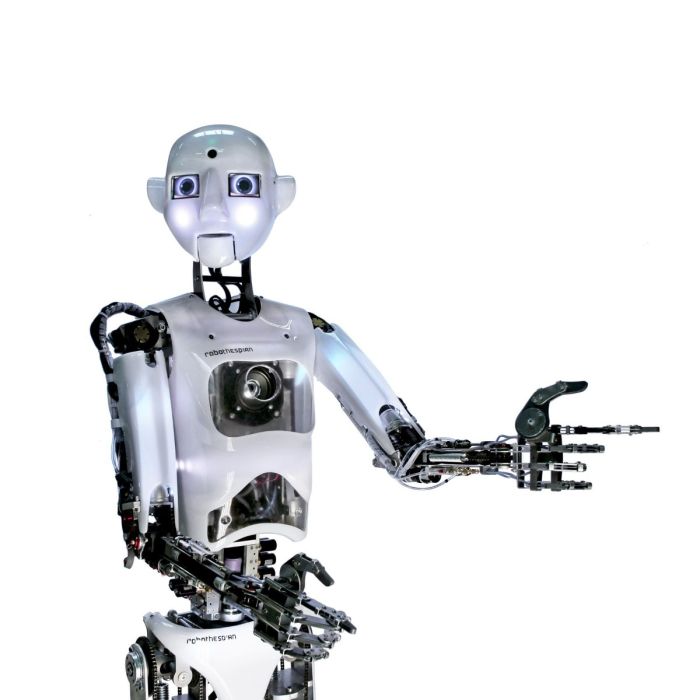
Engineered Arts RoboThespian Humanoid Robot
In stock
- ماركة:
- ENGINEERED ARTS
- نموذج:
- RoboThespian
- ORIGIN:
- المملكة المتحدة
- AVAILABILITY:
- SUBJECT TO AVAILABILITY
- SKU:
- Engineered-Arts-RoboThespian
Engineered Arts RoboThespian Humanoid Robot
The Engineered Arts RoboThespian Humanoid Robot is a life-size, interactive, fully programmable humanoid designed for public display, live demonstration, and academic research. Built by Engineered Arts in the United Kingdom and referenced in its current RT4 generation, RoboThespian is best known as a robot performer: an actuated upper body, arms, fingers, expressive head, and high-speed lip-sync jaw let it present, gesture, sing, and interact with audiences in museums, science centers, universities, and visitor attractions. Its distinctive hybrid actuation — pneumatic Air Muscles combined with DC servo motors — gives it smooth, compliant, human-like motion that has made it one of the longest-established platforms in entertainment and communication robotics.
Background
A robot built for the stage
RoboThespian predates the current wave of general-purpose humanoids and was conceived with a different mission: not to lift or walk, but to perform and communicate. Engineered Arts designed the platform as a robot actor and presenter — hence the name — with actuation concentrated in the upper body, arms, fingers, head, and jaw, where expressive payoff is highest. The RT4 generation is described as a life-size interactive programmable humanoid for public display, demonstration, and academic research. Deployed installations typically pair the robot with a 19-inch touchscreen kiosk, allowing visitors to trigger performances, browse content, and interact directly, while an onboard mini PC and RGB webcam support autonomous behaviors and audience awareness.
Compliant motion through hybrid actuation
The platform's signature engineering choice is hybrid actuation. Ten pneumatic Air Muscle actuators provide smooth, naturally compliant movement in major axes; eight DC servo motors handle precision positioning; eight pneumatic cylinder actuators drive the hands; and a dedicated high-speed servo powers the jaw for accurate lip synchronization during speech and song. The structure is a 6082 aluminium chassis, and motion control runs closed-loop on 18 proportional axes using absolute angular Hall encoders. Compliance matters in public settings: pneumatically driven limbs yield gracefully on contact, contributing to the gentle motion quality the platform is known for. Face options extend the expressive range — a hard face with LCD eyes, RGB cheek LEDs, and lip-sync jaw, or a projected-face version — while gripping hands and active legs are available as options.
Technical Specifications
| Attribute | Value (published) |
|---|---|
| Model | RoboThespian RT4 |
| Type | Life-size interactive programmable humanoid for display, demonstration, and research |
| Height | 1750 mm (robot only); 1775 mm including floor base |
| Weight | 33 kg (robot only); 44 kg including floor base |
| Shoulder width / arms-out width | 410 mm / 1750 mm |
| Reach | 840 mm |
| Base width/diameter | Approximately 480 mm |
| Actuation | 10 pneumatic Air Muscle actuators, 8 DC servo motors, 8 pneumatic hand cylinders, high-speed jaw servo |
| Control | Closed-loop on 18 proportional axes; absolute angular Hall encoders |
| Chassis | 6082 aluminium; compliant motion |
| Face options | Hard face with LCD eyes, RGB cheek LEDs, lip-sync jaw; projected face version |
| Options | Gripping hands; active legs |
| Interface | 19-inch touchscreen kiosk, onboard mini PC, RGB webcam, eye displays |
| Power | 100–250 V AC; robot approximately 200 W (kiosk components separate) |
| Installation | Indoor, 10–30 °C, 45–60 % RH; wired internet; barrier; filtered compressed air at 6 bar |
Figures reflect published RT4 documentation for standard configurations; options such as active legs alter dimensions and requirements, so confirm the current datasheet for your configuration during quotation.
Why has RoboThespian remained a leading robot performer?
Longevity in the exhibits market comes from reliability, content tooling, and audience impact, and RoboThespian is engineered around all three. Closed-loop control over 18 proportional axes lets choreographed performances repeat identically show after show — essential for venues running scheduled programs all day. The touchscreen kiosk turns passive viewing into interaction, letting visitors select content or trigger behaviors, and the onboard PC and webcam enable reactive modes. Because the platform is programmable, institutions can author their own performances, multilingual scripts, and educational sequences rather than being limited to factory content.
What does a RoboThespian installation require?
RoboThespian is an installed exhibit rather than a plug-and-play appliance, and planning the site is straightforward but specific. The robot runs from standard 100–250 V AC mains, drawing roughly 200 W for the robot itself, with kiosk components powered separately. Pneumatic actuation requires a supply of filtered compressed air at 6 bar. The environment should be indoors at 10–30 °C and 45–60 % relative humidity, with wired internet connectivity and a physical barrier between robot and public. At 33 kg excluding base (44 kg with its floor base) and 1750–1775 mm tall with an 840 mm reach and 1750 mm arms-out span, the robot fits typical exhibit footprints with a base diameter around 480 mm. Venues should budget space for the 19-inch kiosk and maintain clearance for the full gesture envelope.
Who is Engineered Arts RoboThespian Humanoid Robot for?
RoboThespian is aimed at organizations that need a dependable, expressive humanoid in front of the public every day. Core audiences include science centers, museums, and visitor attractions seeking a durable interactive centerpiece; universities and research groups studying human-robot interaction, expressive motion, and pneumatic actuation on a proven platform; corporate and experiential marketing teams staging product launches, brand theaters, and trade-show presentations; and cultural or educational programs using a robot presenter for storytelling and STEM engagement. Its indoor, barrier-separated installation model suits venues with fixed exhibit infrastructure rather than mobile or field deployments.
What is Engineered Arts RoboThespian Humanoid Robot used for?
- Museum and science-center exhibits — running scheduled performances and visitor-triggered interactions via its touchscreen kiosk as a long-term installed attraction.
- Live presentation and robotic theater — delivering scripted talks, hosting duties, and theatrical pieces with lip-synced speech, animated eyes, and expressive gestures.
- Academic research and teaching — supporting studies in human-robot interaction, expressive motion, and hybrid pneumatic-servo actuation, plus hands-on robotics education.
- Brand experiences and trade shows — presenting products and engaging audiences at corporate events where a reliable, repeatable robot presenter is required.
- Content-driven STEM outreach — hosting institution-authored multilingual scripts and educational sequences for school and public programming.
- Broadcast and media appearances — serving as a camera-ready robot performer for television, film, and promotional productions.
Pricing and Availability
RoboThespian is supplied as a configurable installation, with pricing dependent on face version, hand and leg options, kiosk configuration, content and software scope, and delivery region. Pricing is provided on a quotation basis and is not published; availability and lead times are confirmed at order time. To proceed, submit a request for quotation outlining your venue, intended programming, and preferred options, and our team will confirm current configuration details, site requirements, and commercial terms.
Frequently Asked Questions
What is RoboThespian?
RoboThespian is a life-size, interactive, programmable humanoid robot from Engineered Arts, currently referenced as the RT4 generation, designed for public display, live demonstration, and academic research.
How does RoboThespian move?
Through hybrid actuation: 10 pneumatic Air Muscle actuators, 8 DC servo motors, 8 pneumatic hand cylinders, and a high-speed jaw servo, controlled closed-loop on 18 proportional axes with absolute Hall encoders on a 6082 aluminium chassis.
Can RoboThespian walk?
The standard platform is a stationary upper-body performer mounted on a floor base; active legs are listed as an option. Configuration-specific capabilities should be confirmed during quotation.
What face and hand options exist?
A hard face with LCD eyes, RGB cheek LEDs, and a high-speed lip-sync jaw, or a projected-face version; gripping hands are available as an option alongside the standard expressive hands.
What does installation require?
Indoor placement at 10–30 °C and 45–60 % humidity, 100–250 V AC power (robot approximately 200 W), wired internet, a public barrier, and filtered compressed air at 6 bar, plus space for the 19-inch touchscreen kiosk.
How big and heavy is the robot?
1750 mm tall and 33 kg excluding the floor base, or 1775 mm and 44 kg including it, with a 410 mm shoulder width, 1750 mm arms-out span, 840 mm reach, and roughly 480 mm base diameter.
Where can I buy Engineered Arts RoboThespian Humanoid Robot and what does it cost?
RoboThespian is available through our procurement channel on a request-for-quotation basis. Pricing is not published and depends on options and region; submit a quotation request and we will confirm current cost, lead time, and availability.
Summary
RoboThespian pairs theatrical expressiveness with exhibit-grade engineering: compliant Air Muscle and servo actuation, closed-loop control on 18 axes, interchangeable face options, and a kiosk-driven interaction model that has kept it working in front of audiences for years. Published dimensions, power figures, and site requirements make installation planning predictable, while options like gripping hands and active legs let venues scale capability to their programming. For scoping a configuration and requesting a formal quotation, this page is the starting point.