Engineered Arts Ameca Humanoid Robot
In stock
- ماركة:
- ENGINEERED ARTS
- نموذج:
- AMECA
- AVAILABILITY:
- SUBJECT TO AVAILABILITY
- SKU:
- Engineered-Arts-Ameca
Engineered Arts Ameca Humanoid Robot
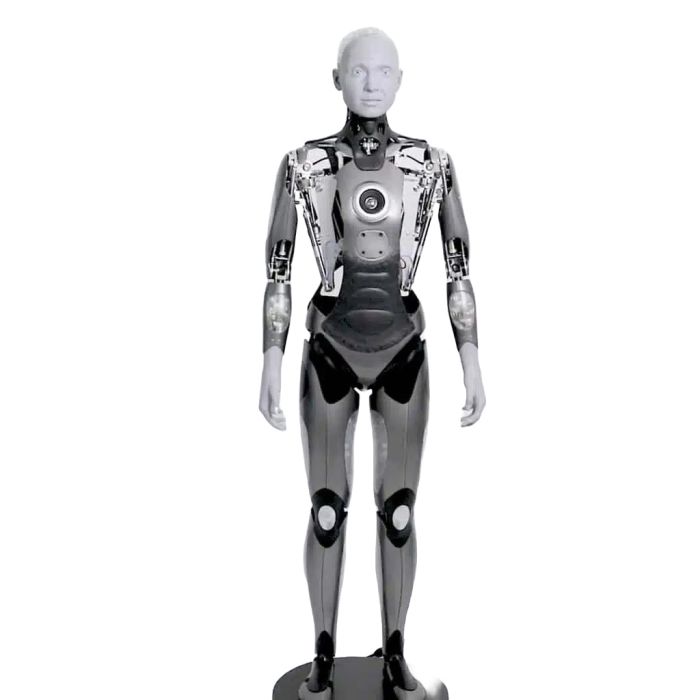
The Engineered Arts Ameca Humanoid Robot is widely regarded as one of the most expressive humanoid robots ever built, purpose-designed for human-robot interaction rather than physical labor. Developed by Engineered Arts in Penryn, United Kingdom, and first released in 2021, Ameca has reached generation 2.6 (2024) and combines a full-size 1870 mm frame with 61 actuated degrees of freedom — 27 of them in the face alone — to produce facial expressions of exceptional subtlety. Under its grey silicone skin and metal-grey shell, the robot runs Engineered Arts' Tritium robot operating system with integrated AI services for listening, speaking, translating, and responding, making it a leading platform for exhibitions, brand experiences, research, and public engagement.
Background
Engineered Arts and the pursuit of expressive machines
Engineered Arts has spent years building entertainment and interaction robots, and Ameca is its flagship result: a humanoid whose engineering priority is communication. Where most humanoid programs chase locomotion and manipulation, Ameca concentrates actuation where humans look first — the face. Its 27 facial degrees of freedom, supported by 5 in the neck, allow micro-expressions, gaze shifts, and lip synchronization that make conversations feel natural. The rest of the body — 8 DoF across the shoulders, 10 across the arms, 8 across the hands, and 3 in the torso — supports gesturing and object interaction at social scale. The design is deliberately gender-neutral, with grey skin and a black-metal-grey shell that signals "robot" honestly while remaining relatable, sidestepping the uncanny problems of photorealistic androids.
From launch sensation to structured product line
Since its 2021 debut, Ameca has become one of the most recognizable robots in the world through viral demonstrations and major technology events. Engineered Arts has matured the platform through successive generations — currently 2.6, dated 2024 — and built a product family around it, including a desktop variant and the customizable Mesmer line. The company's Tritium software has evolved in parallel: Tritium AI now fuses third-party speech recognition, natural language processing, and text-to-speech into a single pipeline, while Tritium Roles lets operators define purpose-driven behaviors in plain text, supplement the robot's knowledge with documents, and align interactions with a brand or venue. This shifts Ameca from a demonstration piece to a configurable interaction product.
Technical Specifications
| Attribute | Value (manufacturer-published) |
|---|---|
| Model / generation | Ameca, generation 2.6 (2024); released 2021 |
| Type | Full-size social humanoid robot |
| Height / width / depth | 1870 mm / 470 mm / 850 mm |
| Arm span / base | 1800 mm / 600 mm diameter |
| Weight | 62 kg |
| Degrees of freedom | 61 total: head 27, neck 5, shoulders 8, arms 10, hands 8, torso 3 |
| Cameras | 2 × 8 MP (one per eye) |
| Audio | 2 ear microphones, 4-channel chest microphone, external USB mic support, 20 W chest speaker, 3.5 mm output |
| Software | Tritium robotOS; Tritium AI with default OpenAI ChatGPT, Whisper, and Amazon Polly integrations, plus custom integrations |
| Control interfaces | REST API, WebSocket, Python and Node.js SDKs |
| Power | 2 mains inlets, 110–240 V AC 50/60 Hz, 400 W; 2 × 24 V DC 200 W |
| Connectivity | RJ45 Ethernet (Wi-Fi announced as coming soon); Thunderbolt ×2, USB ×2, HDMI ×2, 3.5 mm jack |
| Environment | Indoor, 10–30 °C, 45–60 % humidity |
| Safety / compliance | 360-degree LiDAR safety sensors; CE |
| Materials | Silicone, aluminium, steel, plastic |
| Support | Maintenance every 6 months; standard 1-year warranty; ships with Tritium software suite, manual, power cables, safety documentation |
Specifications reflect the manufacturer's current published data for the standard configuration and may change between generations; confirm the exact datasheet during quotation.
What makes Ameca so expressive?
Ameca's expressiveness is a hardware and software achievement combined. The eye-mounted 8 MP cameras support face tracking so the robot holds eye contact and reacts to people around it, while the microphone array localizes speakers. On the software side, Tritium coordinates expression, gaze, gesture, and generated speech in real time, so verbal and non-verbal channels stay coherent. The result is an interaction quality that third-party observers frequently describe as the most expressive in the humanoid field — a characterization worth noting, though such rankings are informal.
How do you program and deploy Ameca?
Deployment is designed to be accessible. Developers get deeper control through REST and WebSocket APIs and Python and Node.js SDKs for choreographing motion, expression, and dialogue. The robot draws standard mains power (110–240 V AC, 400 W) and connects over RJ45 Ethernet, with Wi-Fi announced as forthcoming. Operationally, Ameca is an indoor platform (10–30 °C, 45–60 % humidity) intended for stationary interaction; it is not marketed as a walking or load-carrying machine. Engineered Arts recommends maintenance every six months, and 360-degree LiDAR safety sensing supports safe operation around the public.
Who is Engineered Arts Ameca Humanoid Robot for?
Ameca suits organizations whose goal is engagement, communication, or interaction research rather than physical automation. Typical adopters include science centers, museums, and visitor attractions seeking a flagship interactive exhibit; brands and event agencies deploying a conversational centerpiece at launches, trade shows, and retail experiences; universities and corporate labs studying human-robot interaction, social robotics, expression synthesis, and multimodal AI; and media and entertainment producers needing a camera-ready robotic performer. Because it is mains-powered, indoor-rated, and supported by structured maintenance and a one-year warranty, it fits venues that can host a permanent or recurring installation.
What is Engineered Arts Ameca Humanoid Robot used for?
- Interactive exhibitions and visitor attractions — greeting, conversing with, and reacting to guests as a headline installation in museums and science centers.
- Brand activations and live events — serving as a conversational ambassador at product launches, trade shows, and experiential marketing campaigns.
- Human-robot interaction research — providing a repeatable, richly actuated platform for studying expression, gaze, trust, and multimodal communication.
- AI and dialogue system development — pairing large language model integrations with embodied expression through Tritium AI and its SDKs.
- Customer engagement and hospitality pilots — delivering information and personalized assistance in reception, retail, and hospitality settings.
- Media production and education — appearing in film, broadcast, and classroom contexts where a lifelike robotic presence illustrates the state of the art.
Pricing and Availability
Ameca is a professional platform supplied with the Tritium software suite, documentation, power cables, safety materials, and a standard one-year warranty, with maintenance recommended every six months. Pricing depends on configuration, software scope, support level, and delivery region, and is provided on a quotation basis rather than published. Availability is confirmed at order time. To move forward, submit a request for quotation describing your venue, use case, and timeline, and our team will provide current pricing, lead time, and support options.
Frequently Asked Questions
What is Engineered Arts Ameca?
Ameca is a full-size social humanoid robot from Engineered Arts (UK), released in 2021 and now in generation 2.6, engineered specifically for expressive, natural human-robot interaction.
How many degrees of freedom does Ameca have?
Sixty-one in total: 27 in the head/face, 5 in the neck, 8 across the shoulders, 10 across the arms, 8 across the hands, and 3 in the torso.
Can Ameca walk?
Ameca is deployed as a stationary interaction platform; publicly available material references locomotion only at prototype level. It is designed for expression, conversation, and gesture rather than mobility.
What AI does Ameca use?
Tritium AI integrates speech recognition, natural language processing, and text-to-speech — with default OpenAI ChatGPT, Whisper, and Amazon Polly integrations — and supports custom integrations and plain-text behavioral Roles.
What are Ameca's power and connectivity requirements?
Standard mains power at 110–240 V AC 50/60 Hz (400 W) plus 24 V DC outputs, with RJ45 Ethernet connectivity, Thunderbolt, USB, and HDMI ports; Wi-Fi is announced as coming soon. It operates indoors at 10–30 °C and 45–60 % humidity.
What is included with the robot and what support exists?
The package includes the robot, Tritium software suite, manual, power cables, and safety documentation, backed by a standard one-year warranty and a six-month maintenance cycle. The robot carries CE marking and 360-degree LiDAR safety sensing.
Where can I buy Engineered Arts Ameca Humanoid Robot and what does it cost?
Ameca is available through our procurement channel on a request-for-quotation basis. Pricing is not published and varies by configuration and region; submit a quotation request and we will confirm current cost, lead time, and availability.
Summary
Ameca represents the state of the art in expressive humanoid robotics: a 1870 mm, 62 kg platform whose 61 degrees of freedom — 27 in the face — are orchestrated by Tritium robotOS and Tritium AI into fluid, convincing interaction. Manufacturer-published specifications, structured software tooling, CE compliance, LiDAR safety sensing, and a defined warranty and maintenance program make it a procurement-ready choice for exhibitions, brand experiences, and interaction research. For specifying a configuration and obtaining a formal quotation, this page is the starting point.