
Unitree G1 Basic Humanoid Robot
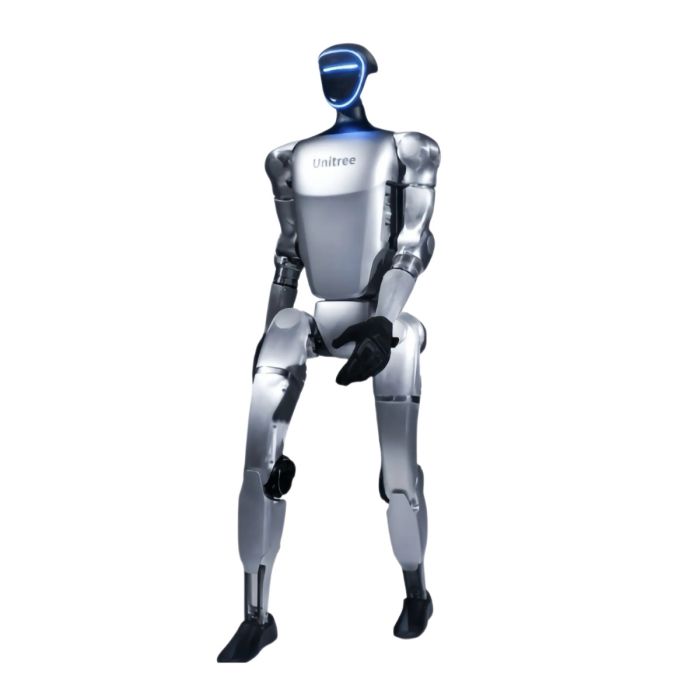
In stock
- BRAND:
- UNITREE ROBOTICS
- MODEL:
- G1 BASIC
- ORIGIN:
- China
- Warranty:
- 8 MONTHS
- AVAILABILITY:
- SUBJECT TO AVAILABILITY
- SKU:
- Unitree-G1-Basic
Unitree G1 Basic Humanoid Robot
A convincing humanoid demonstration and a useful robotics programme are not the same thing: the difference lies in choosing a platform that matches the intended work. The Unitree G1 Basic Humanoid Robot brings articulated movement, environmental sensing and onboard computing into a physical platform for supervised evaluation. Its place in the G1 family is especially important for buyers deciding between observing and demonstrating robot behaviour and undertaking their own software development. This page focuses on the G1 specification rather than borrowing capabilities from more extensively equipped versions.
The product is available through this page, by quotation.
Background
UNITREE ROBOTICS and the G1 family
UNITREE ROBOTICS presents the G1 as a humanoid platform within a family that includes G1 and G1 EDU. The manufacturer's comparison separates their joint configurations, arm loading, knee torque and development provisions. That distinction gives procurement teams a practical starting point: a shared family name does not make every configuration interchangeable, and a demonstration of an optional feature is not a specification for the Basic product.
Humanoid robotics brings mechanical design, balance, perception and control together. For organisations exploring this field, the initial task is often to establish a controlled environment and a clear evaluation objective. The G1 belongs to the Bipedal Humanoids category, where movement and physical interaction require a different assessment approach from stationary equipment.
Positioning and onboard technology
The G1 combines Depth Camera+3D LiDAR sensing with an 8-core high-performance CPU. Its joint motors use low inertia high-speed internal rotor PMSM technology, and the cooling system uses local air cooling. These are elements of its hardware architecture, not evidence that a particular navigation, manipulation or autonomous workflow is ready for deployment.
The manufacturer lists a manual controller and upgraded intelligent OTA functionality for G1. It also identifies a microphone array and speaker, providing audio hardware alongside the motion and sensing systems. Buyers should distinguish these physical provisions from application software: installing a robot in a venue does not itself establish a complete visitor service, teaching programme or operational process.
Technical Specifications
| Specification | G1 |
|---|---|
| Standing dimensions (H x W x T) | 1320x450x200mm |
| Folded dimensions (H x W x T) | 690x450x300mm |
| Weight with battery | About 35kg |
| Total degrees of freedom | 23 |
| Single leg degrees of freedom | 6 |
| Waist degrees of freedom | 1 |
| Single arm degrees of freedom | 5 |
| Maximum knee joint torque | 90N.m |
| Arm maximum load | About 2Kg |
| Basic computing power | 8-core high-performance CPU |
| Wireless connectivity | WiFi 6, Bluetooth 5.2 |
| Smart battery capacity, quick release | 9000mAh |
| Battery life | About 2h |
| Power supply | 13 string lithium battery |
| Charger | 54V 5A |
| Microphone array | 4 Microphone Array |
| Speaker | 5W Speaker |
These specifications are as published by the manufacturer and are confirmed against the datasheet at quotation.
The manufacturer has not published the maximum walking speed, IP rating, operating temperature, charging time, camera resolution, LiDAR model, CPU model or operating system; these details are confirmed at quotation.
What is the difference between G1 Basic and G1 EDU?
The clearest purchasing distinction is development access. The manufacturer's comparison marks secondary development as available for G1 EDU, while the G1 entry has no secondary-development provision listed. A buyer intending to create custom robot applications should therefore assess the EDU route rather than select Basic on the assumption that the family name guarantees the same development facilities.
The mechanical comparison also separates the versions. G1 has 23 total degrees of freedom, with 6 in each leg, 1 at the waist and 5 in each arm. G1 EDU has a broader configuration structure, including optional additional waist movement and optional dexterous-hand provisions. Those options belong to the EDU comparison and should not be treated as standard equipment on this Basic product.
For G1, maximum knee joint torque is 90N.m and arm maximum load is About 2Kg. The manufacturer explains that the arm load varies greatly with arm extension posture. Consequently, selecting a robot for object handling requires a review of the intended posture and task, not simply a comparison of headline load figures. The arm figure is not a general carrying capacity for every movement.
Basic is therefore a distinct purchasing choice, not merely a shorthand for the entire G1 range. A well-written enquiry should explain whether the objective is supervised presentation, hardware assessment or custom development. That information matters more than requesting the largest collection of options without a defined use.
Who is Unitree G1 Basic Humanoid Robot for?
The Basic model is relevant to organisations evaluating humanoid hardware, demonstration teams preparing supervised presentations, and educational institutions introducing the relationship between mechanics, sensing and robot behaviour. These buyers benefit from defining what they want to observe before committing to an application. Movement, physical scale, handling arrangements and operator procedures are useful starting points for an evaluation plan.
For a university laboratory or integration team whose central requirement is secondary development, G1 EDU is the more appropriate family to investigate. The Unitree G1 category provides a route to reviewing the range, but each listed configuration still needs its own specification check. EDU options should be selected against the actual software, hand and computing requirements of the project.
Public-facing organisations should also consider the manufacturer's safety guidance. Unitree asks users to maintain sufficient distance between the robot and people and to use it cautiously. A controlled demonstration area, a designated operator and a clear audience boundary are sensible planning measures for humanoid equipment. The Basic model should not be purchased as an assumed substitute for an unattended service system.
What is Unitree G1 Basic Humanoid Robot used for?
- Supervised humanoid demonstrations. Present articulated robot movement within a planned area under operator supervision.
- Robotics education. Use the platform as a physical reference when discussing joints, sensing and embodied control.
- Hardware evaluation. Assess the G1's physical configuration against an organisation's intended environment and procedures.
- Exhibition planning. Evaluate the practical requirements of presenting a humanoid robot to an audience.
- Procurement comparisons. Establish whether Basic or an EDU configuration matches the project's objectives.
- Operational familiarisation. Develop supervised handling and safety procedures before considering a wider robotics programme.
Pricing and Availability
Request a quotation for the Unitree G1 Basic Humanoid Robot with a description of the intended use, operating location and required scope of support. The enquiry should identify whether the priority is demonstration, institutional evaluation or development, so the configuration discussion begins with the correct version.
Delivery, customs and support are arranged with the quotation. Ask for an itemised package description covering the robot, battery, charger, controller and any additional requested equipment, rather than treating the manufacturer's accessory table as a complete packing list. A quotation for the Unitree G1 Basic Humanoid Robot is available on this page.
Frequently Asked Questions
Does G1 Basic support secondary development?
The manufacturer's comparison does not list secondary development for G1; it lists that provision for G1 EDU. Projects centred on custom software should assess the EDU family.
What sensing hardware does G1 Basic have?
G1 has Depth Camera+3D LiDAR sensing. These hardware entries do not establish a particular autonomous application or software integration.
How much can its arms carry?
The G1 arm maximum load is About 2Kg. The manufacturer states that arm loading varies greatly with arm extension posture, so the proposed handling task needs a posture-specific assessment.
How long does the battery last?
The G1 battery life is About 2h, and its quick-release smart battery capacity is 9000mAh. Evaluation plans should include a practical power-management routine rather than treating a battery-life figure as an uninterrupted event schedule.
Does the robot fold for handling?
G1 has standing dimensions of 1320x450x200mm and folded dimensions of 690x450x300mm. Its weight with battery is About 35kg, so folding does not remove the need for suitable handling arrangements.
Is G1 Basic suitable for unattended public use?
The supplied material does not establish suitability for unattended public operation. Unitree instructs users to keep a sufficient safe distance between the robot and people and to use it with caution.
Where can I buy Unitree G1 Basic Humanoid Robot and what does it cost?
The product is available through this page by quotation. Submit the intended application and package requirements to obtain a proposal covering the selected configuration and associated arrangements.
Summary
The value of a humanoid platform begins with the question it is meant to answer. G1 Basic brings articulated hardware, depth and LiDAR sensing, onboard computing and wireless connectivity into a platform for supervised demonstrations and evaluation. Its specifications remain distinct from G1 EDU, particularly where development access and optional equipment are concerned.
A successful purchase connects those facts to a defined environment, an operator-led safety plan and a clear package specification. For organisations moving beyond an impressive demonstration towards a considered robotics programme, this page is the starting point.
Specifications
General
Physical
Mobility
Performance
Computing
Sensors
Connectivity
Software
Battery + Power
Shipping
Feature
| Height, width and thickness (standing): 1270x450x200mm |
| Height, width and thickness (folded): 690x450x300mm |
| Single-handed freedom: Dexterous hand and double-freedom wrist optional |
| Maximum arm load: 2kg |
| Calf + thigh length: 0.6m |
| Extra large joint movement space Lumbar Z-axis joint: ±155° |
| Knee joint: 0~165° |
| Hip joint: P±154°, R-30~+170°, Y±158°” |
| Full joint hollow internal alignment: Yes |
| Joint encoder: dual encoder |
| Heat dissipation system: localized air-cooled heat dissipation |
| Power supply: 13 series battery |
| Base Computing Power: 8-core high performance CPU |
| Sensor: Depth camera + 3D LIDAR |
| Stereo speakers and microphone array as standard |
| Intelligent OTA upgrade: support |
What's included
Unitree Unitree G1 Basic
Dummy Hands
Quick Release Smart Battery
Battery Charger
Handheld Remote Control