
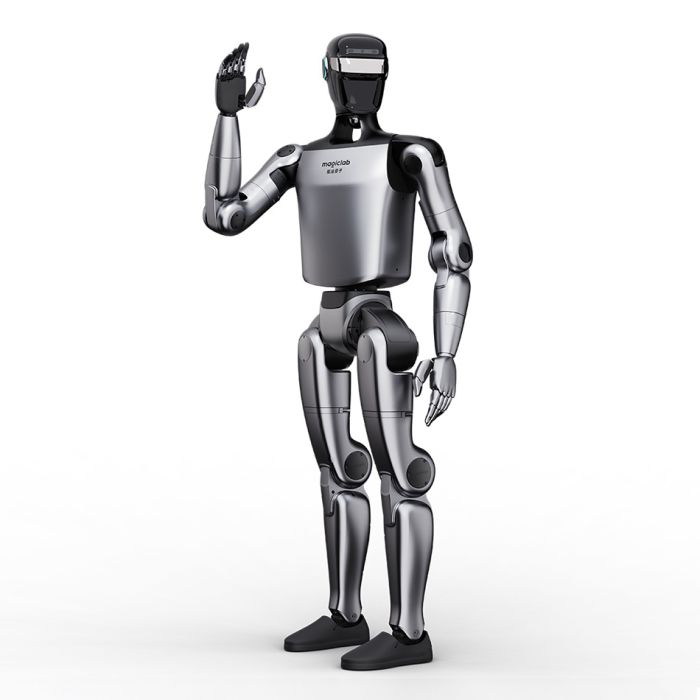
MagicLab MagicBot Z1 Standard Edition Humanoid Robot
In stock
- BRAND:
- MAGICLAB
- MODEL:
- MAGICBOT Z1 STANDARD EDITION
- ORIGIN:
- China
- Warranty:
- 12 MONTHS
- AVAILABILITY:
- SUBJECT TO AVAILABILITY
- SKU:
- MagicLab-MagicBot-Z1
MagicLab MagicBot Z1 Standard Edition Humanoid Robot
A convincing humanoid demonstration begins with movement, but a sensible purchase begins with knowing where the platform’s remit ends. The MagicLab MagicBot Z1 Standard Edition Humanoid Robot brings essential motion capabilities to an entry-level experience, rather than offering the secondary development access of its developer sibling. For enthusiasts and organisations exploring embodied robotics, that distinction matters: the right edition is the one that matches the intended activity, not simply the one with an impressive physical presence.
The product is available through this page, by quotation.
Background
MagicLab and the arrival of MagicBot Z1
MagicLab unveiled MagicBot Z1 on July 8, 2025. The manufacturer is Magiclab Robotics Technology (Wuxi) Co., Ltd. The product belongs to the bipedal humanoid class, where coordinated joints, perception hardware and motion control work together to produce movement in a human-shaped platform. This class attracts interest from robotics enthusiasts, educators and technology teams because physical behaviour makes robotics concepts visible in a way that a software simulation alone does not.
The Z1 range has two main editions: Standard Edition and Developer Edition. MagicLab positions the Standard Edition as an entry-level experience with essential motion capabilities for robotics enthusiasts and technology users. This positioning provides a useful boundary for procurement: it is an introduction to the platform’s physical capabilities, not a substitute for an edition intended for secondary development.
Motion control and perception
The Z1 Standard Edition has 24 total degrees of freedom, with 5 degrees of freedom in each arm. The Z1’s joint motion range reaches up to 320°. MagicLab identifies large-amplitude movement, including a backbend, as an example of the platform’s motion capability. Joint range describes the mechanical movement available; it does not define which movements are appropriate in every demonstration space or operating situation.
The perception hardware comprises 3D LiDAR, a depth camera, a binocular fisheye camera and a head tactile sensor. Basic computing is provided by an 8-core high-performance CPU. MagicLab also provides a standardised robot controller with motion control algorithms supporting terrain adaptability on flat ground, grass, gravel and stairs. These hardware and control features establish the platform’s scope without implying that the Standard Edition offers custom software development access.
Technical Specifications
| Specification | Z1 (Standard Edition) |
|---|---|
| Dimensions standing (H×W×D) | 1369*422*200mm |
| Dimensions folded | 730*422*395mm |
| Weight with battery | Approximately 40kg |
| Total degrees of freedom | 24 |
| Single arm degrees of freedom | 5 |
| Maximum knee torque | 100N.m |
| Maximum arm load | 2kg |
| Joint motion range | Up to 320° |
| Basic computing power | 8-core high-performance CPU |
| Quick-release smart battery capacity | 10000mAh |
| Battery life | Approximately 2h |
| Charger | 62V 5A |
Specifications are as published by the manufacturer and are confirmed against the datasheet at quotation.
The manufacturer has not published the maximum walking speed, IP rating, charging time, operating temperature, memory and storage, or camera resolution; these are confirmed at quotation.
The Standard Edition has handheld remote control, WiFi6 and Bluetooth 5.2 connectivity, and support for OTA upgrades. Secondary development is not provided on this edition. The battery is a quick-release design. For purchase planning, distinguish the battery capacity and stated battery life from charging time: the available figures do not establish how long a complete charging cycle takes.
Maximum arm load and maximum knee torque describe different aspects of the machine. Neither should be treated as a general promise of task performance, nor should the arm-load figure be relabelled as a whole-robot payload. Likewise, the folded dimensions are useful for planning handling and space, but they do not establish packaging dimensions or the equipment needed to move the robot safely.
What is the difference between the Z1 Standard Edition and Developer Edition?
The decisive difference in the available information is secondary development. The Standard Edition has none; the Z1 Development Version provides it. This is more important than a broad description such as “research robot”, because research can mean very different things. Observing physical movement and explaining humanoid architecture do not require the same access as writing custom behaviours or integrating experimental software.
The Standard Edition therefore suits an interest in the robot’s essential motion capabilities and an entry-level experience. Remote control and OTA upgrade support are part of its feature set, but OTA support is not equivalent to a development interface. Buyers should not read wireless connectivity or the presence of an onboard CPU as evidence that custom programming is available.
For a project whose purpose is secondary development, the Developer Edition is the relevant sibling to consider. The supplied information does not provide its detailed computing, mechanical or software specifications, so the Standard Edition figures should not be transferred to it. An edition comparison at quotation should focus on the required development access, supporting documentation and the practical scope of the proposed work.
Who is MagicBot Z1 Standard Edition for?
Robotics enthusiasts and technology users are the manufacturer’s stated audience. The Standard Edition also fits the purchasing discussion for organisations seeking a physical introduction to humanoid robotics, provided their activities centre on the supplied motion capabilities rather than custom development. A clear brief should identify who will operate the robot, where demonstrations will take place and what participants are expected to learn.
For educators, the relevant distinction is between demonstrating robotics and programming a robot. A supervised session can discuss joints, perception and motion control using a physical platform as the focus. A course requiring students to develop new robot functions has a different requirement and should consider the MagicLab MagicBot Z1 Development Edition Humanoid Robot instead.
Technology demonstration teams should define the intended activity before specifying the equipment. Terrain adaptability is not an IP rating, and movement capability is not a certification for operation around an unrestricted audience. Organisations comparing the wider Bipedal Humanoids category should assess supervision, operating space and the edition’s software scope alongside its mechanical figures.
What is MagicBot Z1 Standard Edition used for?
- Entry-level robotics exploration: Introduce enthusiasts to a humanoid platform through its essential motion capabilities.
- Supervised technology demonstrations: Use physical movement as the focus of a planned presentation about embodied robotics.
- Humanoid architecture teaching: Discuss the relationship between joints, arm movement and coordinated bipedal motion.
- Perception hardware familiarisation: Introduce the roles of LiDAR, cameras and tactile sensing without assuming custom sensor access.
- Edition selection exercises: Help teams distinguish a motion-focused experience from a project requiring secondary development.
- Deployment planning discussions: Examine space, handling, supervision and operating requirements before committing to a wider humanoid programme.
Pricing and Availability
Request a quotation for the Standard Edition with a concise outline of the intended use and operating location. State whether the requirement is an enthusiast experience, a demonstration programme or an educational activity, and identify any expectation of custom programming. This helps keep the edition choice aligned with the project rather than discovering a development requirement after purchase.
Delivery, customs and support are arranged with the quotation. The quotation should also establish the supplied package, documentation and applicable support arrangements, rather than treating feature descriptions as a complete packing list. A quotation for the MagicLab MagicBot Z1 Standard Edition Humanoid Robot is available on this page.
Frequently Asked Questions
Does the Standard Edition support secondary development?
No. Secondary development is not provided on the Standard Edition; the Z1 Development Version provides it. Choose the edition around the required software access rather than assuming both editions serve the same purpose.
What are its standing and folded dimensions?
The standing dimensions are 1369*422*200mm, and the folded dimensions are 730*422*395mm. These are robot dimensions, not shipping-package measurements.
How much does the robot weigh with its battery?
The weight with battery is Approximately 40kg. Handling arrangements should be part of the deployment plan, particularly when moving between demonstration locations.
How long does the battery last?
The stated battery life is Approximately 2h, and the quick-release smart battery capacity is 10000mAh. Plan activities around the stated runtime without treating it as a guarantee for every operating pattern.
Which sensors does the Standard Edition have?
Its perception hardware comprises 3D LiDAR, a depth camera, a binocular fisheye camera and a head tactile sensor. The presence of these sensors does not change the Standard Edition’s lack of secondary development.
What terrain does the Z1 support?
MagicLab identifies flat ground, grass, gravel and stairs within the Z1’s terrain adaptability. Site suitability and a controlled operating area remain separate planning considerations.
Where can I buy MagicBot Z1 Standard Edition and what does it cost?
The product is available through this page by quotation. Submit the intended application and destination so that the edition, delivery, customs and support arrangements can be addressed together.
Summary
The Z1 Standard Edition puts essential humanoid motion at the centre of an entry-level experience. Its articulated structure, perception hardware, remote control and OTA support provide a concrete basis for exploring embodied robotics, while the absence of secondary development draws a clear line around its remit.
The purchasing decision returns to the distinction between an engaging demonstration and a development platform. Define the activity first, match the edition to it, and address operating requirements through the quotation. For beginning that process, this page is the starting point.