
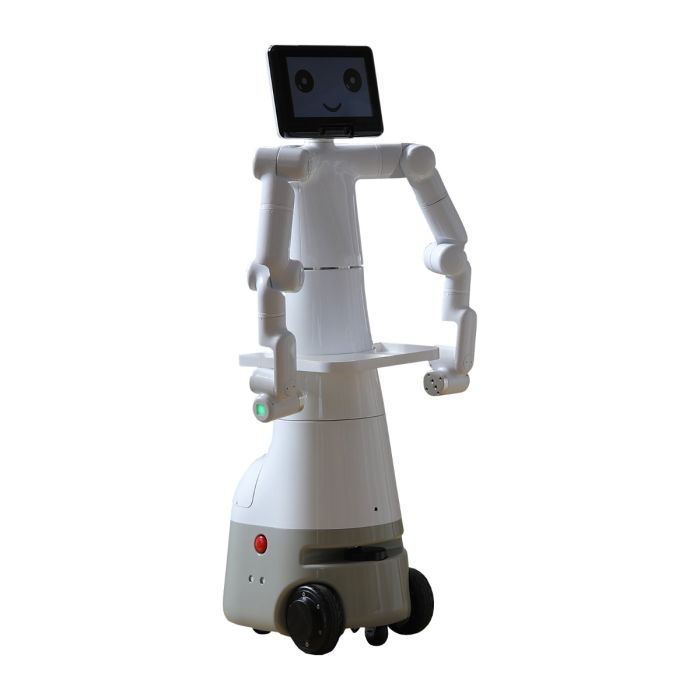
Elephant Robotics Mercury X1 Wheeled Humanoid Robot (4011300003)
In stock
- BRAND:
- ELEPHANT ROBOTICS
- PART #:
- 4011300003
- ORIGIN:
- China
- Warranty:
- 12 MONTHS
- AVAILABILITY:
- ALLOW 4-6 WEEKS FOR DELIVERY
- SKU:
- Elephant-Robotics-4011300003
Elephant Robotics Mercury X1 Wheeled Humanoid Robot (4011300003)
A convincing robot demonstration is not the same as a repeatable experiment: perception, movement and manipulation must work together rather than succeed separately. The Elephant Robotics Mercury X1 Wheeled Humanoid Robot (4011300003) brings those disciplines onto a wheeled dual-arm platform designed for embodied intelligence applications. Its appeal lies in the relationship between the upper body, mobile base, sensing and onboard computing. For research and development teams, that combination creates a platform around which to organise experiments in how a robot observes its surroundings, approaches a task and coordinates physical action.
The product is available through this page, by quotation.
Background
Elephant Robotics and the Mercury family
The Mercury family includes Mercury A1, Mercury B1 and Mercury X1. The defining relationship for this product is its composition: Mercury X1 combines the Mercury B1 dual-arm robot with a high-performance mobile base. That gives buyers a clear architectural starting point without treating every Mercury model as interchangeable. The specifications on this page belong to Mercury X1; they should not be transferred to another member of the family.
For procurement teams, this relationship also helps frame the initial requirements discussion. The question is not simply whether a humanoid-shaped robot is appropriate, but whether the project needs arm activity and movement through an environment within the same platform. Establishing that requirement before discussing accessories or software keeps the evaluation focused on the actual experimental task.
A platform for embodied intelligence
Embodied intelligence connects perception and decision-making with physical action. In this class of research, an algorithm is evaluated not only by what it recognises, but also by how its decisions affect movement and interaction. Mercury X1 is designed for that application area, with 19DOF and a wheeled dual-arm configuration.
The main control is Jetson Orin Nano SUPER 8GB, with AI performance of 67 TOPS, while the arm sub controller is ESP32. Mobile sensing comprises LIDAR, Ultrasonic Radar and 2D Vision. These are useful starting points for planning a system architecture, but a research team still needs to define its software, task logic and validation procedure. Hardware selection and application development remain distinct parts of the project.
Technical Specifications
| Specification | Mercury X1 |
|---|---|
| Degrees of freedom | 19DOF |
| Product height | 1.18m |
| Net weight | 55KG |
| Working voltage | 24V |
| Battery life | 8 hours |
| Maximum payload | 1KG |
| Repeatability | ± 0.05mm |
| Maximum operating speed | 1.2m/s |
| Maximum climbing angle | 15° |
| Maximum climbing height | 2CM |
| Storage space | 15L |
| Main control | Jetson Orin Nano SUPER 8GB |
| AI performance | 67 TOPS |
| Screen | 9-inch Touching Screen |
| Microphone | Line array 4 microphones,5m 180° pickup |
| IO | 24V 6 Input, 6 Output |
Specifications are as published by the manufacturer and are confirmed against the datasheet at quotation.
The manufacturer has not published the battery capacity, charging time, IP rating, package contents, arm reach, operating temperature, power consumption or chassis dimensions; these details are confirmed at quotation.
What makes Mercury X1 suitable for mobile manipulation research?
Mercury X1 brings a dual-arm robot and a mobile base into the same system. That matters when the research question involves both reaching a task location and acting there. Mobile manipulation studies commonly examine the handover between navigation and arm activity: where the robot stops, how the task is presented and how movement is coordinated. The X1 architecture is relevant to that combined problem rather than arm motion alone.
Its maximum payload is 1KG and its repeatability is ± 0.05mm. These figures belong in the task assessment, alongside the objects to be handled and the required motion. A maximum payload does not establish suitability for every object, grasp or arm posture. Define the intended object and handling sequence when requesting a quotation so that the proposed application can be discussed explicitly.
The platform supports both ROS1 and ROS2 versions and provides RVIZ simulation environment support. This gives teams a stated software framework for their evaluation. It does not remove the need to establish which interfaces, packages and development workflow the project will use. Keeping those questions separate from the hardware specification makes acceptance testing clearer and avoids treating framework support as a finished application.
Communication includes WIFI/Network port/Bluetooth/USB serial port, and Linux is supported. The touch screen and microphone array add interface hardware to the platform. For an interactive research programme, the next step is to define the required user experience and software behaviour, rather than assume that a particular dialogue, recognition or service workflow is already included.
Who is Mercury X1 for?
Mercury X1 is relevant to university laboratories, robotics research groups and engineering teams investigating embodied intelligence or mobile manipulation. Its integrated architecture suits projects in which perception, base movement and arm activity must be studied together. Teaching teams can also use this class of platform to organise work across robotics disciplines, with students examining the connections between sensing, control and physical task execution.
Commercial development teams evaluating a future robotic workflow should begin with a bounded trial. Define the environment, the object interaction and the success criteria before expanding the scope. The published speed, climbing limits and payload provide constraints for that discussion; they are not substitutes for a site assessment or a task-specific safety review.
If the requirement concerns the dual-arm component rather than the complete mobile platform, the Elephant Robotics Mercury Humanoid Robot B1 (4011300002) is a relevant comparison because Mercury B1 forms part of X1. Its suitability requires a separate specification review. Buyers exploring the wider category can also compare Wheeled Humanoids, using mobility and manipulation requirements to guide their shortlist.
What is Mercury X1 used for?
- Embodied intelligence experiments: Structure studies around the connection between environmental observations, decisions and physical action.
- Mobile manipulation development: Explore task sequences that bring base positioning and dual-arm activity into a shared workflow.
- ROS-based research: Develop and evaluate robotics workflows using the stated ROS1, ROS2 and RVIZ support.
- Perception integration studies: Investigate how LIDAR, Ultrasonic Radar and 2D Vision fit into an application architecture.
- Robotics teaching: Organise practical learning around sensing, control, computing and the planning of physical experiments.
- Interactive application prototyping: Use the screen and microphone hardware as starting points for developing a defined interaction workflow.
Pricing and Availability
Request a quotation for Mercury X1 with a description of the proposed application, operating environment and integration requirements. Include the objects to be handled, the expected demonstration or research workflow and the software environment your team intends to use. This helps make the quotation a project-specific discussion rather than a comparison of headline figures alone.
Delivery, customs and support are arranged with the quotation. Ask for the package contents and any required development or interface details to be recorded explicitly before proceeding. A quotation for the product is available on this page.
Frequently Asked Questions
Is Mercury X1 a walking humanoid robot?
No. Mercury X1 is a wheeled dual-arm humanoid robot composed of the Mercury B1 dual-arm robot and a high-performance mobile base.
What payload and repeatability does Mercury X1 offer?
The maximum payload is 1KG and repeatability is ± 0.05mm. Describe the intended object, grasp and motion sequence during the quotation discussion to establish the task requirements.
How fast does Mercury X1 move?
The maximum operating speed is 1.2m/s. Plan the operating area and test procedure around the application rather than assuming maximum speed is appropriate for every movement.
What onboard computing does it use?
The main control is Jetson Orin Nano SUPER 8GB with AI performance of 67 TOPS. The arm sub controller is ESP32.
Does Mercury X1 support ROS?
It supports both ROS1 and ROS2 versions and provides RVIZ simulation environment support. Define the required software interfaces and development workflow as part of the project evaluation.
What is the stated battery life?
The battery life is 8 hours. Include the intended duty cycle in the quotation discussion so that the operating plan and charging arrangements can be addressed together.
Where can I buy Mercury X1 and what does it cost?
The product is available through this page, by quotation. Submit your application and integration requirements to request a quotation covering the proposed configuration and support arrangements.
Summary
Mercury X1 addresses the gap between separate robotics demonstrations and a coordinated physical experiment. Its Mercury B1 dual-arm robot, mobile base, onboard computing and sensing bring the main elements of embodied intelligence research into one platform. The strongest evaluation starts with a clear task: what the robot must observe, where it must move and what it must do when it arrives.
Use the published specifications to set boundaries, then resolve the application, package and integration details through quotation. For a project that needs mobility and manipulation considered together, this page is the starting point.