
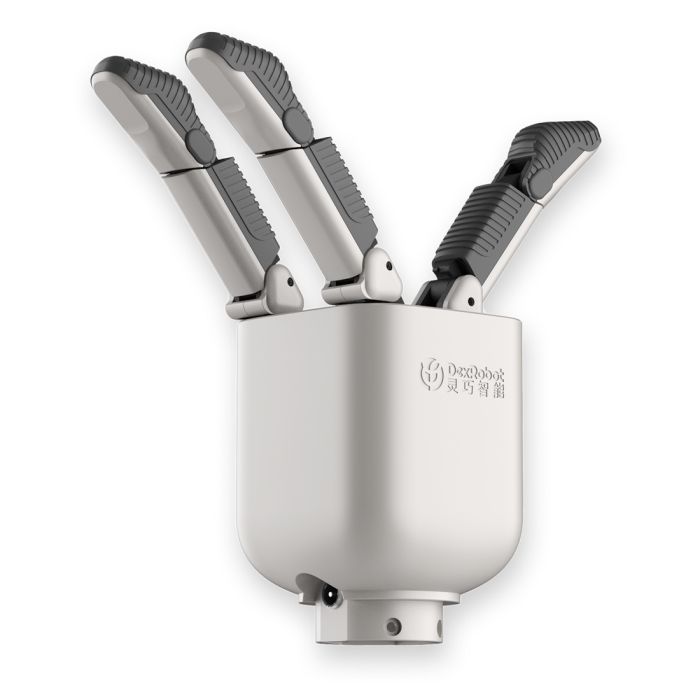
Dexrobot 021S High-Function Three-Fingered Dexterous Hand
In stock
- BRAND:
- DEXROBOT
- PART #:
- 021S
- ORIGIN:
- China
- Warranty:
- 12 MONTHS
- AVAILABILITY:
- USUALLY SHIPS IN 7-14 BUSINESS DAYS
- SKU:
- DexRobot-021S
Dexrobot 021S High-Function Three-Fingered Dexterous Hand
A successful grasp is not just a movement: it is a sequence of seeing, making contact and controlling force. The Dexrobot 021S High-Function Three-Fingered Dexterous Hand brings those elements together through palm-mounted vision, fingertip force sensing and adaptive torque control. For teams developing robotic manipulation, the important question is how these elements fit the intended task, rather than how closely the hand resembles a human one. Its three-finger architecture provides a focused starting point for that assessment.
The product is available through this page, by quotation.
Background
DEXROBOT and the DexHand021 family
DEXROBOT identifies this version as DexHand021 S. The named family also includes DexHand021 S-T, DexHand021 MP, DexHand021 Pro and DexHand021 Concept. Keeping those identities separate matters when preparing an integration specification: dimensions, electrical requirements and performance figures must belong to the version being purchased, not simply to the wider product family.
The S version is described as a highly functional three-finger dexterous hand achieving 80% of core hand functions. That positioning puts practical manipulation at the centre of the discussion. For a buyer, it is useful to translate the intended application into specific object-handling steps, then assess the hand against those steps. A broad description of hand function does not replace a task-specific acceptance test.
Coordinating motion, vision and contact
The hand combines 8 DOFs with a Gear + Tendon rope + Linkage transmission. Its palm carries a standard 5 MP Auto-focus RGB Camera, while 3D fingertip force sensing provides real-time contact force feedback. These features address different parts of manipulation: arranging the fingers, observing the working area and measuring contact during a grasp.
Adaptive torque control adds 0 - 1 A stepless torque adjustment with dynamic adaptation. The software provision is an open-source SDK with multi-protocol support, and communication for DexHand021 S is CAN FD / RS485. For an engineering team, this makes the relationship between sensing, command generation and arm integration an important part of the project plan, rather than an afterthought following mechanical installation.
Technical Specifications
| Specification | Value — DexHand021 S |
|---|---|
| Core hand functions | 80% |
| Weight | 0.6kg |
| Grip force | 22N |
| Degrees of freedom | 8 DOFs |
| Repeatability | ± 0.5 mm |
| Lifespan | 200,000 Lifespan Cycles |
| Tactile sensitivity | 0.1 N |
| Palm-mounted RGB camera | 5 MP |
| Adaptive torque control adjustment | 0 - 1 A |
| Dimensions | 208mm * 80mm * 82.8mm |
| Voltage | DC 24 V |
| Minimum grasp diameter | ≤ 30 mm |
These figures are as the manufacturer publishes them and are confirmed against the datasheet at quotation.
The manufacturer has not published the IP rating, operating temperature range, software OS support or fingertip tactile coverage detail; these are confirmed at quotation.
How does DexHand021 S combine vision and force feedback?
Vision and force feedback answer different questions. An image helps a manipulation system observe an object and its surroundings; contact feedback helps the control system respond once the fingers touch it. DexHand021 S incorporates both a palm-mounted autofocus RGB camera and real-time fingertip force feedback. The engineering task is to connect those inputs to a grasp strategy appropriate to the object, rather than treating either sensor as a complete handling solution.
The 0.1 N tactile sensitivity and adaptive torque adjustment are relevant to projects examining controlled contact. The ± 0.5 mm repeatability supports precision picking of micro-objects. These are distinct characteristics: repeatability describes repeated positioning, while tactile sensitivity concerns contact detection. They should remain separate criteria in a test plan, particularly where small objects or delicate contact transitions are involved.
For integration, the open-source SDK and communication interfaces provide the software-facing part of the hand. DexHand021 S adapts to mainstream robotic arms through multiple communication protocols. When defining a complete installation, the buyer should identify the exact arm, controller, connection method and intended command sequence. An interface match is one part of integration; mounting, power distribution and application-level control still belong in the engineering brief.
Who is DexHand021 S for?
DexHand021 S is relevant to automation engineers evaluating flexible industrial manipulation and to research teams developing grasping and contact-control methods. Its combination of articulated movement, visual input and force sensing gives these teams several aspects of manipulation to examine within one end-effector. A suitable evaluation begins with representative objects and a clear definition of successful handling, including approach, contact, retention and release.
Laboratories studying robotic manipulation can use this class of hand to explore the relationship between perception and action. Industrial development teams can assess whether a dexterous hand addresses tasks that a simpler gripping arrangement does not. In both settings, the choice should follow the application: object geometry, required motions, environmental conditions and control architecture are more useful selection criteria than appearance alone.
Teams comparing Robot Hands should keep the S version's specification distinct from the other DexHand021 variants. The available information does not establish which sibling is better for a particular buyer segment. A comparison brief should therefore state the required sensing, movement and integration features explicitly, without assigning another version's capabilities to DexHand021 S.
What is DexHand021 S used for?
- Flexible industrial manipulation: Evaluate articulated object handling within an automation development programme.
- Precision picking of micro-objects: Develop picking tasks around the stated repeatability and representative test pieces.
- Contact-control research: Study grasp behaviour using real-time 3D fingertip force feedback.
- Vision-guided manipulation development: Incorporate palm-camera images into an application-specific perception and control workflow.
- Robotic arm integration: Develop communication and command handling through CAN FD / RS485 and the SDK.
- Grasp strategy evaluation: Compare approach, finger coordination and release methods across the objects relevant to a project.
Pricing and Availability
Request a quotation for DexHand021 S with a description of the application, the robotic arm or development platform, and the intended operating environment. Include the objects to be handled and any acceptance criteria, so that the discussion covers the complete integration requirement rather than the hand alone.
Delivery, customs and support are arranged with the quotation.
A useful quotation request also identifies the required software environment and any expectations for mounting, cabling or commissioning. These details help separate the product specification from the surrounding project requirements. The product is available on this page.
Frequently Asked Questions
Is DexHand021 S the version described on this page?
Yes. This page covers Dexrobot 021S High-Function Three-Fingered Dexterous Hand , identified in the product information as DexHand021 S. The specifications here are not assigned to DexHand021 S-T, DexHand021 MP, DexHand021 Pro or DexHand021 Concept.
What are its weight, grip force and degrees of freedom?
DexHand021 S weighs 0.6kg, delivers a 22N grip force and provides 8 DOFs. Grip force is not a payload figure and should not be treated as one when specifying an application.
Does it include a palm camera?
It has standard palm-mounted vision with a 5 MP Auto-focus RGB Camera. The camera provides a visual input for manipulation development; the application still requires its own perception and control workflow.
What contact feedback does the hand provide?
3D fingertip force sensing supplies real-time contact force feedback, and tactile sensitivity is 0.1 N. Adaptive torque control provides 0 - 1 A stepless adjustment with dynamic adaptation.
How does it connect to a robotic arm?
DexHand021 S uses CAN FD / RS485 communication and DC 24 V power. An open-source SDK and multi-protocol support are provided; the quotation request should identify the exact arm and controller for integration planning.
How should repeatability and lifespan be used in an evaluation?
The specified repeatability is ± 0.5 mm, and the lifespan is 200,000 Lifespan Cycles. Use these as separate evaluation criteria, alongside tests reflecting the intended objects, grasp sequence and working conditions.
Where can I buy DexHand021 S and what does it cost?
The product is available through this page by quotation. Submit the application and integration requirements to request commercial details and arrangements for delivery, customs and support.
Summary
DexHand021 S approaches manipulation as a coordinated sequence of observation, movement and controlled contact. Its three-finger mechanism, palm camera, fingertip feedback and adaptive torque control give engineering teams a concrete set of features to assess against their handling tasks. The strongest purchasing brief connects those features to actual objects, an identified robotic platform and measurable acceptance criteria. For a quotation grounded in that application, this page is the starting point.