
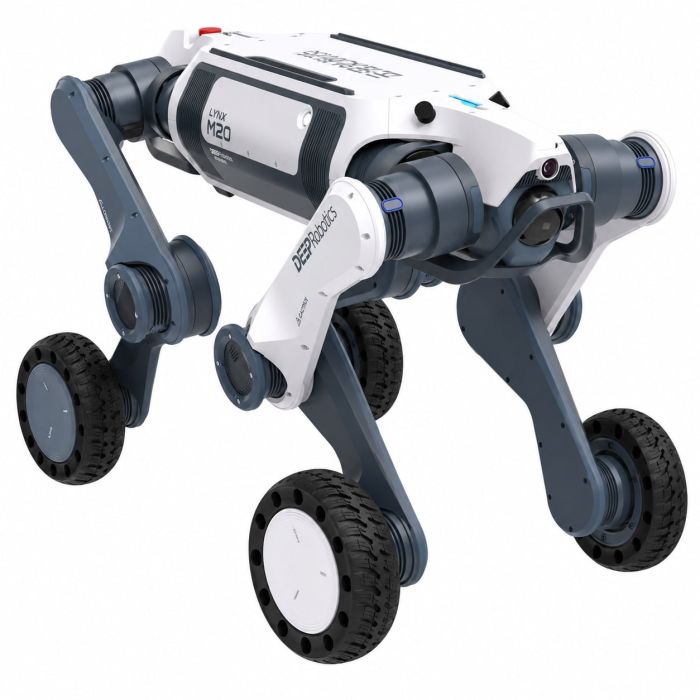
Deep Robotics LYNX M20S Omni Terrain Industrial Wheeled Quadruped Robot Dog
In stock
- BRAND:
- DEEP ROBOTICS
- MODEL:
- LYNX M20S
- ORIGIN:
- China
- AVAILABILITY:
- ALLOW 2-4 WEEKS FOR DELIVERY
- SKU:
- Deep-Robotics-LYNX-M20S
Deep Robotics LYNX M20S Omni Terrain Industrial Wheeled Quadruped Robot Dog
A robot carrying equipment is only useful if the whole mission works: the load, the route, the sensing and the return to base. The Deep Robotics LYNX M20S Omni Terrain Industrial Wheeled Quadruped Robot Dog brings these considerations together in a wheeled-legged industrial platform. For organisations planning operations across demanding sites, its appeal lies not in a single headline limit but in the relationship between payload, mobility and endurance. Evaluating those elements together gives a more useful starting point than selecting a robot solely for its maximum speed or lifting capacity.
The product is available through this page, by quotation.
Background
DEEP ROBOTICS and the LYNX M20 series
DEEP ROBOTICS places LYNX M20S within a series that also includes LYNX M20 and LYNX M20 Pro. The LYNX M20 series is the world's first wheeled-legged robot built specifically for challenging terrains and hazardous environments during industrial operation. This positioning centres the family on industrial mobility rather than treating the robot dog format as an end in itself.
The model distinction matters when preparing a technical comparison. This page presents LYNX M20S specifications, not an interchangeable set of figures for the entire series. Buyers comparing the named versions should maintain separate requirements and configuration records for each. The available information does not establish which sibling is better for a particular project, so a recommendation needs a version-specific comparison rather than an assumption based on the model name.
Mobility supported by sensing and autonomy
Wheeled-legged platforms combine rolling travel with articulated mobility, addressing the mixed surfaces encountered in industrial settings. LYNX M20S pairs this architecture with SLAM Mapping & Localization, Autonomous Navigation and Omnidirectional Obstacle Avoidance. Its sensing equipment includes LiDAR ×2 and Wide-Angle Cameras ×2, alongside industrial processors for onboard computing.
RF image transmission and OTA upgrades are also part of the feature set. Autonomous Charging is optional, while the battery arrangement is a Hot-Swappable Dual Battery System. These are distinct operational considerations: exchanging batteries and specifying autonomous charging are not the same procurement decision. A project brief should identify how the robot will be supervised, how charging will fit into the workflow and what equipment the intended task requires.
Technical Specifications
| Specification | LYNX M20S |
|---|---|
| Dimensions (Standing) | 820mm×430mm×570mm |
| Weight (with battery) | 36kg |
| Effective Payload (standard terrain) | 36kg |
| Maximum Payload Capacity | 100kg |
| Continuous load capacity on regular flat terrain | 35kg |
| Operating Time (no payload) | 3.5–5 hours |
| Range (no payload) | 16–20 km |
| Operating Time (with payload) | 2.5–3.5 hours |
| Range (with payload) | 12–15 km |
| Single Battery Charging Time | 1.5 hours |
| Max. Tested Speed | 9m/s |
| Max. Operating Speed | 2m/s |
| Max. Stair Height | 30cm |
| Max. Single-Step Obstacle Height | 100cm |
| Max. Slope | 45° |
| Computing power | 3 × octa-core 64-bit industrial processors (16GB + 128GB) |
| LiDAR | ×2 (128 channels,360° × 95°,~1,152,000 pts/s) |
| Cameras | Wide-Angle Cameras ×2 |
| Ingress Protection Rating | IP67 |
| Operating Temperature | -30°C to 55°C |
| Water submersion | Up to 1 meter deep for 30 minutes |
| Electrical interfaces | Power input (24V/72V), Gigabit Ethernet, USB 3.0 |
These figures are as published by the manufacturer and are confirmed against the datasheet at quotation.
The manufacturer has not published the battery capacity, included accessories, software development kit, wheel specifications or certifications other than the IP rating; these details are confirmed at quotation.
How should buyers compare LYNX M20S payload, speed and endurance?
The payload figures describe different categories and must remain separate. Effective Payload on standard terrain is 36kg, Maximum Payload Capacity is 100kg, and continuous load capacity on regular flat terrain is 35kg. The maximum capacity is not a substitute for either the effective payload figure or the continuous flat-terrain load figure. Procurement documents should retain these labels rather than reducing them to a single carrying-capacity claim.
Speed requires the same discipline. Max. Tested Speed is 9m/s, whereas Max. Operating Speed is 2m/s. Route planning should distinguish a test limit from an operating limit. Stair height and single-step obstacle height are also separate specifications: the former is 30cm and the latter is 100cm. Neither should be used as a blanket description of every obstacle on a site.
Endurance changes with payload. Without payload, operating time is 3.5–5 hours and range is 16–20 km; with payload, operating time is 2.5–3.5 hours and range is 12–15 km. A useful enquiry therefore describes the equipment to be carried, the route surface and the intended work pattern. That information helps turn a specification comparison into a deployment discussion without treating every maximum as simultaneously achievable.
Who is LYNX M20S for?
LYNX M20S is relevant to industrial operators, robotics integrators and technical teams evaluating mobile equipment for difficult environments. Inspection planners can assess its navigation and sensing features against their route requirements. Equipment-transport teams can focus on the separately defined payload categories, while integrators can examine the electrical interfaces and onboard computing arrangement.
For buyers in the Gulf, environmental review belongs alongside route and task planning. The operating temperature is -30°C to 55°C and the ingress protection rating is IP67. Site assessment should also cover exposure conditions, cleaning procedures and any mandatory approvals. An IP rating does not establish approval for explosive atmospheres or replace a site's safety requirements.
Teams exploring the wider Wheeled Quadrupeds category should compare complete operating requirements rather than appearance alone. No supported version-by-version performance comparison is available here to justify steering a buyer towards LYNX M20 or LYNX M20 Pro. For an integration project, the enquiry should explicitly request the software access, mounting details and accessory information needed to make a selection.
What is LYNX M20S used for?
- Industrial inspection planning: Evaluate autonomous navigation and onboard sensing against defined patrol routes and observation tasks.
- Equipment transport: Assess task loads using the effective, maximum and continuous-load categories separately.
- Remote site observation: Consider the cameras and RF image transmission within a supervised monitoring workflow.
- Emergency response assessment: Explore mobile reconnaissance requirements within a controlled response plan and appropriate safety procedures.
- Navigation development: Use the SLAM, navigation and obstacle-avoidance feature set as the basis for an integration assessment.
- Field mobility trials: Compare representative surfaces, stairs and obstacles with the distinct terrain limits before operational deployment.
Pricing and Availability
Request a quotation for LYNX M20S with a description of the intended task, payload and operating environment. State whether optional autonomous charging is required and identify any integration questions concerning software, interfaces or task equipment. The quotation should distinguish the robot configuration from any additional project requirements, particularly because the included accessories are not documented in the available information.
Delivery, customs and support are arranged with the quotation.
For a configuration-led purchasing discussion, request a quotation for LYNX M20S, available on this page.
Frequently Asked Questions
What is the difference between effective and maximum payload?
Effective Payload on standard terrain is 36kg, while Maximum Payload Capacity is 100kg. Continuous load capacity on regular flat terrain is a separate figure of 35kg; these categories should not be treated as equivalent.
How long does LYNX M20S operate with a payload?
Operating time with payload is 2.5–3.5 hours, with a range of 12–15 km. The corresponding no-payload figures are 3.5–5 hours and 16–20 km.
Which speed figure should be used for operational planning?
Max. Operating Speed is 2m/s. The separate Max. Tested Speed of 9m/s describes the tested figure, not the operating limit.
Does LYNX M20S support autonomous charging?
Autonomous Charging is optional. The robot also has a Hot-Swappable Dual Battery System, and Single Battery Charging Time is 1.5 hours.
What navigation and sensing features does it have?
The feature set includes SLAM Mapping & Localization, Autonomous Navigation and Omnidirectional Obstacle Avoidance. Sensing comprises LiDAR ×2 (128 channels,360° × 95°,~1,152,000 pts/s) and Wide-Angle Cameras ×2.
Does IP67 establish hazardous-area certification?
No: ingress protection and hazardous-area certification address different requirements. LYNX M20S has an IP67 ingress protection rating, but certifications other than the IP rating are not published.
Where can I buy LYNX M20S and what does it cost?
The product is available through this page, by quotation. Submit the required configuration and application details to obtain a quotation covering the proposed purchase and associated arrangements.
Summary
A complete mission depends on more than a robot's strongest headline figure. LYNX M20S combines wheeled-legged mobility, onboard sensing, navigation features and a dual-battery arrangement, with distinct limits for payload, terrain, speed and endurance. Keeping those limits separate produces a clearer technical brief and a more disciplined purchasing decision.
Begin with the load and route, then identify supervision, charging and integration requirements. For translating that brief into a configuration and quotation, this page is the starting point.
Specifications
General
Physical
Performance
Computing
Sensors
Connectivity
Battery + Power
What's included
Downloads
Related Products
Out of stock