
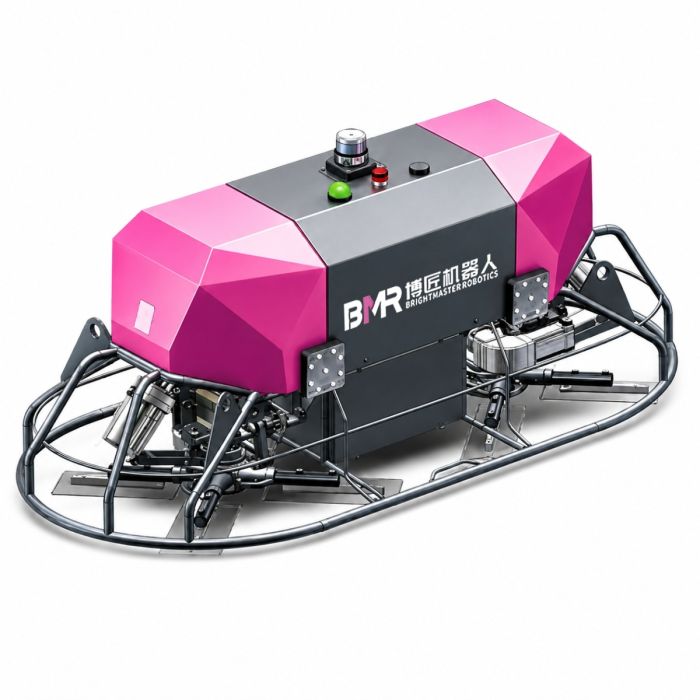
BMR Concrete Finishing Robot
In stock
- BRAND:
- BMR
- MODEL:
- CONCRETE FINISHING ROBOT 80SZ
- ORIGIN:
- China
- Warranty:
- 12 MONTHS
- AVAILABILITY:
- ALLOW 6-8 WEEKS FOR DELIVERY
- SKU:
- BMR-Concrete-Finishing-Robot
BMR Concrete Finishing Robot
A large concrete pour brings different responsibilities onto the same surface: planning the work, directing equipment and deciding when each finishing stage should proceed. The BMR Concrete Finishing Robot brings automatic operation and remote control into that shared workflow. The documented model, Concrete Finishing Robot 80SZ, performs concrete compaction, slurry lifting, surface finishing and polishing on cast-in-place concrete. Its relevance is not simply that it moves automatically, but that contractors can assess a robotic finishing platform alongside the practical demands of their site, their finishing method and their supervision arrangements.
The product is available through this page, by quotation.
Background
The manufacturer and the documented model
Shenzhen BrightMaster Robotics Co., Ltd. is the manufacturer. The product information identifies Concrete Finishing Robot 80SZ as the model and places it within large-area concrete finishing and polishing applications. Basements, plazas, factories, airports and shopping malls are the named settings, giving buyers a clear starting point for assessing the intended work.
For procurement, the model reference matters as much as the broader product name. The technical figures below belong to 80SZ, rather than to an unspecified concrete robot or another machine in a construction equipment range. A project enquiry should therefore identify this model and explain the proposed finishing task. That keeps the discussion focused on the documented machine and avoids treating different stages of concrete construction as interchangeable.
Navigation and motion control
The technical highlights are SLAM mapping, a fully automatic navigation system, integrated intelligent motion control algorithms and real-time control technology. The robot supports both fully automatic and remote-control modes. These features place navigation and movement control at the centre of its approach to concrete finishing.
In general, SLAM combines mapping with localisation so that a mobile robot can relate its position to its surroundings. For a construction buyer, the important distinction is between this navigation function and the separate requirement to achieve the specified concrete finish. A navigation figure describes machine movement; it does not define surface flatness. The equipment belongs within the wider field of Concrete Robots, where each machine should be evaluated for its particular construction stage.
Technical Specifications
The following figures apply to Concrete Finishing Robot 80SZ. Keeping the model and its operating measurements together provides a practical basis for technical review and quotation discussions.
| Specification | Value — 80SZ |
|---|---|
| Finishing disc diameter | 800mm |
| Weight | 340kg |
| Dimensions (LxWxH) | 1600x900x1310mm |
| Single-pass operating efficiency | ≥300㎡/h |
| Blade rotation speed | 0~150r/min |
| Automatic operation navigation deviation | ≤200mm |
| Power supply | 48V 160AH |
| Operating endurance | ≥4h |
| Charging time | ≤4h |
| Operating temperature | 0~45°C |
These figures are as published by the manufacturer and are confirmed against the datasheet at quotation.
The manufacturer has not published the box contents, IP rating, motor power, flatness tolerance, software and app details, sensor details, warranty-independent service life or certifications; these are confirmed at quotation.
What do automatic and remote-control modes offer a finishing team?
The BMR Concrete Finishing Robot supports automatic construction on cast-in-place concrete surfaces and also provides remote-control operation. This gives buyers distinct operating modes to consider when planning how the machine will fit into a supervised finishing workflow. Automatic navigation is a documented feature, while remote control remains a separate supported way of operating the equipment.
The working scope covers compaction, slurry lifting, surface finishing and polishing. These are concrete-surface operations, not a statement that the robot undertakes every task associated with constructing a slab. Placing concrete, establishing levels, selecting a finishing sequence and accepting the completed surface remain separate matters in a project specification. A useful equipment assessment begins by defining which finishing activities the contractor intends to assign to the robot.
The single-pass operating efficiency is ≥300㎡/h. The term “single-pass” is important: it describes the stated operating measure, not a guaranteed completed-floor output across an entire project. Concrete work involves access, sequencing, surface condition and inspection, so a buyer should develop a work plan rather than treating a pass rate as a finished-area commitment.
Likewise, automatic operation navigation deviation is ≤200mm. This is a navigation measurement, not a floor-level or finish-quality tolerance. Keeping those concepts separate helps procurement teams ask the right questions: how the machine will be deployed, how work will be supervised and what acceptance criteria the finished concrete must meet. The mode options and navigation technology provide the basis for that discussion without replacing project-specific planning.
Who is BMR Concrete Finishing Robot for?
The intended buyers include concrete finishing contractors, construction companies and project teams responsible for extensive cast-in-place surfaces. The named applications span basements, plazas, factories, airports and shopping malls. These settings bring different access arrangements and site-management requirements, but share the need to organise finishing work across large areas.
For specialist contractors, the principal question is how robotic operation fits existing working methods. For a main contractor or developer, the discussion also involves responsibility for equipment operation, supervision and surface acceptance. Facilities and industrial project teams should connect the equipment enquiry to the actual concrete works package rather than to the eventual use of the building alone.
Site suitability deserves particular attention in Gulf projects. The operating temperature range is 0~45°C, so the conditions in which the robot will work need to be considered during planning. The dimensions of 1600x900x1310mm and weight of 340kg also belong in an access and handling review. Doorways, routes to the slab and arrangements for moving equipment are practical procurement questions, not details to leave until deployment.
The supplied information identifies only 80SZ and does not establish alternative finishing trims for different buyer segments. Selection should therefore focus on whether this documented model suits the proposed work, with the required scope clearly stated in the quotation enquiry.
What is BMR Concrete Finishing Robot used for?
- Concrete compaction: Automatic construction on cast-in-place surfaces includes large-area concrete compaction.
- Slurry lifting: The documented working scope includes lifting slurry as part of the concrete finishing process.
- Surface finishing: The robot undertakes finishing operations across large cast-in-place concrete areas.
- Concrete polishing: Polishing forms part of its stated concrete-surface working scope.
- Basement and factory projects: Basements and factories are named settings for large-area finishing and polishing operations.
- Public and commercial projects: Plazas, airports and shopping malls are also identified application settings.
Pricing and Availability
Request a quotation for the BMR Concrete Finishing Robot with Concrete Finishing Robot 80SZ identified as the required model. Include the intended application, site conditions, access arrangements and the finishing activities you wish to address. This gives the enquiry a defined technical scope rather than relying on a general request for concrete automation.
Use the quotation process to establish the supply scope, required documentation, operating arrangements and project-specific requirements. Delivery, customs and support are arranged with the quotation. The BMR Concrete Finishing Robot is available on this page.
Frequently Asked Questions
Which model do the specifications cover?
The figures cover Concrete Finishing Robot 80SZ. The supplied product information identifies this model without providing specifications for other finishing versions.
Does the robot support remote control?
Yes, it supports both fully automatic and remote-control modes. Its technical highlights also include SLAM mapping, automatic navigation, intelligent motion control algorithms and real-time control technology.
What concrete operations does it perform?
The documented scope includes large-area concrete compaction, slurry lifting, surface finishing and polishing. These operations are carried out on cast-in-place concrete surfaces.
What is its single-pass operating efficiency?
The single-pass operating efficiency is ≥300㎡/h. This measure should be kept separate from a project's completed-floor production target, which also involves the wider construction workflow.
Does navigation deviation specify the finished floor's flatness?
No. The automatic operation navigation deviation of ≤200mm concerns navigation, not the geometry or acceptance standard of the finished concrete surface.
What are the endurance and charging figures?
The operating endurance is ≥4h and the charging time is ≤4h. The power supply is 48V 160AH, and project planning should address how operation and charging will fit the work schedule.
Where can I buy BMR Concrete Finishing Robot and what does it cost?
Request a quotation through this page for the required model and project scope. The quotation establishes the commercial terms, with delivery, customs and support arranged as part of the enquiry.
Summary
Concrete finishing is a coordinated site activity, not simply a machine moving across a slab. The BMR Concrete Finishing Robot brings fully automatic and remote-control operation to compaction, slurry lifting, surface finishing and polishing, with 80SZ providing a defined set of dimensions, operating figures and navigation features for assessment.
The strongest procurement approach keeps each figure in its proper role: navigation deviation describes movement, single-pass efficiency describes a pass, and operating limits inform deployment. Match those details to the proposed site, clarify the supply scope and establish the required finishing outcome through the quotation process. For that project-specific discussion, this page is the starting point.