
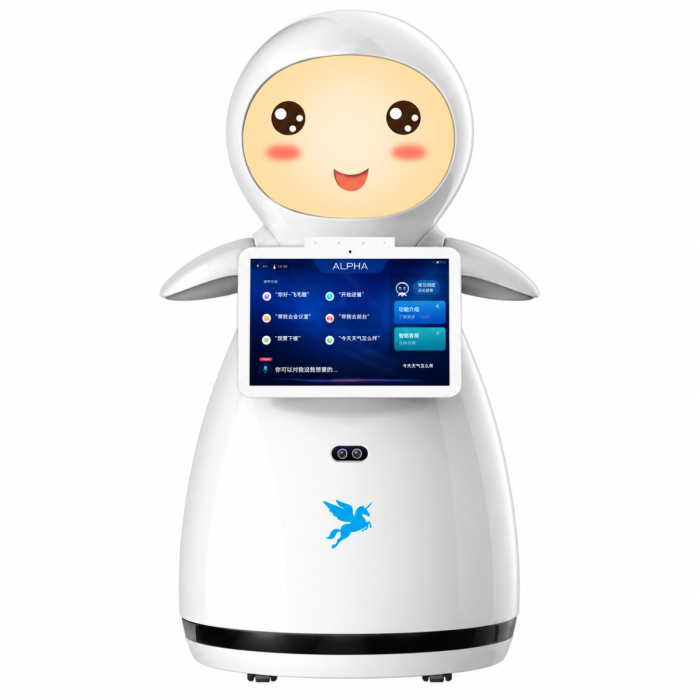
Alpha Robotics Snow Reception Robot
In stock
- BRAND:
- ALPHA ROBOT
- MODEL:
- SNOW
- ORIGIN:
- China
- SKU:
- Alpha-Robot-Snow
Alpha Robotics Snow Reception Robot
A visitor may know the name of a department without knowing where to go, or reach a reception area without knowing what to ask. Alpha Robotics Snow Reception Robot brings voice interaction, information display and guided navigation into that gap between arrival and understanding. Its role extends beyond presenting a welcome: facial recognition, business consultation and explaining functions support a broader reception experience. For organisations planning a public-facing robot, the useful starting point is the visitor journey, with the robot's functions matched to the questions, information and directions that journey requires.
The product is available through this page, by quotation.
Background
The manufacturer and its service-robot focus
Alpha Robotics Co., Ltd. is a high-tech enterprise focusing on the research, development, production and sales of service robots. Snow belongs in that service context, where interaction with people and access to information matter alongside movement through a venue. Reception robotics brings together several disciplines: navigation, interface design, content management and the practical organisation of visitor services.
For a buyer, this makes the surrounding service process important. A reception robot needs a defined purpose within the venue: welcoming arrivals, answering routine enquiries or helping people reach a destination. Planning that purpose before commissioning helps establish what information should be presented and which requests should remain with staff.
Interaction, navigation and development
Snow combines human body induction in different directions with facial recognition and voice interaction. It supports business consultation, guiding navigation and explaining. Its laser radar sensor provides positioning in complex environments during guided navigation, with obstacle avoidance. These capabilities connect an information exchange with the practical task of helping a visitor move through a space.
The touchable high-definition display supports mobile advertisement display, video playback, product information query and map display. An open SDK package and open API provide secondary development for functions tailored to an application scenario. Snow also supports ROS 1 (Melodic, Noetic) and ROS 2 (Foxy, Humble), with detailed SDK documentation and examples. This gives technical teams a development route alongside the reception functions.
Technical Specifications
| Specification | Value |
|---|---|
| Dimensions | L550 x W600 x H1120 mm |
| ROS support | ROS 1 (Melodic, Noetic) and ROS 2 (Foxy, Humble) |
Specifications are as published by the manufacturer and are confirmed against the datasheet at quotation.
The manufacturer has not published the payload, IP rating, box contents, Wi-Fi and Bluetooth connectivity, camera resolution, operating temperature or certifications; these are confirmed at quotation.
How does Snow combine reception information with guided navigation?
A fixed information point leaves the visitor to interpret directions and continue alone. Snow supports both the information exchange and guided navigation. Voice interaction and business consultation address enquiries, while the display presents maps, product information, video and advertising content. During guided navigation, the laser radar sensor provides positioning and obstacle avoidance.
The distinction matters when planning a service. Some visitors need only an answer; others need a visual explanation or assistance finding a destination. A reception workflow can be designed around those different needs rather than treating every arrival as the same interaction. The content should identify destinations clearly and use terminology that matches signs and staff instructions throughout the building.
Secondary development is a separate consideration from preparing display content. The open SDK package and open API support application-specific functions, while ROS support gives developers a defined software compatibility reference. Buyers should prepare a development brief covering intended interactions, information sources and acceptance tests. Support for development does not establish an existing connection to a particular booking, banking or visitor-management system; any such integration needs a project-specific scope.
Facial recognition also calls for operational planning. Organisations using recognition in a public-facing service should assess their privacy obligations, visitor notices and internal approval processes. The reception design should make clear when a visitor can turn to a member of staff, particularly where an enquiry is sensitive or requires a decision rather than general information.
Who is Snow for?
Snow is intended for service scenarios including stations, airports, hotels, shopping malls, banks, hospitals, schools, government affairs halls and restaurants. These settings share a practical challenge: people arrive with different levels of familiarity and need an understandable route to information or a destination. Buyers assessing Reception Robots can use that shared requirement to frame their evaluation.
Venue operators and reception managers should begin with the questions visitors ask most often. In a hotel, that might mean organising information about facilities; in a shopping mall, it might mean planning directory content. In a school or hospital, the project team should define the boundaries between general visitor guidance and enquiries that require authorised staff.
Technical teams have a different evaluation task. The SDK, API and ROS support are relevant where the proposed service needs secondary development. A useful assessment brings operational and technical staff together, so the intended visitor experience is considered alongside software scope, content ownership and the physical route. Selecting a robot is only part of establishing a workable reception service.
What is Snow used for?
- Reception enquiries: Use voice interaction and business consultation to support general visitor questions within a defined service scope.
- Guided navigation: Help visitors reach destinations using the robot's laser radar positioning and obstacle avoidance functions.
- Visual wayfinding: Present maps on the touchable high-definition display as part of the visitor information experience.
- Product information: Make product information available through the display's query function in customer-facing settings.
- Venue communications: Present mobile advertisements and video content as part of an organised information programme.
- Scenario-specific services: Use the open SDK package and open API for secondary development matched to the intended application.
Pricing and Availability
Request a quotation with the proposed venue, intended reception tasks and any secondary-development requirements. Include the destinations involved in guided navigation and the types of information the robot should present. This gives the enquiry a practical scope and helps distinguish the core reception requirement from additional development work.
Delivery, customs and support are arranged with the quotation. For a procurement discussion based on the intended deployment, quotation enquiries are available on this page.
Frequently Asked Questions
Can Snow recognise people and interact by voice?
Snow supports facial recognition, voice interaction and human body induction in different directions. These functions form part of its reception capabilities alongside business consultation and explaining.
How does Snow navigate around a venue?
Snow uses a laser radar sensor for positioning in complex environments during guided navigation, with obstacle avoidance. The proposed routes and reception workflow should be included in the deployment assessment.
What can the touchscreen display?
The touchable high-definition display supports mobile advertisement display, video playback, product information query and map display. Content planning should reflect the information visitors need at the point of interaction.
Can developers customise its functions?
Yes. Snow has an open SDK package and an open API for secondary development, including functions adapted to the application scenario. The development brief should identify the intended behaviour and any external systems involved.
Which ROS versions does Snow support?
Snow supports ROS 1 (Melodic, Noetic) and ROS 2 (Foxy, Humble). Detailed SDK documentation and examples accompany that support.
Which venues are included in its use scenarios?
The stated scenarios include stations, airports, hotels, shopping malls, banks, hospitals, schools, government affairs halls and restaurants. The service design should reflect the particular venue's visitor needs and staff responsibilities.
Where can I buy Alpha Robotics Snow Reception Robot and what does it cost?
The product is available by quotation through this page. Submit your venue and application requirements to request a quotation covering the proposed configuration and service arrangements.
Summary
The gap between arriving and understanding is a useful way to assess a reception robot. Snow addresses that gap through voice interaction, facial recognition, business consultation, display functions and guided navigation. Its open SDK package, open API and ROS support also provide a basis for application-specific development.
The next step is to turn those capabilities into a clear service brief: what visitors need to know, where they need to go and when staff should take over. For a quotation grounded in that brief, this page is the starting point.